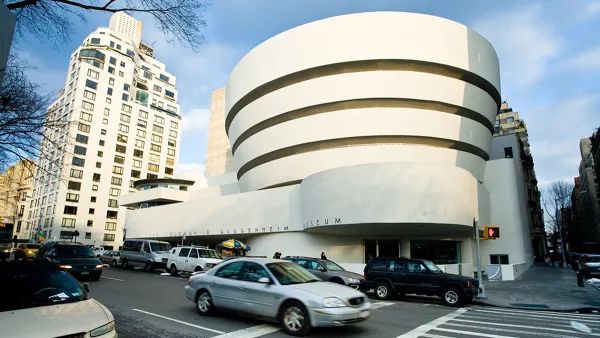
A new exhibition of the sketches, designs and architectural models of Frank Lloyd Wright opens at one of his most famous creations, the Guggenheim Museum in New York.


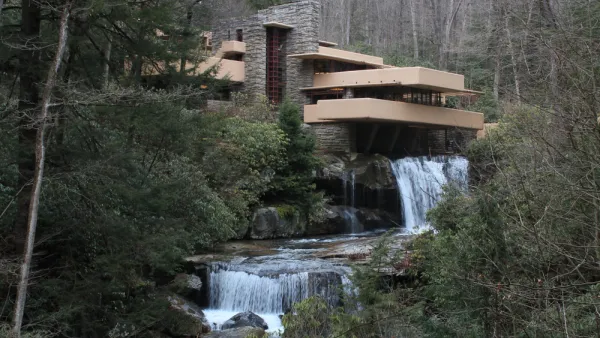
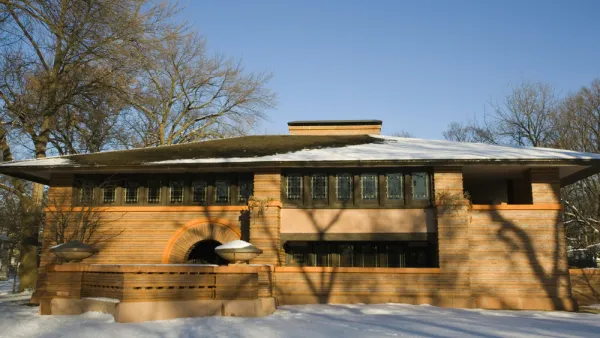
"Wright's career spanned more than seven decades; he was born two years after the Civil War and died at the dawn of the space age. The exhibition is therefore a journey from architecture that, on the swirling ramp of the Guggenheim, can seem almost old-fashioned to work that closely resembles the museum. The strong horizontals, open interior spaces, and overhanging roofs of Wright's early Prairie House style combine nineteenth-century sumptuousness with potent modern thrust. In his great house Fallingwater, of 1936, powerful cantilevers lent some of the crispness of European modernism. And then there are the hexagons, hemicycles, triangles, and spirals that pervade his late work. It's appropriate that the exhibition's section about the Guggenheim itself, unquestionably the culmination of Wright's achievement, comes at the top of the spiral. Then again the Guggenheim spiral, ascending toward the sky, can be an overbearing metaphor for a chronological exhibition. (Wright would probably have loved it.) Not every oeuvre fits such a narrative, and in Wright's case the curators decided that some work was better treated thematically than chronologically. Residential designs and major urban projects are in separate galleries-mini-exhibitions that remind you of the limitations of Wright's ramp."
Read the full story: Spiralling Upward

8 Frank Lloyd Wright Buildings Named World Heritage Sites
Eight buildings designed by Frank Lloyd Wright are the first works of U.S. modern architecture to be named UNESCO World heritage sites.
8 Frank Lloyd Wright Buildings Nominated as UNESCO World Heritage Sites
If accepted as UNESCO World Heritage sites, the eight Frank Lloyd Wright buildings would be the first examples of modern architecture in the United States included in that august company.
National or Regional? Finding American Identity in Architecture
In an extended discussion, Keith Eggener examines what it means for a work of architecture to be "naturally" American, and why looking at modern American styles through an intensively regional lens may be unhelpful.

Planetizen Federal Action Tracker
A weekly monitor of how Trump’s orders and actions are impacting planners and planning in America.

Amtrak, CN end decades-long dispute with eight-year agreement
The new operating agreement establishes an updated framework for the companies to work together, including processes to resolve disputes.

Judges permit Denver to divert 77,000 acre feet from the Colorado River for reservoir expansion
Overuse and climate change have caused the Colorado River’s water levels to plummet.

NYC DOT wants faster, more permanent street upgrades
The city is examining ways to build more concrete infrastructure without getting entangled in 'decades-long' projects.

'Something we’ve never seen before:' rising utility rates could strain city finances nationwide
Data centers, climate change and other factors have caused utility rates in the United States to increase by 38% since 2020.

Trump to overrule local leaders, lease millions of acres of America’s Pacific Island territories’ seafloors to mining companies
International law says that the Indigenous people of America’s territories have a right to prior and informed consent regarding projects that impact their countries.

FREE Course: Walkable City 1: Why Walkability?
After describing his path towards focusing on walkability as the essence of good planning, Jeff Speck marches through his five principal reasons for making more walkable places.
Reinventing Malls: Planning Alchemy—Turning Gray Fields Into Gold
The course focuses on the opportunities and imperatives that shape reinvention of mall sites.

Harvard University Graduate School of Design
KFH Group Inc.
Greater Baltimore Committee
The Architects Foundation
University of Cincinnati Online
The Pocatello Development Authority
The Urban Renewal Agency of the City of Pocatello