Dow Jones Architects of London are proposing to create "waste towers", designed to compress waste locally before transporting to landfills outside the city.


"In order for the city to reach its goal of becoming "85% self-sufficient in terms of waste by 2020," a new waste-management infrastructure is required – thus the need for 'new buildings in Greater London to house advanced waste technologies.
"These would offer an alternative to the greenhouse gas-producing incineration method used by most waste service providers contracted by councils. Dow Jones and Arup assessed the scale of buildings that would be needed to deal with certain amounts of waste using specific technologies, then scattered them on four hypothetical urban sites, proposing them as 'parts of the city and building types that would form an appropriate match.'"
"While this further convinces me that today's most interesting architectural projects are the ones that thoroughly rethink civic infrastructure – waste-treatment plants, algae farms, solar towers, tide-power generators, high-speed rail lines, space elevators – it also makes me wonder what an even more distributed form of sustainable waste-management might look like."
Read the full story: Waste Towers

Colorado Landfills Emit as Much Pollution as 1M Cars
Landfills are the third-largest source of methane pollution in Colorado, after agriculture and fossil fuel extraction.

Texas Infrastructure Gets a ‘C’
The American Society of Civil Engineers rates states in 16 categories related to transportation, water, waste management, parks, and more.
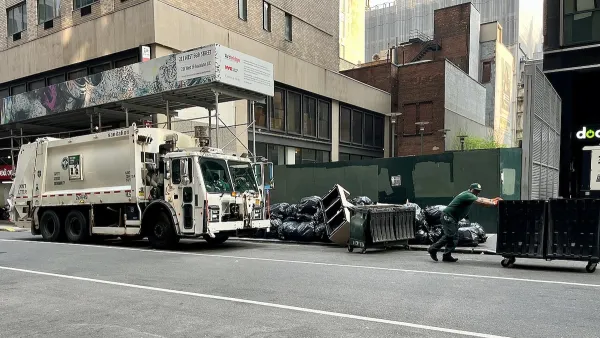
Parked Cars Hamper NYC Trash Containerization Effort
Sanitation workers must manually collect bags from containers blocked by parked cars, slowing a process that is meant to be safer and more efficient.

Planetizen Federal Action Tracker
A weekly monitor of how Trump’s orders and actions are impacting planners and planning in America.

California plans to bury El Niño’s downpour
If the state plays its cards right, it may be able to store a billion acre-feet of El Niño’s water in aquifers.

Desperate measures: Advocates weigh draining Lake Powell to fill Colorado River
Draining the reservoir could reduce evaporation losses by a couple hundred thousand acre-feet.

Los Angeles just elected an urban planner as its mayor
Transportation analysts are optimistic that Raman will be more aggressive in addressing transit issues than Bass.

Mamdani’s pied-à-terre tax survives legal challenge
A panel of judges found that the plaintiffs failed to demonstrate injury as a result of New York City's implementation of the tax.

Eastern Nebraska is running out of electricity
Data centers and electrification are straining eastern Nebraska’s grid, throttling economic development.

FREE Course: Walkable City 1: Why Walkability?
After describing his path towards focusing on walkability as the essence of good planning, Jeff Speck marches through his five principal reasons for making more walkable places.
Reinventing Malls: Planning Alchemy—Turning Gray Fields Into Gold
The course focuses on the opportunities and imperatives that shape reinvention of mall sites.

City of Rosemead
Rutgers University, Edward J. Bloustein School of Planning and Public Policy
One Hundred Miles
University of Michigan School for Environment and Sustainability (SEAS)
Hunter College, City University of New York (CUNY)
The Architects Foundation
City of Cambridge
Montrose County
The Pocatello Development Authority