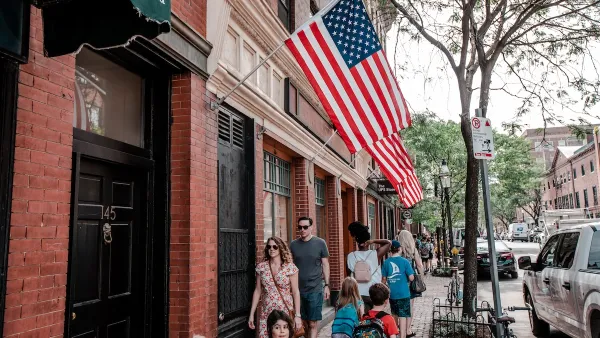
The last empty lot in Boston's posh Back Bay neighborhood will soon be developed into a luxury, contextually appropriate, condominium.


"A Boston developer owns the last empty residential lot in the historic Back Bay neighborhood - and he has big plans for 161 Commonwealth Ave.
Developer Ted Raymond plans to construct a five-story luxury condominium building on the lot, which his employees currently use to park their cars. The structure will be combined with an existing town house next door at 163 Commonwealth, which he also owns. In the 1970s, Raymond paid less than $500,000 for the properties.
Each floor of the new project will have one 4,000-square-foot unit that will range in price from $6.4 million to $8 million - excluding interior finishes, which will cost extra. The prices put the project in the same league as the Residences at Mandarin Oriental Boston on Boylston Street, arguably the city's most chic address."
Read the full story: The last empty lot
Boston is hard to build housing in: its chief of planning wants to keep it that way
Chief of Planning Kairos Shen said she would not make changes to Boston’s affordability requirements for new housing, which critics say have slowed down development.

Learning loss and urban schools, part 2
Did test scores in progressive cities drop more post-COVID than test scores in moderate ones?

Boston to study congestion pricing in NYC
Mayor Michelle Wu said she was sending a delegation to NYC to understand congestion pricing's impact on the city.

Planetizen Federal Action Tracker
A weekly monitor of how Trump’s orders and actions are impacting planners and planning in America.

California plans to bury El Niño’s downpour
If the state plays its cards right, it may be able to store a billion acre-feet of El Niño’s water in aquifers.

Desperate measures: Advocates weigh draining Lake Powell to fill Colorado River
Draining the reservoir could reduce evaporation losses by a couple hundred thousand acre-feet.

Los Angeles just elected an urban planner as its mayor
Transportation analysts are optimistic that Raman will be more aggressive in addressing transit issues than Bass.

Mamdani’s pied-à-terre tax survives legal challenge
A panel of judges found that the plaintiffs failed to demonstrate injury as a result of New York City's implementation of the tax.

Eastern Nebraska is running out of electricity
Data centers and electrification are straining eastern Nebraska’s grid, throttling economic development.

FREE Course: Walkable City 1: Why Walkability?
After describing his path towards focusing on walkability as the essence of good planning, Jeff Speck marches through his five principal reasons for making more walkable places.
Reinventing Malls: Planning Alchemy—Turning Gray Fields Into Gold
The course focuses on the opportunities and imperatives that shape reinvention of mall sites.

City of Rosemead
Rutgers University, Edward J. Bloustein School of Planning and Public Policy
One Hundred Miles
University of Michigan School for Environment and Sustainability (SEAS)
Hunter College, City University of New York (CUNY)
The Architects Foundation
City of Cambridge
Montrose County
The Pocatello Development Authority