Arts and Culture editor Rebecca Mazzei looks at public art - both official and unofficial - across the landscape of Detroit, and advocates for a bold new public art fund for the city.


"What I'm saying is there has to be a clear-eyed evaluation of Detroit's actual assets, and two big ones are our artists and our land. An initiative such as this would, first off, be tailored to supporting the activities of people who actually live here. It would lead by example, proving that local public art projects are, as Heidelberg's Tyree Guyton says, "medicine" for the community. Second, it would allow Detroiters to experience world-class art in inconspicuous places, on grounds they feel familiar with, for free. Plus, welcoming internationally known artists to interact with our environment is a smart move that teaches artists (who have influence in shaping culture and are more likely to listen) to value our region's natural resources and to learn more about our rich history."
Detroit resident and art patron Marc Schwartz agrees:
"Detroit, through misfortune, has one natural resource which every other major city in the world except for Paris, with its extensive parks system, covets: land space. It allows for many opportunities transforming the land or placing objects on it. Working with vacant land in some manner is probably the least expensive way to make transformation. You could change the city landscape more cost effectively than a $20 million building could."
Read the full story: Wake up the neighborhood
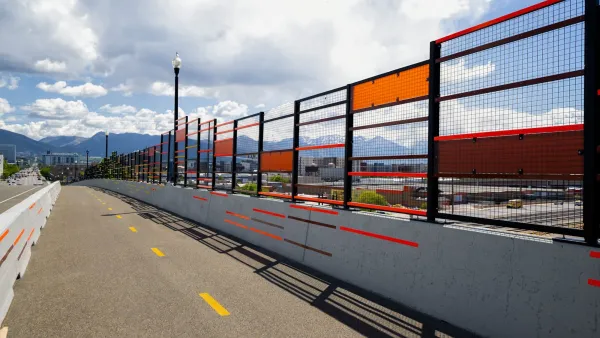
Salt Lake City opens protected bike path on viaduct trail
The 400 South Viaduct Trail features the state's longest continuous piece of public art.
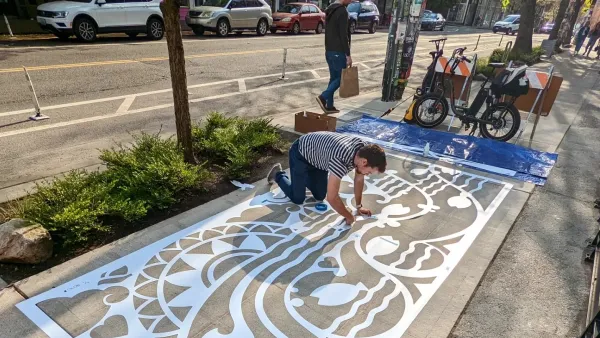
This Seattle sidewalk art only appears when it rains
Prompted to find a silver lining to the gloom of rainy Pacific Northwest days, an artist hit upon a novel solution: water-activated sidewalk paint.
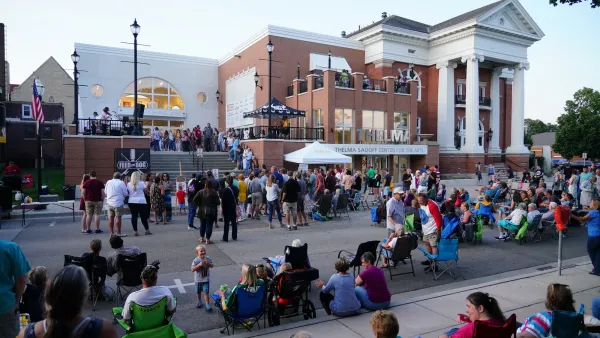
How Placemaking Lost its Way — And How it Can Get Back on Track
The term has often become diluted, getting attached to projects that don’t live up to its lofty aspirations.

Desperate measures: Advocates weigh draining Lake Powell to fill Colorado River
Draining the reservoir could reduce evaporation losses by a couple hundred thousand acre-feet.

Eastern Nebraska is running out of electricity
Data centers and electrification are straining eastern Nebraska’s grid, throttling economic development.

Move over, LA: St. Louis gears up for Olympics, invests millions in downtown redevelopment
The Missouri city will host the 2028 Olympic soccer group stage and knockout matches.

Mass. votes against statewide minimum lot size for single-family homes
Over 2 million residents voted on Question 7; it was decided by just over 30,000 votes.

Maryland’s $15 billion bridge project gains key approval
The Maryland Transit Authority said the project will create over 60,000 jobs and add $23 billion to the local economy.

‘No clear next steps’ for Chicago's permanent festival grounds
Eleventh Ward Ald. Nicole Lee has suggested Soldier Field as a possible location for the permanent event space.

FREE Course: Walkable City 1: Why Walkability?
After describing his path towards focusing on walkability as the essence of good planning, Jeff Speck marches through his five principal reasons for making more walkable places.
Reinventing Malls: Planning Alchemy—Turning Gray Fields Into Gold
The course focuses on the opportunities and imperatives that shape reinvention of mall sites.

City of Rosemead
Rutgers University, Edward J. Bloustein School of Planning and Public Policy
One Hundred Miles
University of Michigan School for Environment and Sustainability (SEAS)
Hunter College, City University of New York (CUNY)
The Architects Foundation
City of Cambridge
Montrose County
The Pocatello Development Authority