As a Texas beach erodes and the waves come closer to shore, homeowners are scrambling to figure out what to do when the public beach invades their private property.


"Surfside, Texas, is a small beach town south of Houston. There are no fancy condos here, no high-rise developments. The town, with just one traffic light, is mainly rows of cottages on tidy lawns. At 809 Beach Drive, a sky-blue house sports a sign that displays its name: the Sand Castle."
"The Sand Castle needed a lot of care - it was a wreck - but you couldn't beat the location."
"'We had sand dunes and salt grasses growing in front of our house," recalls Brooks Porter. And just beyond the dunes was the beach.'"
"Since then, Surfside has seen some of the worst erosion on the Texas coast. The dunes are gone. So is the salt grass. The house now sits at the water's edge, stranded like a beached whale."
"A whale on stilts, that is."
"But Brooks Porter says it's not the water that worries him. It's the state of Texas."
"The Porters have been engaged in a decade-long struggle with the state government, and it's a fight that may foreshadow battles in other coastal areas. At issue: What happens when the public beach moves onto private property?"
Read the full story: As Beaches Creep In, Ownership Disputes Erupt

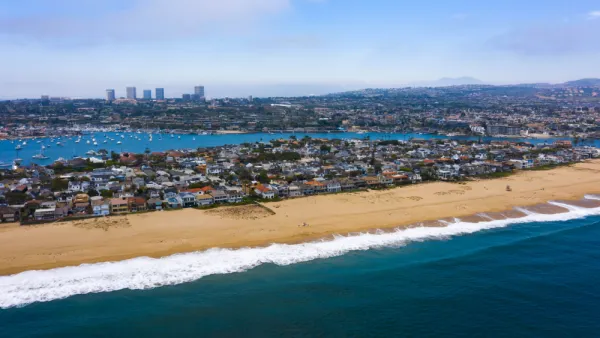
Beachfront Residences Can't Extend Yards Onto Public Beaches, CA Coastal Commission Decides
"It's like squatting by the rich," said one commissioner.
Rush to Rebuild Could Cause Long-Term Damage to NY/NJ Beaches
Just seven months ago Hurricane Sandy damaged 94 percent of New Jersey's beaches and eroded dozens of miles of coastline in New York. As waterfront communities rush to rebuild before summer, some fear disastrous long-term consequences.
San Francisco's Battle With Mother Nature
As climate change accelerates coastal erosion across the continent, officials everywhere look to San Francisco to see how it will stem the tide, Felicity Barringer reports.

Planetizen Federal Action Tracker
A weekly monitor of how Trump’s orders and actions are impacting planners and planning in America.

The state-sanctioned urbicide of Austin
People don’t kill cities. Freeways do.

US to reduce Colorado River water deliveries to Mexico
A new Colorado Treaty amendment reduces Mexico’s Colorado River water allocation by 250,000 acre feet.

Brightline West’s future may rely on $6 billion federal loan
The company has until Nov. 2 to make a $400 million equity investment into its proposed high-speed rail line.

LA Metro’s ultimatum: no extra buses for LA28 if federal funding isn’t imminently secured
If Metro does not provide additional buses, LA28 organizers will have to find a new way to manage Olympic traffic. LA28’s budget does not include a line item for transit.

Colorado’s Largest Data Center Could Rise Next to Homes — Without a Public Hearing
The proposed campus would consume 11 times the power of Denver International Airport; as it has across the country, opposition mounts.

FREE Course: Walkable City 1: Why Walkability?
After describing his path towards focusing on walkability as the essence of good planning, Jeff Speck marches through his five principal reasons for making more walkable places.
Reinventing Malls: Planning Alchemy—Turning Gray Fields Into Gold
The course focuses on the opportunities and imperatives that shape reinvention of mall sites.

Eagle County Government
Harvard University Graduate School of Design
Nashville Planning Department
The Architects Foundation
University of Cincinnati Online
The Pocatello Development Authority
The Urban Renewal Agency of the City of Pocatello
Journal of the American Planning Association