Pubilc art should be guided by public input, according to this commentary.


"Despite the huge numbers who visit galleries and museums, most people don't go. If they do, the convention of the art gallery is that the work is entitled to be there and your right to question it is correspondingly limited. But in the street where you live, the supermarket where you shop, the square where you sit, you have a right to state an opinion."
"Talking to the public must be one lesson to be learned in the decade since Antony Gormley's Angel of the North drew our attention to the notion that a symbol of a place becomes part of its identity, both summing it up and driving it forward."
"Given that art in public spaces is increasingly fashionable, it has never been so important to make it better. There are warning signals aplenty about uncertain quality ranging from our streets being filled with a 'sheer proliferation of Frankenstein monster memorials' (Tim Knox, Sir John Soane's Museum) to 'a lot of public art is gunge' (Gormley)."
"Anyone considering a public art commission, especially one intended to lead or to signal the transformation of a region or an environment, should be cautious about expecting too much."
"Yet we should expect a great deal of a public work of art at the level where it really matters - in our interaction with the places where we live, work and play. They should be enjoyable; we should be cheered by what we see, perplexed perhaps, made curious certainly; a daily encounter should not become dull routine. And there is a deep reason why we respond to such objects and images as we do."
Read the full story: Art in public spaces should be decided by the people
The Importance of Posters in Public Life
Street posters play an important role in participatory civic life, according to this article from re:place magazine.
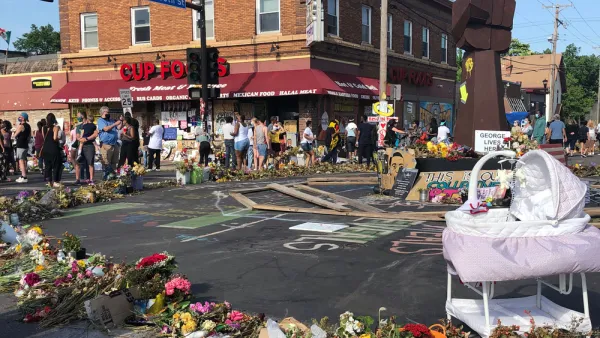
The Racial Reckoning in Public Spaces
Following George Floyd’s murder in 2020, there was an explosion of anti-racist street art across the country. “When we allow ourselves to release our emotions, oftentimes what is produced out of that is art.”
Feds and Orgs Team Up to Boost Creative Placemaking
Rocco Landesman, Chairman of the NEA, has long make the link between the arts and economic development. He is one of the big hitters behind ArtPlace, a public-private collaboration to foster creative placemaking.

Planetizen Federal Action Tracker
A weekly monitor of how Trump’s orders and actions are impacting planners and planning in America.

California plans to bury El Niño’s downpour
If the state plays its cards right, it may be able to store a billion acre-feet of El Niño’s water in aquifers.

Desperate measures: Advocates weigh draining Lake Powell to fill Colorado River
Draining the reservoir could reduce evaporation losses by a couple hundred thousand acre-feet.

Chicago voters approve permanent festival grounds, penalty for vacant property owners
Currently, major summer and fall festivals take over public parks for weeks at a time, drawing criticism from nearby residents

NYC votes to cut outdoor dining red tape, speed up permitting
New York City also voted to allow the Department of Transportation to begin work on urgent projects before notifying elected officials.

California appears to reject Prop. 45
The proposition would have expanded the projects that qualify for a streamlined environmental review, effectively paring down the California Environmental Quality Act.

FREE Course: Walkable City 1: Why Walkability?
After describing his path towards focusing on walkability as the essence of good planning, Jeff Speck marches through his five principal reasons for making more walkable places.
Reinventing Malls: Planning Alchemy—Turning Gray Fields Into Gold
The course focuses on the opportunities and imperatives that shape reinvention of mall sites.

City of Rosemead
Rutgers University, Edward J. Bloustein School of Planning and Public Policy
One Hundred Miles
Hunter College, City University of New York (CUNY)
The Architects Foundation
University of Cincinnati Online
City of Cambridge
Montrose County
The Pocatello Development Authority