Boston's plan to blanket the city with wireless internet access has met a series of obstacles which seriously threaten the project.


"Boston's ambitious push to provide citywide wireless Internet access is faltering: Fund-raising is millions of dollars short, the volunteer heading the project may step down, and plans for universal coverage are being scaled back and delayed.
The group leading the effort acknowledges that it has raised only "hundreds of thousands" of dollars instead of the nearly $15 million it sought. And unlike its initial pilot project, which blankets the Grove Hall neighborhood, the next phase will target only portions of the Fenway and Mission Hill.
City leaders insisted they aren't backing away from their ultimate goal of Wi-Fi in every corner of Boston. Instead, they said, they're adjusting their expectations and abandoning their original timetable - which promised citywide access by 2008 - to refocus on a series of neighborhood "bubbles" that test technology and business models."
"The challenges in Boston parallel those in dozens of other cities across the United States and abroad that are grappling with technology glitches and higher-than-expected costs in launching public Wi-Fi, or wireless fidelity, networks. The networks are meant to enable people with laptops, handheld computers, cellphones, music players, and other devices to connect to the Internet cheaply via radio waves."
Read the full story: Boston comes up short in Wi-Fi effort
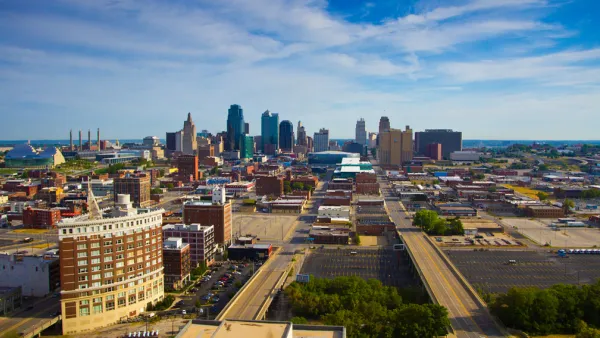
Kansas City to Expand its 'Smart City' Tech
The 1960s had the space race, the 2010s has the smart cities race. Kansas City means to win this one.
Private Telcos More Expensive Than Municipal Broadband 85% of the Time
A Harvard study found that, in 27 communities and cities with both private and city owned internet, the municipal broadband was almost always cheaper.
Free Municipal WiFi: A Dream Deferred
A new journal article by Eric Fraser assesses what went wrong with plans to bring wireless Internet access to the masses, finding that a hostile regulatory environment trumps even the best-laid plans.

Planetizen Federal Action Tracker
A weekly monitor of how Trump’s orders and actions are impacting planners and planning in America.

California plans to bury El Niño’s downpour
If the state plays its cards right, it may be able to store a billion acre-feet of El Niño’s water in aquifers.

Desperate measures: Advocates weigh draining Lake Powell to fill Colorado River
Draining the reservoir could reduce evaporation losses by a couple hundred thousand acre-feet.

Los Angeles just elected an urban planner as its mayor
Transportation analysts are optimistic that Raman will be more aggressive in addressing transit issues than Bass.

Mamdani’s pied-à-terre tax survives legal challenge
A panel of judges found that the plaintiffs failed to demonstrate injury as a result of New York City's implementation of the tax.

Eastern Nebraska is running out of electricity
Data centers and electrification are straining eastern Nebraska’s grid, throttling economic development.

FREE Course: Walkable City 1: Why Walkability?
After describing his path towards focusing on walkability as the essence of good planning, Jeff Speck marches through his five principal reasons for making more walkable places.
Reinventing Malls: Planning Alchemy—Turning Gray Fields Into Gold
The course focuses on the opportunities and imperatives that shape reinvention of mall sites.

City of Rosemead
Rutgers University, Edward J. Bloustein School of Planning and Public Policy
One Hundred Miles
University of Michigan School for Environment and Sustainability (SEAS)
Hunter College, City University of New York (CUNY)
The Architects Foundation
City of Cambridge
Montrose County
The Pocatello Development Authority