Phoenix's public art program is widely touted as one of the best in the country. But a proposed floating sculpture has elicited criticism from an otherwise uninvolved public, mainly due to the fact that the city is facing a large budget deficit.


"Phoenix's public-art program has made its mark across the city, adorning parks, canals, freeways and street corners. Many of the projects showcase cultural aspects of the Southwest. Some are hidden in plain sight, such as the pedestrian bridges crossing the Piestewa Freeway, their jagged silhouettes mirroring nearby mountains."
"Since the first art piece was installed 20 years ago in a McDowell Road freeway underpass, the city has spent more than $26 million on about 120 projects ranging from murals, sculptures and photographs to textiles, paintings and glass blocks."
"The average Phoenix resident probably doesn't give the city's public-art program much thought - until a controversy breaks out. That is what happened in December, when a public outcry rose up over a planned $2.4 million floating sculpture for a downtown park."
"There were jabs at the design, some saying it resembled a jellyfish. But at the heart of the debate was the city's proposed expenditure when facing its largest budget deficit."
FULL STORY: Phoenix public art: Hidden in plain sight

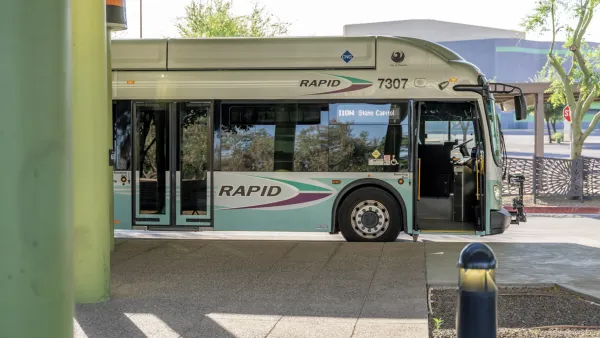
Phoenix announces new on-demand transit service, more frequent RAPID buses
Both new services will launch in October, and are part of Phoenix's Project Effective Access Solutions for Easing Congestion.
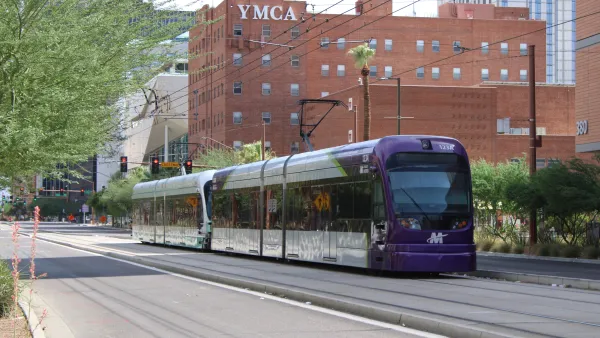
Phoenix cuts transit fares for low-income riders, tables fare-free days
The city council tabled discussions of four free transit days until it could do more research on the economic impact.
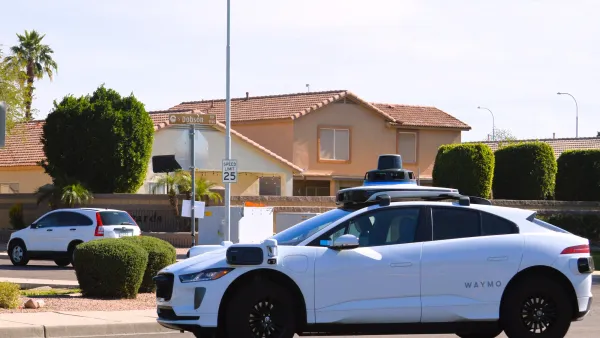
Uber and Waymo part ways in Phoenix
The companies ended a three-year pilot program, with Waymo saying it plans to keep its Phoenix robotaxi fleet available through its own app.

Planetizen Federal Action Tracker
A weekly monitor of how Trump’s orders and actions are impacting planners and planning in America.

The state-sanctioned urbicide of Austin
People don’t kill cities. Freeways do.

US to reduce Colorado River water deliveries to Mexico
A new Colorado Treaty amendment reduces Mexico’s Colorado River water allocation by 250,000 acre feet.

5 New England states march closer to 800 megawatt wind energy project
Securing federal approval for the project may be complicated under the Trump administration, which has historically been hostile towards domestic wind power.

Baltimore to break ground on $50 million Transit Priority Project
The project will bring faster bus trips, safer streets and better bike connections to Baltimore.

Airbnb launches $250 million 'last-dollar financing' housing accelerator, makes first investment in Austin
The company will put $6.4 million towards affordable housing development in Texas’ capital.

FREE Course: Walkable City 1: Why Walkability?
After describing his path towards focusing on walkability as the essence of good planning, Jeff Speck marches through his five principal reasons for making more walkable places.
Reinventing Malls: Planning Alchemy—Turning Gray Fields Into Gold
The course focuses on the opportunities and imperatives that shape reinvention of mall sites.

Eagle County Government
Harvard University Graduate School of Design
Nashville Planning Department
The Architects Foundation
University of Cincinnati Online
The Pocatello Development Authority
The Urban Renewal Agency of the City of Pocatello
Journal of the American Planning Association