After two decades of study and contention, the Twin Cities are gettinglight rail.


The way has been cleared for a federal funding agreement to besignedand a groundbreaking ceremony to be held this week. According to theStarTribune of Minneapolis and St. Paul, if Congress didn't sign off on theproject by January 31, state funding for the project would have beenrevokedand the project would have collapsed. After years of debate over whetherandwhere to build the line, support gathered around the Hiawatha Line in1998when the Minnesota legislature agreed to help pay for the route. Thenextchallenge will be to build the line on time within its $675 millionbudget.Contracts for construction and rolling stock will be activated as soonasthe Federal Transit Administration signs the full funding grantagreementcommitting $334 million to the project. The Met Council, the regionalplanning agency for the seven-county Twin Cities area, will own the railline, and Metro Transit will run it.
Thanks to Dateline APA
Read the full story: After years of study, light rail is a go in Twin Cities area


Planetizen Federal Action Tracker
A weekly monitor of how Trump’s orders and actions are impacting planners and planning in America.

Chicago breaks ground on $3 billion megadevelopment
The new neighborhood, titled Foundry Park, will one day host 3,700 residences.
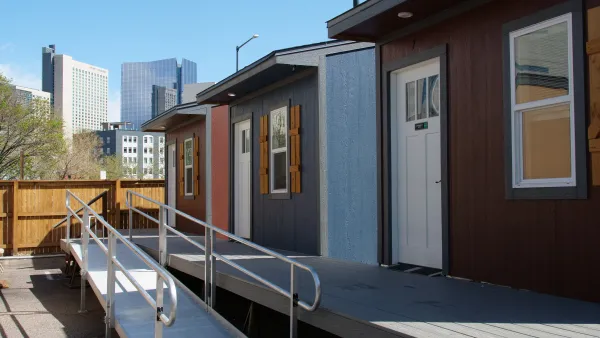
Denver is solving homelessness. Why aren't the rest of us?
Since 2023, Denver's street homeless population has decreased by 64%, proving that effective tools exist to support those in need of housing.

LA accused of breaching $1.4 billion sidewalk repair settlement
The city faces a backlog of nearly 5,000 street repair requests.

MTA kicks off six-year, $1 billion transit upgrade project
The authority is replacing the roughly 90-year-old train signals on the A and C line with modern technology.

Developers may expand largest gas pipeline network in Northwest
Pipeline giant Williams has proposed new expansions for its Northwest Pipeline from the Colorado Rockies through Idaho, Oregon and Washington.

FREE Course: Walkable City 1: Why Walkability?
After describing his path towards focusing on walkability as the essence of good planning, Jeff Speck marches through his five principal reasons for making more walkable places.
Reinventing Malls: Planning Alchemy—Turning Gray Fields Into Gold
The course focuses on the opportunities and imperatives that shape reinvention of mall sites.

City of Rosemead
Rutgers University, Edward J. Bloustein School of Planning and Public Policy
One Hundred Miles
The Architects Foundation
University of Cincinnati Online
Montrose County
Northern Illinois Transit Authority (NITA)
The Pocatello Development Authority