As commuters face delays and frustrations with aging infrastructure, the government in Auckland, New Zealand has announced plans to invest more than $1 billion in its regional rail system.


"Giant strides are being made to upgrade the city's rail network. Project Dart, a $600 million, Government-funded programme, is full steam ahead upgrading infrastructure - double-tracking on the western line, new signalling and new and refurbished stations - ahead of the billion dollar-plus electrification of the network from Papakura to Swanson. ARTA, the Auckland Regional Transport Authority responsible for passenger transport, is pouring more money into stations on the southern and eastern lines. All up, it's the biggest investment in railways since the early-80s.
But commuters live with the here and now. So little was invested for so long that the revival is like following the career of injury-hit Shane Bond - you take the rough with the smooth.
That can mean noisy, rattly carriages with dodgy air conditioning and rudimentary seating. Or trains running late due to signalling failures or a breakdown. Or the "one lane bridge factor" - waiting while a train coming the other way negotiates a single-track section of the network. While double-tracking of the western line is gathering pace, the work itself brings delays. Things will get worse before they get better: Construction of a new station at New Lynn and double tracking between New Lynn and Avondale is expected to bring months of frustration. Like NZ cricket supporters, you've got to have faith. And things are much, much better for a passenger service which was just about extinct a decade ago."
Read the full story: Uphill slog to fix rail
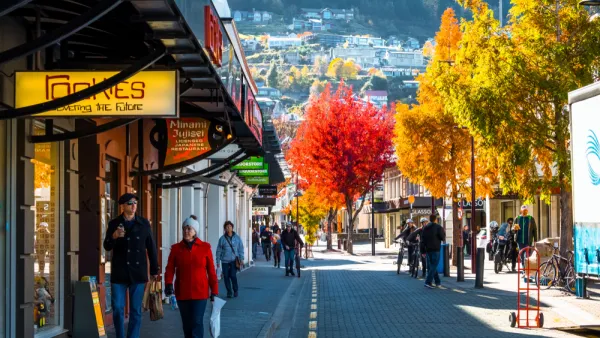
Zoning Reform: Lessons From New Zealand
The island nation is mandating mid-density zoning requirements and transit-oriented development in an effort to increase housing affordability and encourage compact development.
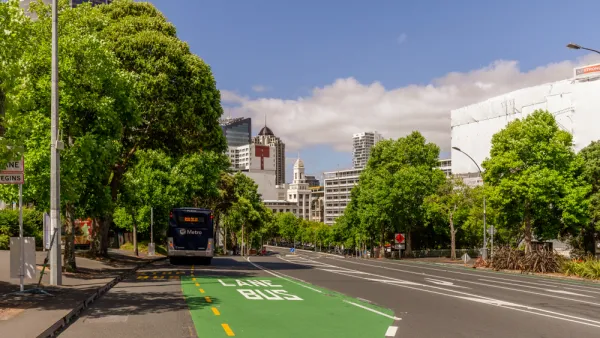
Smashing Transit Ridership Success in New Zealand
The city of Auckland, in New Zealand, set a goal to double its transit ridership in ten years. With a little under four years left to achieve that goal, the city is already well on its way.
New Zealand Bars Foreigners from Buying Residences
Homes are getting more expensive in New Zealand, so they're making it illegal for foreigners to buy homes in the country.

Desperate measures: Advocates weigh draining Lake Powell to fill Colorado River
Draining the reservoir could reduce evaporation losses by a couple hundred thousand acre-feet.

Eastern Nebraska is running out of electricity
Data centers and electrification are straining eastern Nebraska’s grid, throttling economic development.

Malls are becoming the midtowns of the future
Mall and office park redevelopments are a generational opportunity to create new nodes of urbanity.

NYC breaks ground on anti-flooding infrastructure project
New York City's new system will reduce stormwater flows to local sewers by 90%.

One Kentucky town’s secret to affordable housing
The Smoketown Community Land Trust has already built seven affordable homes for community members.

Houston gains petal-shaped cooling infrastructure to make streets more ‘delightful’
The city has installed the pavilions along 15 blocks in Houston.

FREE Course: Walkable City 1: Why Walkability?
After describing his path towards focusing on walkability as the essence of good planning, Jeff Speck marches through his five principal reasons for making more walkable places.
Reinventing Malls: Planning Alchemy—Turning Gray Fields Into Gold
The course focuses on the opportunities and imperatives that shape reinvention of mall sites.

City of Rosemead
Rutgers University, Edward J. Bloustein School of Planning and Public Policy
One Hundred Miles
University of Michigan School for Environment and Sustainability (SEAS)
Hunter College, City University of New York (CUNY)
The Architects Foundation
City of Cambridge
Montrose County
The Pocatello Development Authority