One citizen planner's journey across the United States provides a glimpse at how stronger connections between people and places can create better communities.


 Between Memorial Day weekend and July 10th I traveled across the United States on U.S. Highway 50. During my six plus weeks on the road -- from Ocean City, Maryland, to West Sacramento, California -- I met with over one hundred planners, planning commissioners, local officials, and citizen activists.
While I've posted many reports about my travels on a web blog I maintained -- www.rte50.com -- I thought that Planetizen readers might be especially interested in one of the topics that repeatedly came up: the importance of connecting neighborhoods, and people, in our cities and towns.
Since my return to Burlington, Vermont, I've spent time working on our city's new transportation plan -- I'm a member of the advisory committee providing input on the plan. One of the points we've been discussing is how to build more "connectivity" into Burlington. In part, that means enabling residents to more easily walk or bicycle between neighborhoods.
That's an idea I heard mentioned by many planners and planning commissioners in communities I visited during June and July. At its most basic, as in Montrose, Colorado, it means retrofitting already developed residential enclaves so that there are sidewalk and road connections. One problem that Kerwin Jensen, Montrose's planning director, described to me is the difficulty people have in getting around by bike or on foot without being forced to use heavily traveled county roads. (For more details, see my report from Montrose)
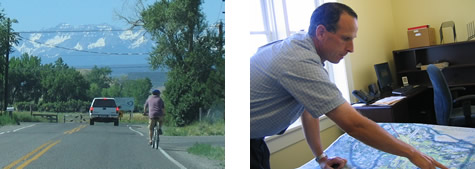
But also in Colorado -- and elsewhere -- I found planners proactively ensuring that connectivity is in place as developments are being built. In Fruita, Colorado, planners Dahna Raugh & Chris Brubaker showed me how new residential subdivisions are being linked in to the city's growing trail system.
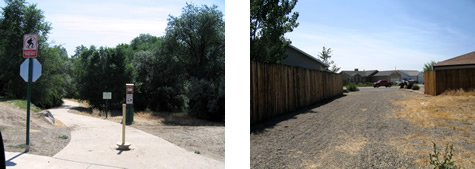
A couple of days later, in Moab, Utah, community development director David Olsen stressed his small city's commitment to connecting all of the city's neighborhoods by a trail system. He showed me parts of the Mill Creek Parkway trail, noting that it already connects three of the city's four K-12 schools.
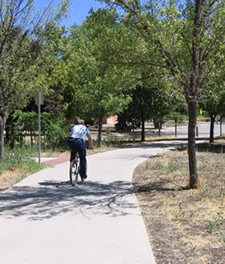
While planners and planning commissioners still confront residents who feel that building trails and connecting subdivisions only serves to make it easier for criminals to get access to their neighborhood, this is an argument without evidence. In fact, a growing body of research shows that having a nearby trail or recreational path is an amenity that, if anything, increases property values.
Indeed, recreational trails are one key element in something else I also regularly heard about during my travels: "quality of life."
But let me to get back to connections, because what I want to mention goes beyond just the physical connections that trail networks represent. What struck me during my Route 50 trip was the interest in strengthening connections between people. This came up, for example, in the importance (expressed to me in several communities) of retaining a "small town" character.
I wrote about this in one of my posts from O'Fallon, Illinois. Interestingly, O'Fallon is a booming suburb. Yet planning Director Ted Shekell, Mayor Gary Graham, and others I met with all told me they wanted O'Fallon to hold onto its small town feel. For planning commission Chair Gene McCoskey, that means a place where "kids have a neighborhood," and where you can count on your schools and churches for providing a supportive network, and, as Gene put it, "a sense of accountability." And as Mayor Graham interestingly added, it also means having elected and appointed officials who are readily accessible, "who listen and who are responsive."
But what can planners do to support the kind of connections between people I just described? One idea is promoting mixed-use places where there are simply more opportunities for people to run into each other and connect. This, I believe, is at least part of what's behind the interest many suburban areas have in developing new downtowns and town centers.
In Creve Coeur, Missouri, a St. Louis suburb, planners are focusing on developing a downtown for their suburban city. Why do this? I asked planning commissioner Gene Rovak. One reason, Gene replied, "is to give us a sense of identity." As Gene's fellow planning commissioner Carl Moskowitz added, "our new downtown will also be a walking district ... with [higher density] housing as part of it, empty nesters will have the chance to sell their homes but stay in Creve Coeur."
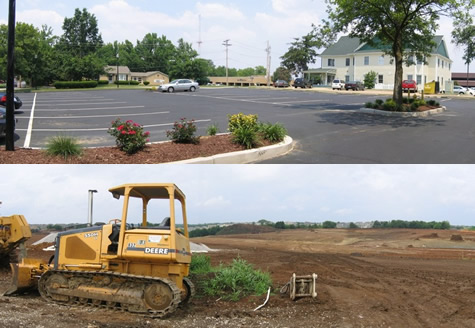
Another way of supporting connections is through "third places" -- that is, neighborhood groceries, coffee shops, restaurants, and other gathering spots.
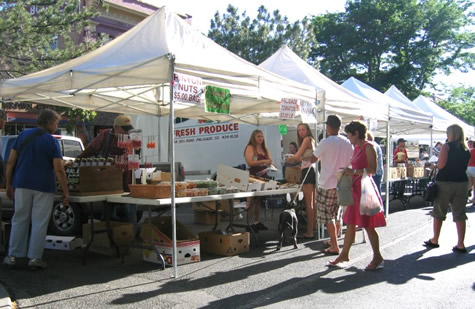
Farmers markets also seem a part of this. One of the attractions -- besides the fresh food -- is the opportunity to see friends and neighbors and catch up on what's going on. In fact, Richard McCarthy, President of the Farmers Market Coalition mentioned this to me when I interviewed him. (Full interview).
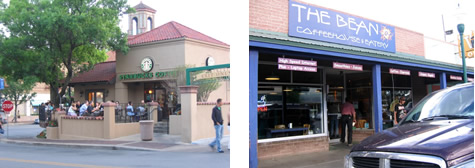
During my travels I was certainly struck by the proliferation of coffee houses.
Perhaps we should thank Starbucks for helping generate this -- or maybe they've just been smart in identifying something people have been thirsting for. But even in small cities and towns, the local coffee house or java cafe was a place where I almost invariably found large numbers of people (especially young people) sitting down & chatting away. Many were Starbucks, but even more were lively, locally owned places.
For planners, the question is not so much what we're doing to encourage this trend, but are we doing things that impede it.
Do our zoning codes prevent these kind of third places in our neighborhoods? That's a difficult issue in many places where residents are concerned about opening the door -- even just a crack -- to commercial activity in the midst of residential neighborhoods. Do we have burdensome parking requirements that make these small-scale uses difficult downtown (especially given how much parking is often already available)?
One last thought. There was one other type of connection that impressed me during my travels. That was how well connected planners and planning commissioners seemed to be in terms of knowing their communities. In fact, that's an essential part of being an effective planner or planning board member.
It's something that Elaine Cogan in her columns for the Planning Commissioners Journal has often stressed: to be effective, you need to have the pulse of the community -- whether it's what's going on in neighborhoods, what's on the mind of your Mayor or City Council, or what's the viewpoint of the business community or local developers. Yes, planners love to (and need to) work with census information, maps, and all sorts of data, but it's staying connected with people that's the real key to effective local planning.
Wayne Senville is Publisher & Editor of the Planning Commissioners Journal, a national quarterly received by more than 7,500 citizen and professional planners. His more than 100 posts from his trip along Route 50 this Summer are available at www.rte50.com.

Planetizen Federal Action Tracker
A weekly monitor of how Trump’s orders and actions are impacting planners and planning in America.

California plans to bury El Niño’s downpour
If the state plays its cards right, it may be able to store a billion acre-feet of El Niño’s water in aquifers.

Desperate measures: Advocates weigh draining Lake Powell to fill Colorado River
Draining the reservoir could reduce evaporation losses by a couple hundred thousand acre-feet.

Mamdani’s pied-à-terre tax survives legal challenge
A panel of judges found that the plaintiffs failed to demonstrate injury as a result of New York City's implementation of the tax.

Eastern Nebraska is running out of electricity
Data centers and electrification are straining eastern Nebraska’s grid, throttling economic development.

Seattle passes record-breaking transit services expansion
Proposition 1 will double the city’s transit tax to add 95,000 more bus trips and preserve 180,000 bus trips annually.

FREE Course: Walkable City 1: Why Walkability?
After describing his path towards focusing on walkability as the essence of good planning, Jeff Speck marches through his five principal reasons for making more walkable places.
Reinventing Malls: Planning Alchemy—Turning Gray Fields Into Gold
The course focuses on the opportunities and imperatives that shape reinvention of mall sites.

City of Rosemead
Rutgers University, Edward J. Bloustein School of Planning and Public Policy
One Hundred Miles
Hunter College, City University of New York (CUNY)
The Architects Foundation
University of Cincinnati Online
City of Cambridge
Montrose County
The Pocatello Development Authority

