


In honor of Landscape Architecture Month, we present three profiles of professional landscape architects Dennis Carmichael, FASLA, Melissa Marie Evans, ASLA, and Steve Martino, FASLA. Learn what influenced them to enter the field, what work they have been doing, and what advice they have to offer others interested in landscape architecture.
Dennis Carmichael, FASLA
 Current Position and Affiliation:
Principal/Vice President, EDAW, Alexandria, Virginia
Education:
Bachelor of Landscape Architecture, State University of New York College of Environmental Science and Forestry, 1976
How did you get into the field?
I got into the field of landscape architecture from participating in the first Earth Day and then subsequently reading "Design with Nature" by landscape architect Ian McHarg. The profession seemed both important and urgent at the time, and I find that to be even more true today.
What aspect of landscape architecture are you most passionate about?
What excites me most about the work is urban landscapes – parks, plazas, and streetscapes – where we make a visible difference in the lives of people. There is nothing more satisfying than knowing that we have contributed to the revitalization of a place.
What is the most challenging part of your job?
The biggest challenge for any landscape architect is getting the work realized in the manner in which it was designed. There are many obstacles to success – time, money, public process, contractors and maintenance – that can affect the work and I find you have to constantly defend the design from beginning to end to achieve that success. It is worth the time, however.
Brief description of a recent project:
We have been the landscape architects for one of the parks that are being built atop the tunnel in downtown Boston – the so-called "big dig". It is a dream project – an important place in an important city – and we have created a plan that reveals the history of the site we learned in our public process. It will be a richly appointed greensward in the middle of the historic waterfront and what is exciting is that we have envisioned a very contemporary landscape in an historic setting, so I think the contrast will be vivid and compelling. It is also likely to be a catalyst for revitalization of a terrific neighborhood and a great place for people to gather in the city.
What is the most recent book you read that challenged the way you think about your profession?
I recently read "The Devil in the White City" by Erik Larson (which I know makes me the last landscape architect in America to read it) and was fascinated by the account of Frederick Law Olmsted. What was most enlightening was the sheer audacity of the idea of building a World's Fair in two years and then having the tenacity to actually get it done. I think in some ways today we are not as bold as he was, and yet we have tools and transportation means that he never had.
How do you think landscape architecture has changed since you first entered the field?
The profession of landscape architecture has changed dramatically since I began my career in one fundamental way. While the work we do is essentially the same, the awareness of clients and citizens of our skills and contributions is significantly higher than it was when I started out. It is so much easier today to get work, present work, and implement work because people realize the value we bring to the land and to cities.
Do you have any advice for someone entering the field?
To an entering landscape architect, I would say that your generation has to continue the work that our generation started. In my generation, we have recognized environmental degradation and reduced our impact to the land. That is only the first step. The next step is a much harder one – to create restorative landscapes that actually make our environment better and return it to a healthy state. This is a daunting prospect, but one which is both important and urgent in the twenty first century.
Melissa Marie Evans, ASLA
 Current Position and Affiliation:
Owner, EB LandWorks, Inc., Fayetteville, Arkansas; ASLA Arkansas Chapter Trustee
Last Position and Affiliation:
Project Manager at Freeland-Kauffman & Fredeen, Inc., Rogers, Arkansas
Education:
Bachelor of Landscape Architecture, University of Arkansas, 1992
How did you get into the field?
I enjoyed art in high school and was interested in the built environment. In college I majored in architecture and learned about landscape architecture in Design I. It was more suited to my interests so I changed my major at the beginning of my sophomore year.
What aspect of landscape architecture are you most passionate about?
Environmental sustainability.
What is the most challenging part of your job?
The most challenging aspect is educating clients and other design professionals about what landscape architects can do and how we can all design in a way to be more sensitive to the Earth.
Brief description of a recent project:
My firm worked on the Construction Documents for a new plaza and the surrounds of two new buildings for the University of Arkansas campus in Fayetteville. Richard Burck and Associates in Boston, MA were the lead landscape architects on the project and we really enjoyed the collaboration with them.
What is the most recent book you read that challenged the way you think about your profession?
"A Joy I'd Never Known" by Jan Dravecky; it made me think about priorities in life and keeping work on a manageable level rather than being such a workaholic.
How do you think landscape architecture has changed since you first entered the field?
Since I first entered the field in the early 90's, more women are entering the field and more people know what landscape architecture is.
Do you have any advice for someone entering the field?
Keep an open mind and keep learning but remember, you can't possibly know all the answers and it is OK to admit that.
Steve Martino, FASLA
 Current Position and Affiliation:
President, Cactus City Design, Phoenix, Arizona
Last Position and Affiliation:
President, Steve Martino and Associates, Phoenix, Arizona
Education:
I Studied art and architecture at Arizona State University, 1969
How did you get into the field?
By Accident: I planned on being an architect. Out of school I took a two-year job with a landscape architect. At the time, I thought architects should also be landscape architects. This was my first critical look at the man-made landscape. I was puzzled why the desert was not appreciated and mostly why desert plant material was not used in landscaping. I thought the desert was more interesting than anything man-made in the city. My quest was to figure out how to use native desert plants in the landscape, and eventually, to develop a design style that was desert derived. My goal was to celebrate the desert rather than make apologies for it, which was the current design field's approach.
What aspect of landscape architecture are you most passionate about?
I am most passionate about creating outdoor living space and places that people look forward to being in.
What is the most challenging part of your job?
The most challenging part of my job is finding designers who have a passion for design excellence. When I started, I thought getting clients and doing good work would be the challenge. However, these two things were not a problem in my practice. It proved to be that managing a business while also being the sole designer for all my projects would be my greatest challenge.
Brief description of a recent project:
In a current residential project which is under construction we have ventured into industrial design with our design for furniture, outdoor showers, interior skylight baffles, glass work, water features, counters, etc. This project took five separate structural engineering firms to design the specialized elements: We used the house engineer for concrete, masonry, and major steel work; a pool and water feature engineer for the pools; a glass engineer for our drilled and pinned glass walls; a specialty engineer for sculptural fencing; and a composite engineer for the fiberglass structures.
What is the most recent book you read that challenged the way you think about your profession?
"Franklin D. Israel: Buildings and Projects" by Frank O. Gehry
How do you think landscape architecture has changed since you first entered the field?
The quality of design has increased drastically since I started, but I think the basic services are still the same. When I joined the ASLA in 1980, the main market for landscape architects in my area was providing "sprawl" design services for developers. The ASLA had a motto in these days that made me feel good about the profession. It stated that we were "Stewards of the Environment." However, as I looked around, not much of that "stewardship" made it down to the street level. I used to say maybe we were the Martha Stewarts of the environment. The Savings and Loan robber barons were dumping their money into huge projects that displace the natural environment with exotic landscapes that tried to make the desert look like somewhere else. Landscape architects would stand in line to be these developer's stooges.
Twenty-five years later, most of the firms in my area have grown into rather large firms catering to developers conquering and displacing the natural environment. Unfortunately, I think we are still a profession servicing sprawl.
Do you have any advice for someone entering the field?
Learn a specialty. Have a solid background in design. Learn skills in graphic design, urban design, marketing, lighting design, water feature design, etc.


Planetizen Federal Action Tracker
A weekly monitor of how Trump’s orders and actions are impacting planners and planning in America.

Northwest rail fans eager for Sept. 30 debut of Amtrak’s Airo fleet
Get ready for that new train smell and more seats. But they won’t go faster or run more frequently on the Cascades route in Washington and Oregon.
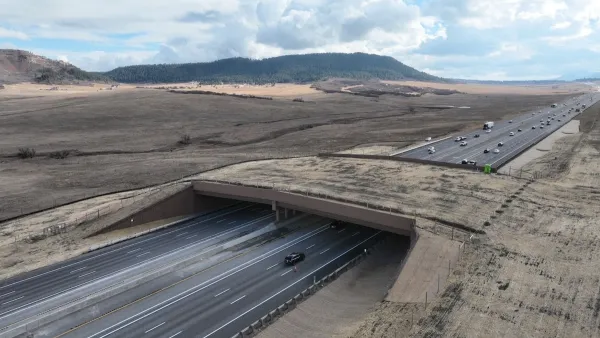
Record-breaking wildlife overpass in Colorado brings 91% reduction in animal collisions
Prior to the overpass, vehicles were hitting one deer per day on Colorado’s Interstate 25.

Detroit to transform waterfront with $2.2 billion investment
Developers will convert about 18 acres of unused parking lot space into civic spaces.

‘Going backwards:’ Baltimore mayor, students rally against state's transit funding plan
Maryland's proposed six-year plan provides no funding for Baltimore’s BMORE bus program and reduces its road maintenance funding.

Trump wants to cancel nearly 98% of funding for HUD housing support program
Multiple housing groups are suing the administration in an effort to preserve the funding.

FREE Course: Walkable City 1: Why Walkability?
After describing his path towards focusing on walkability as the essence of good planning, Jeff Speck marches through his five principal reasons for making more walkable places.
Reinventing Malls: Planning Alchemy—Turning Gray Fields Into Gold
The course focuses on the opportunities and imperatives that shape reinvention of mall sites.

City of Thousand Oaks
City of Wisconsin Rapids
Harvard University Graduate School of Design
The Architects Foundation
University of Cincinnati Online
Northern Illinois Transit Authority (NITA)
The Pocatello Development Authority
The Urban Renewal Agency of the City of Pocatello

