Activists claim that the planned development sits in a floodplain.


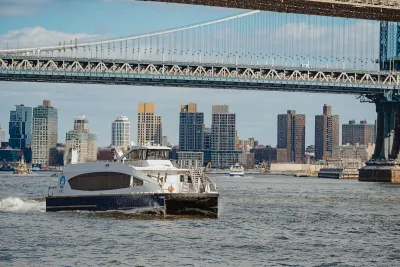
Environmental activists are suing New York City in hopes of stopping a planned waterfront residential complex they claim would sit in a floodplain, posing a danger to residents. The complex would house over 1,300 units, Gothamist reports.
“The lawsuit is the latest chapter in a decadeslong disagreement over how the land near the East River’s Bushwick Inlet should be used. A sweeping zoning change in 2005 made way for skyscrapers across swaths of Williamsburg and Greenpoint, but also promised public parkland on the nearly 30 acres surrounding the inlet — heavily polluted land that was historically home to fossil fuel companies. More than 20 years later, according to Friends of Bushwick Inlet Park, only a third of the promised parkland is open,” Willow Higgins writes for Gothamist.
In court papers, environmental activists claim that the city’s environmental review of the location relies on outdated climate projections. The city has yet to file a response.
Read the full story: Brooklyn environmentalists sue to block Greenpoint waterfront development
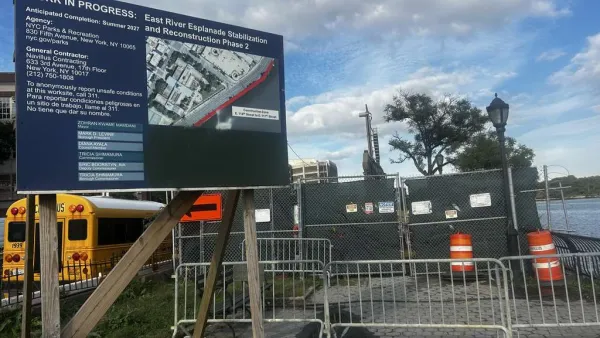
Ballooning costs delay NYC green space restoration after six years of planning
“There’s a stark inequity in how the city prioritizes infrastructure projects across different Manhattan neighborhoods," said Maria Kessler, executive director for Friends of the East River Esplanade. “Why is this neighborhood the last and unserved?”
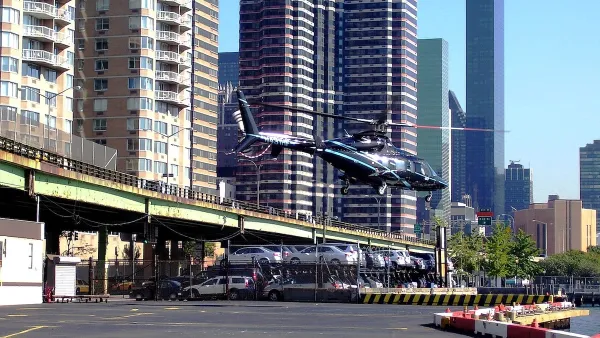
Manhattan Waterfront Parking Lot to Become Public Park
A lot that has served as parking for decades will add a much-needed public amenity to the East River waterfront.
NYC Budget Makes Key Building Code Change
The change could spur more housing development if accompanying reforms in the City of Yes for Housing Opportunity plan are approved.

Planetizen Federal Action Tracker
A weekly monitor of how Trump’s orders and actions are impacting planners and planning in America.

Washington state to charge fee to drivers with fuel-efficient cars
Revenue from the fee will go towards supporting the state’s highways.

Trump to blast ‘hydrocarbon highway’ through ‘world’s longest art gallery’
Environmental and historic preservation groups are suing to stop the project.

The MTA wants to entice international bus manufacturers to set up shop in America
The MTA hopes to create more competition for better bus options while still "buying American."

Environmentalists sue to halt NYC waterfront development
Activists claim that the planned development sits in a floodplain.

NYT examines the plan to help Chicago’s struggling neighborhoods
The Times found that Chicago’s tax increment financing program "largely" failed to help West Side neighborhoods.

FREE Course: Walkable City 1: Why Walkability?
After describing his path towards focusing on walkability as the essence of good planning, Jeff Speck marches through his five principal reasons for making more walkable places.
Reinventing Malls: Planning Alchemy—Turning Gray Fields Into Gold
The course focuses on the opportunities and imperatives that shape reinvention of mall sites.

City of Charlotte
City of Rosemead
Rutgers University, Edward J. Bloustein School of Planning and Public Policy
University of Michigan School for Environment and Sustainability (SEAS)
Hunter College, City University of New York (CUNY)
The Architects Foundation
University District Partnership