Nearly 20K households, including about 78K people, would be affected by the rule.



This story was originally published in Stateline, which reports on the big challenges that cross state borders.
A coalition of 22 states is suing to block a federal rule change that would strip housing assistance from “mixed-status” families — those including U.S. citizens and people without legal immigration status.
Under the U.S. Department of Housing and Urban Development rule, any household that includes one member without lawful status would be cut off from housing assistance. Currently, subsidies are pro-rated to include only eligible recipients, a provision enacted by Congress. The rule, if unblocked, goes into effect Dec. 14.
The states argue that HUD’s new rule violates federal law. “HUD lacks authority to rewrite federal law to exclude families this Administration disfavors from federal affordable housing programs,” the lawsuitsays.
HUD argues the rule would allow the department to redistribute tenant subsidies from mixed-status families to what the new rules classifies as eligible households. Secretary Scott Turner said the rule “ends the exploitation of taxpayer dollars.”
“This rule guarantees ONLY AMERICAN citizens and certain eligible noncitizens will reside in HUD-funded housing,” Turner said in a statement to Stateline. “This change represents a reallocation of up to $218 million which will now go to eligible Americans that are currently on a waitlist.”
California accounts for the largest share of affected families, followed by Texas and New York. In these states, thousands of households that currently receive prorated rental assistance could lose eligibility entirely if the rule is finalized, rental housing advocates warn.
Nationwide, nearly 20,000 mixed-status families would be affected by the rule. Most would leave assisted housing voluntarily while nearly 1,000 households would require formal eviction, HUD estimated.
Advocates and plaintiffs in the suit say of the total 78,000 people affected by the new rule, 55,000 are fully eligible for federal housing assistance, a population that skews toward the youngest of renters.
HUD figures listed in the complaint say that 65% of eligible people in mixed-status households are children and that mixed-status families are a small share of households that receive federal housing assistance, less than 1%.
The states also argue that the rule will shift costs of housing the displaced people onto state and local governments and make it harder for eligible people to keep their housing by requiring them to prove their legal status.
Plaintiffs in the 22-state lawsuit include the attorneys general of Arizona, California, Colorado, Connecticut, Delaware, Hawaii, Illinois, Maine, Maryland, Massachusetts, Michigan, Minnesota, New Jersey, New Mexico, New York, Oregon, Rhode Island, Virginia, Vermont, Washington, Wisconsin and the District of Columbia, as well as the governor of Pennsylvania. It was filed in the U.S. District Court for the District of Massachusetts.
“For decades Congress has recognized the importance of keeping families together even if not every member of a family qualifies for assistance,” Arizona Attorney General Kris Mayes, a Democrat, said in a statement. “The Trump administration does not get to unilaterally change those protections.”
Tenant and immigrant rights groups, as well as a coalition of cities from across the country, also have sued over the HUD rule.
Stateline reporter Robbie Sequeira can be reached at [email protected].
Read the full story: 22 states sue feds over rule stripping housing aid from mixed-status immigrant families
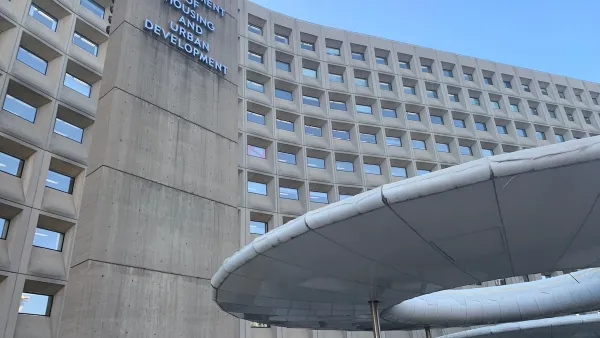
HUD to end aid for mixed-immigration-status households
The new rule is projected to impact 80,000 people, nearly half of whom are children.
NYC, state sue feds over mixed-immigration-status housing assistance rule
The state’s lawsuit argues that the rule change violates the Administrative Procedure Act.
Analysis: ROAD to Housing Act could take years to implement
HUD is tasked with implementing nine new rules as part of the ROAD to Housing Act — while operating with a significantly reduced staff.

Washington state to charge fee to drivers with fuel-efficient cars
Revenue from the fee will go towards supporting the state’s highways.

Illinois considers spending $1 billion in taxpayer money on data center
A quantum computing campus and data center are currently under construction in Chicago.

Trump to blast ‘hydrocarbon highway’ through ‘world’s longest art gallery’
Environmental and historic preservation groups are suing to stop the project.

22 states sue feds over rule stripping housing aid from mixed-status immigrant families
Nearly 20K households, including about 78K people, would be affected by the rule.

NYC, state sue feds over mixed-immigration-status housing assistance rule
The state’s lawsuit argues that the rule change violates the Administrative Procedure Act.

Michigan to turn neighborhood into virtual power plant
Residents will soon be able to divert their excess energy to the grid in exchange for compensation.

FREE Course: Walkable City 1: Why Walkability?
After describing his path towards focusing on walkability as the essence of good planning, Jeff Speck marches through his five principal reasons for making more walkable places.
Reinventing Malls: Planning Alchemy—Turning Gray Fields Into Gold
The course focuses on the opportunities and imperatives that shape reinvention of mall sites.

City of Charlotte
City of Rosemead
Rutgers University, Edward J. Bloustein School of Planning and Public Policy
University of Michigan School for Environment and Sustainability (SEAS)
Hunter College, City University of New York (CUNY)
The Architects Foundation
University District Partnership