Draining the reservoir could reduce evaporation losses by a couple hundred thousand acre-feet.


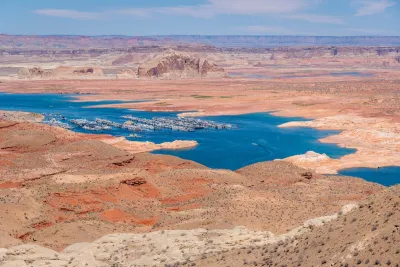
As the Southwestern United States battles a 27-year drought — the longest in 1,200 years — and the Colorado River gets drier and drier, some advocates are pushing for a drastic action: draining Lake Powell, one of the river’s two key reservoirs. Draining the reservoir and letting all its water flow into Lake Mead could reduce evaporation losses by a couple hundred thousand acre-feet, increase hydropower production at Lake Mead and reveal sites sacred to Indigenous people, which the man-made Lake Powell obscures.
The Glenn Canyon Dam created Lake Powell. Pipes in the dam send water down to turbines, which generate energy, and then into the Colorado River. However, once Lake Powell’s water level dips too low, water can't escape through the main pipes. “Allowing more water to flow through the Glen Canyon Dam — by draining the lake through the existing bypass tubes and newly drilled diversion tunnels near the riverbed — is no longer dismissed out of hand,” Jim Robbins writes for Yale Environment 360.
The plan to drain Lake Powell, called Fill Mead First, faces many obstacles. The federal government does not include draining the lake as an option in its ten-year plan to manage the Colorado River, and new diversion tunnels would likely take decades to build and cost billions. However, the Glen Canyon Institute is in support of the plan, and Jack Schmidt, director of the Center for Colorado River Studies at Utah State University, said drilling lower pipes is “an utterly reasonable idea.”
Read the full story: As the Colorado River Shrinks, Calls to Drain Lake Powell Grow

Feds say Arizona, California and Nevada must cut Colorado River water use by 1.25 million acre-feet
The new plan does not apply mandatory cuts to any of the river’s upper basin states.
Even a “best case scenario” El Niño won't fix the West’s drought
While lower basin states may see increased precipitation, increased snowfall in upper basin states is needed to bring sufficient water to the West.
Why a Colorado River water conservation agreement is so hard to reach
As the nation's two largest reservoirs hit their lowest levels on record, what would it take to avert the crisis? An expert weighs in.

Planetizen Federal Action Tracker
A weekly monitor of how Trump’s orders and actions are impacting planners and planning in America.

California plans to bury El Niño’s downpour
If the state plays its cards right, it may be able to store a billion acre-feet of El Niño’s water in aquifers.

Chicago breaks ground on $3 billion megadevelopment
The new neighborhood, titled Foundry Park, will one day host 3,700 residences.

Want to study the Missouri River? Soon, you may need unanimous approval from 10 states
Legislation would require 10 governors’ permission to study or build projects moving water outside the basin.

Desperate measures: Advocates weigh draining Lake Powell to fill Colorado River
Draining the reservoir could reduce evaporation losses by a couple hundred thousand acre-feet.

This road in NYC is infamously dangerous — and Mamdani can't fix it
New York City's Ocean Parkway is known for reckless driving, but the power to implement safety measures lies with the state rather than the city.

FREE Course: Walkable City 1: Why Walkability?
After describing his path towards focusing on walkability as the essence of good planning, Jeff Speck marches through his five principal reasons for making more walkable places.
Reinventing Malls: Planning Alchemy—Turning Gray Fields Into Gold
The course focuses on the opportunities and imperatives that shape reinvention of mall sites.

City of Rosemead
Rutgers University, Edward J. Bloustein School of Planning and Public Policy
One Hundred Miles
Hunter College, City University of New York (CUNY)
The Architects Foundation
University of Cincinnati Online
City of Cambridge
Montrose County
The Pocatello Development Authority