The proposed campus would consume 11 times the power of Denver International Airport; as it has across the country, opposition mounts.


This article was produced by Capital & Main. It is republished here with permission.
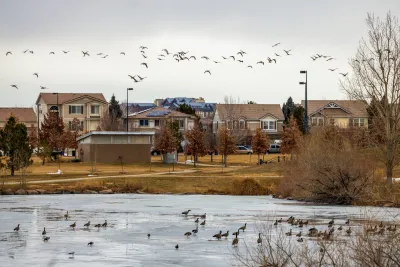
A Denver-area housing development under construction on a former 800-acre dryland farm touts its “incredible connection to nature.” Yet a Black-eyed-Susan covered vacant lot across the street could upend that connection: It’s slated to become the largest data center in Colorado.
Planning documents quietly filed with the city of Aurora show two two-story buildings on the property that would equal 861,866 square feet combined. The current design calls for 334 megawatts of planned IT capacity, with a total electrical demand to power computer banks, as well as lights and other appliances, of about 500 megawatts, said Mark Freeman, Vantage Data Center Inc.’s vice president of global marketing, in an e-mail.
At full buildout, the energy consumed would equal about 11 times the power used by Denver International Airport, about eight miles to the north.
The 143-acre project proposal is little known to residents in Aurora, Colorado’s third-largest city. Its location in a half-built residential area in a census block disproportionately impacted by pollution highlights how the lack of rules for such developments largely leaves residents out of the planning process, an investigation by Capital & Main found.
Many cities and counties in the state currently allow staff to decide the fate of data center projects in areas zoned for commercial and industrial uses. Such proposals often aren’t required to go through a planning commission and city council process that includes public hearings.
The Trident Data Center, proposed by Vantage Data Centers Management Company LLC, is in “an industrial zone district, where data centers are a permitted use and can be approved administratively, so long as no major adjustments are requested,” said Jennifer Soules, a city of Aurora spokesperson, in an e-mail. “The project does not meet the criteria for a neighborhood meeting.”
State officials suggested that Vantage Data Centers should “strongly consider” holding a community hearing before applying to the Colorado Department of Public Health and Environment for a construction permit. Vantage’s Freeman said the company will “develop the campus responsibly and in a way that supports Aurora’s economic growth while addressing common community concerns.”
He added that the project is in the early planning stages, and Vantage is beginning to reach out to elected officials and community leaders.
“We also will be launching a sentiment survey to better understand community needs,” Freeman said.
This review process mirrors one used by Denver city staffers and state officials to approve a data center without a public hearing in Globeville and Elyria-Swansea, which ranks among the nation’s most polluted zip codes. The CoreSite developmentultimately calls for three buildings. Construction on the first data center, designed for an 18-megawatt capacity, is nearly complete. The other two will require a city permit. The company cannot apply for these permits during the city’s current moratorium.
The CoreSite facility will be just yards from a senior living center, an affordable housing complex and a health clinic, all of which led to a reckoning about how data centers are reviewed in Colorado and shaped discussions among state legislators about how to regulate the fast-growing industry.
Under pressure from residents, the Denver City Council in May voted to institute a moratorium on such developments for at least a year while it forms a working group to consider new rules. Other municipalities followed. Today, towns and counties statewide, representing about one third of Colorado’s population, have paused data center applications. This includes places that voted overwhelmingly for Donald Trump in the 2024 presidential election.
The trend reflects a nationwide push by municipalities and states, on the heels of a growing public outcry, to slow down the unprecedented growth of power- and water-hungry computer-filled facilities designed to further artificial intelligence. Lawmakers in 16 states have considered banning such developments. About 379 jurisdictions, from Maine to Arkansas to Utah and Washington, adopted moratoriums, or barred data centers outright. It has also become a dominant political issue on both sides of the aisle in the runup to the November midterms.
At least 4,000 data centers currently exist across the United States. Tax incentives in 38 states furthered their development — although officials in some states are starting to unwind them, citing budget deficits. President Trump said in August that data centers are “tremendously important” for the economy and could become a bigger industry than oil.
The market is growing so quickly that forecasters are revising their projections in real time. Data center capacity in America grew to 118 gigawatts in July, an upwards revision of 52% compared to the December forecast, BloombergNEF found. For comparison, that’s enough energy to power 65% of homes in the United States each year.
Analysts expect facilities hosting about 194 gigawatts to be online by 2035, an 83% revision upward. The industry used about 4.4% of the country’s electricity in 2023, but that percentage could triple by 2028.
Technology companies said the “boom is spreading jobs and prosperity nationwide,” resulting in “an estimated $27 billion in potential state and local tax revenue over the next decade.”
Yet such growth is also accompanied by unparalleled community opposition due to concerns about emissions, land and water use, and rising electricity rates resulting from hooking up such facilities to already strained power grids. Seven in 10 Americansdo not want data centers in their communities, according to a May Gallup poll.
A national review of such facilities found nearly half are, as with Denver and Aurora, in census tracts with greater pollution burdens as measured by the Center for Disease Control’s Environmental Justice Index. Residents, state lawmakers and conservationists are also concerned that pollution from data centers’ electricity demands will unravel progress toward greenhouse gas reduction targets.
Despite the bipartisan pushback, state legislators in Colorado have struggled to devise bills to either incentivize, or regulate, such facilities.
Two measures introduced in the spring legislative session, one that would have provided incentives to data center developers to locate in the state and a second that would have required companies to use renewable energy, hold public hearings and forge community benefit agreements, died in committee.
The state is home to about 60 such facilities, ranging from smaller centers that have been around for decades to the largest, a 160-megawatt, three building facility now under construction by QTS, also in Aurora. The campus is rising about four miles south of the proposed Trident facility, also in a census block disproportionately impacted by pollution.
Aurora City Councilmember Amy Wiles watches cranes erecting the second of QTS’ three buildings across a farmer’s field every day when she walks her golden retrievers. Since her election to the 11-member council in November, Wiles has researched how her city, among the nation’s most diverse, can write rules to curb data center effects on the community.
She held a town hall meeting and invited QTS representatives and officials from Xcel Energy, the state’s largest electric utility, to speak. She represents the ward with the most undeveloped land in the city, including affordable housing developments under construction near the Trident project.
“The community response has been overwhelming,” Wiles said. “They do not want data centers, period.”
The council voted against a six-month data center moratorium Wiles introduced in August. It instead approved a resolution giving the city manager 30 days to bring back measures to regulate water use and establish buffer zones for data centers near neighborhoods.
Councilmembers agreed the city should ban cooling technologies that require tens of thousands of gallons of water each day. Instead, companies will be required to use closed-loop chillers to cool computer systems. The Trident facility will use such a technology, Vantage spokesman Freeman said. Planning documents the company filed with the city show one building would require 800,000 gallons initially.
The Trident proposal also calls for 28 emergency diesel backup generators across the two planned buildings, Freeman said. The company is asking to install the semi-truck-sized engines in a region where residents are exposed to more toxic air pollutants than 98% of the state’s census tracts and with greater hospitalization rates for asthma than 96% of such geographic regions, state records show. About two thirds of residents here struggle to pay for housing and are people of color.
Due to the community’s socioeconomic vulnerability, state officials suggested that Vantage engage with residents before applying for a construction permit.
“At a minimum,” regulators wrote in an Environmental Justice Summary, “the Air Pollution Control Division expects Vantage Data Centers Management Company, LLC to hold at least one community meeting before submitting the permit application to explain the project to the community and receive feedback.”
The vacant lot Vantage wants to build on is in the Denver-Aurora-Greeley metropolitan area, a region ranked eighth worst out of 226 such areas nationwide by the American Lung Association for high ozone days. Poisonous gases that contribute to the formation of ozone cause the state to violate federal air pollution standards each year.
The air was so polluted for more than two-thirds of this year’s “ozone season,” the period between May 31 and Aug. 31, that state officials issued warnings for residents with respiratory issues, young children and older adults to stay inside.
Residents voiced concern about pollution from diesel generators, as well as the data center industry’s power demands, at an August hearing of the state’s Public Utilities Commission on new rates for large load electricity customers.
Xcel Energy put forward the plan in April, saying it ensures “existing customers do not subsidize new large customers.” The company expects two-thirds of its demand growth to come from facilities like data centers.
Under the proposal, customers that need 20 megawatts or more must sign long-term contracts and cover costs to upgrade the grid. Residents told the PUC that the plan does not go far enough to require data center operators to use renewable energy.
“This year, an exceptional drought put Littleton under water restrictions in March — the earliest in state history,” testified Laura Rosenbaum, sustainability coordinator for Littleton, a Denver suburb. “We need to work as a region to drive meaningful change. We can’t let new large load customers like data centers stop us from moving our grid to renewable energy.”
Copyright 2026 Capital & Main
FULL STORY: Colorado’s Largest Data Center Could Rise Next to Homes — Without a Public Hearing

Judge strikes down Trump-backed data center on public land
The Biden administration originally approved the same patch of federal land for a solar farm in 2023.
15 million people rely on the Rio Grande — in 2 years, it may run dry
The river fuels billions of dollars in agricultural production. Reducing agricultural water use may be the only way to save it.

Planetizen Federal Action Tracker
A weekly monitor of how Trump’s orders and actions are impacting planners and planning in America.

The state-sanctioned urbicide of Austin
People don’t kill cities. Freeways do.

US to reduce Colorado River water deliveries to Mexico
A new Colorado Treaty amendment reduces Mexico’s Colorado River water allocation by 250,000 acre feet.

LA Metro’s ultimatum: no extra buses for LA28 if federal funding isn’t imminently secured
If Metro does not provide additional buses, LA28 organizers will have to find a new way to manage Olympic traffic. LA28’s budget does not include a line item for transit.

Colorado’s Largest Data Center Could Rise Next to Homes — Without a Public Hearing
The proposed campus would consume 11 times the power of Denver International Airport; as it has across the country, opposition mounts.

5 New England states march closer to 800 megawatt wind energy project
Securing federal approval for the project may be complicated under the Trump administration, which has historically been hostile towards domestic wind power.

FREE Course: Walkable City 1: Why Walkability?
After describing his path towards focusing on walkability as the essence of good planning, Jeff Speck marches through his five principal reasons for making more walkable places.
Reinventing Malls: Planning Alchemy—Turning Gray Fields Into Gold
The course focuses on the opportunities and imperatives that shape reinvention of mall sites.

Eagle County Government
Harvard University Graduate School of Design
Nashville Planning Department
The Architects Foundation
University of Cincinnati Online
The Pocatello Development Authority
The Urban Renewal Agency of the City of Pocatello
Journal of the American Planning Association