Fair housing law has never been easy to enforce. But HUD's proposal to eliminate the use of disparate impact analysis will remove another crucial tool for doing so.



The Department of Housing and Urban Development has proposed rescinding its use of disparate impact analysis, which helps federal officials identify housing policies that produce discriminatory effects. This policy can be vital for stopping racist patterns of behavior, given that racist intent is often difficult to prove.
Writing for Shelterforce, Amber Banks, head of the African American Alliance of CDFI CEOs, explains how tenant screening, credit standards, appraisals, insurance practices and lending rules can appear neutral while still limiting access by people of color to housing and investment. She argues that removing HUD’s ability to use "disparate impact" statistical analysis would make racial discrimination harder to identify and challenge in court.
Read the full story: How HUD Is Seeking to Make Fighting Housing Discrimination Even Harder

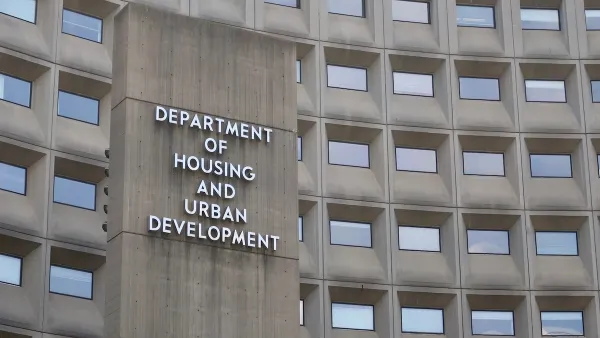
HUD Whistleblowers: Agency is ‘Systematically Undermining’ Fair Housing Laws
HUD employees say the agency has decimated the Office of Fair Housing, reducing staff by 70 percent, and forced a gag order that prevents them from effectively enforcing fair housing and civil rights laws.

Oregon cities are excluding a key tool that could help their housing goals: maps
An effort to use geospatial analysis to understand how housing and access to opportunity are distributed in Oregon cities has largely stalled.

USDOT will stop enforcing a key civil rights law
The agency will no longer enforce Title VI, eliminating disparate impact protections for federally protected groups.

Planetizen Federal Action Tracker
A weekly monitor of how Trump’s orders and actions are impacting planners and planning in America.

Data reveals that NYC’s bet on congestion pricing has paid off
After almost two years of the program, reports show positive impacts on traffic and air quality and no disruptions to parking.

Denver is solving homelessness. Why aren't the rest of us?
Since 2023, Denver's street homeless population has decreased by 64%, proving that effective tools exist to support those in need of housing.

Michigan needs billions to save its water infrastructure. The state won't fund it
Michigan needs to invest $2.8 billion per year over the next 20 years to fix its water infrastructure. The FY 2027 budget allocates only $27.9 million.

Trump asks Supreme Court to allow border wall through Texas national park
Judge Kathleen Cardone previously blocked the Big Bend border wall project, and Texas’ Land Commissioner has spoken out against it as well.

This MA town is drowning in its own sewage — and residents like it that way
Susan Murcott, a waste water expert, said if Carlisle didn't address their leaking sewage, the problem could turn “deadly.”

FREE Course: Walkable City 1: Why Walkability?
After describing his path towards focusing on walkability as the essence of good planning, Jeff Speck marches through his five principal reasons for making more walkable places.
Reinventing Malls: Planning Alchemy—Turning Gray Fields Into Gold
The course focuses on the opportunities and imperatives that shape reinvention of mall sites.


City of Rosemead
Rutgers University, Edward J. Bloustein School of Planning and Public Policy
One Hundred Miles
The Architects Foundation
University of Cincinnati Online
Montrose County
Northern Illinois Transit Authority (NITA)
The Pocatello Development Authority