The president's cancellation of the bill signing came as a shock to both sides of the political aisle.


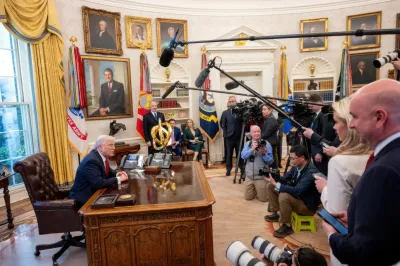
President Donald Trump "abruptly canceled" an event where he was to sign the new bipartisan housing bill passed by the Congress.
According to an article by Natalie Allison, Mariana Alfaro, Jarrell Dillard and Theodoric Meyer in The Washington Post, "An hour and a half before he was due to sign the bill at the Capitol at noon, the president caught lawmakers and some staff by surprise, declaring on social media that a news conference and signing ceremony was 'hereby cancelled until such a time as we pass the desperately needed SAVE AMERICA ACT, which I consider to be a National Emergency.'"
Senate Republicans say they were unaware of the plan to reject the housing bill and are unclear on what the president's plans are moving forward. A senior White House official said "Trump hasn’t 'closed the door' on signing the bill in the next 10 days," and the bill could also become law without his signature.
According to the article, "Trump’s sudden announcement came as a surprise to his closest advisers, who had spent the morning touting the housing legislation as a fulfillment of Trump’s promises to bring down prices for average Americans."
Read the full story: Trump abruptly cancels signing of bipartisan bill on affordable housing
Analysis: ROAD to Housing Act could take years to implement
HUD is tasked with implementing nine new rules as part of the ROAD to Housing Act — while operating with a significantly reduced staff.
Senate passes bipartisan housing bill
The Senate version of the 21st Century ROAD to Housing Act now heads to the House for a vote.
Senate Passes Major Housing Bill During Shutdown
The ROAD to Housing Act is a broad-ranging plan aimed at streamlining housing production and increasing affordability.

Planetizen Federal Action Tracker
A weekly monitor of how Trump’s orders and actions are impacting planners and planning in America.

Eastern Nebraska is running out of electricity
Data centers and electrification are straining eastern Nebraska’s grid, throttling economic development.

Study reveals best places in the U.S. for cycling, walking
New research from Streetlight Data examines bicycle and pedestrian miles per capita in the 100 largest U.S. cities by population.

Officials look to alter BART extension as price goes through the roof
Tariffs and the war with Iran are behind the rising cost.

To power data centers, Utah company may build hundreds of nuclear reactors on state land
In its permit application, Valar asked for the county to confirm that changes within its outlined plan would still be covered by the permit.

San Antonio is using environmental review to stall ICE detention center
San Antonio sued last month to pause work on the new detention center until the federal government studied its effect on the surrounding area.

FREE Course: Walkable City 1: Why Walkability?
After describing his path towards focusing on walkability as the essence of good planning, Jeff Speck marches through his five principal reasons for making more walkable places.
Reinventing Malls: Planning Alchemy—Turning Gray Fields Into Gold
The course focuses on the opportunities and imperatives that shape reinvention of mall sites.

City of Charlotte
City of Rosemead
Rutgers University, Edward J. Bloustein School of Planning and Public Policy
University of Michigan School for Environment and Sustainability (SEAS)
Hunter College, City University of New York (CUNY)
The Architects Foundation
City of Cambridge
The Pocatello Development Authority
The Urban Renewal Agency of the City of Pocatello