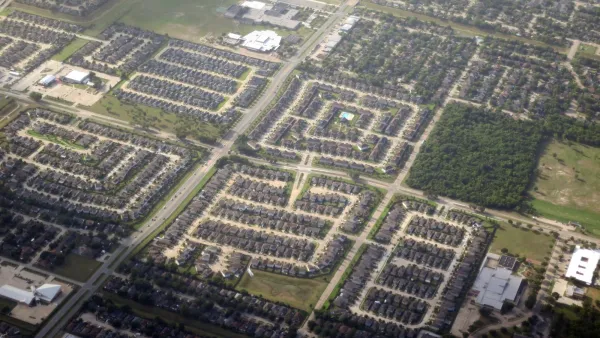
In a follow up to their 2014 study, Johns Hopkins has released new data on urban sprawl in the U.S. and new findings on its health and wellbeing impacts.


A new project led by researchers from the Johns Hopkins Bloomberg School of Public Health calculates sprawl scores for over 200 metropolitan areas, nearly 1000 urban counties and thousands of census tracts, providing an update to their 2014 study on the correlation between sprawl and quality-of-life outcomes.
Supported by the Center for Smart Transportation and the Bloomberg American Health Initiative, the index defines, measures, and evaluates urban sprawl in the U.S. by measuring development density, land use mix, population and employment centering, and street connectivity.
The study finds that sprawling residential living is linked to worse health outcomes, including higher rates of hospitalizations due to COPD and heart attacks; high rates of residential energy burden, increased rates of disconnected youth and social connections and even higher risks of Lyme disease infection. Unsurprisingly, the analysis found that less sprawling areas provide health benefits and offset living costs compared to areas that are more sprawling.
View the study's full metropolitan sprawl rankings, as well as interactive maps, data and the full report at the link below.
FULL STORY: Who Sprawls the Most?


Wildfires are coming for America’s suburbs
Buying land in between paved cities and forests has become increasingly popular, but those same areas are naturally fire prone.

Arizona Tapping Groundwater to Fuel Suburban Growth
Critics say Arizona’s growth patterns are unsustainable and dangerous, given the depleted Colorado River and the state’s deepening reliance on groundwater.
How to Fix Racist Housing Policies: Sue the Suburbs
Strengthening U.S. Department of Housing and Urban Development's civil rights enforcement could send a powerful signal to communities resistant to changing discriminatory housing rules.

Planetizen Federal Action Tracker
A weekly monitor of how Trump’s orders and actions are impacting planners and planning in America.

The state-sanctioned urbicide of Austin
People don’t kill cities. Freeways do.

US to reduce Colorado River water deliveries to Mexico
A new Colorado Treaty amendment reduces Mexico’s Colorado River water allocation by 250,000 acre feet.

Mamdani overhauls NYC's Vision Zero plan with 100 new policy goals
The overhaul aims to reduce traffic deaths and make streets safer for pedestrians, cyclists and drivers through lower speed limits, new safety infrastructure and more.

Amtrak not solely to blame for New Jersey commuter rail's unreliability, report finds
A new study from the Garden State Initiative found that NJ Transit’s budget grew 20% across a 4 year period, but reliability declined significantly over the same period.

EPA erases limits on planet-warming pollution from power plants
Under Monday’s plan, power plants would still have some limits on how much mercury, arsenic and other contaminants they can emit.

FREE Course: Walkable City 1: Why Walkability?
After describing his path towards focusing on walkability as the essence of good planning, Jeff Speck marches through his five principal reasons for making more walkable places.
Reinventing Malls: Planning Alchemy—Turning Gray Fields Into Gold
The course focuses on the opportunities and imperatives that shape reinvention of mall sites.

Eagle County Government
Harvard University Graduate School of Design
Nashville Planning Department
The Architects Foundation
University of Cincinnati Online
The Pocatello Development Authority
The Urban Renewal Agency of the City of Pocatello
Journal of the American Planning Association