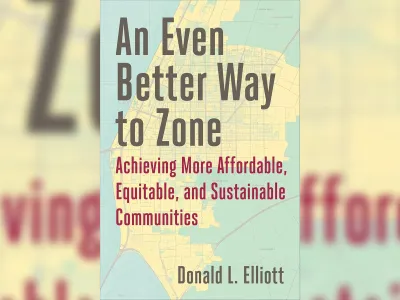
Don Elliot’s sophisticated and much-anticipated follow up to "A Better Way to Zone" tackles equity, affordability and provides a better blueprint from theory to application.



This review is part of a special collaboration between Planetizen and Booked on Planning, a biweekly podcast where AICP planners Stephanie Rouse and Jennifer Hiatt chat with authors of the latest books shaping urban planning today. Listen to the episode with today’s author in the player below.
In “An Even Better Way to Zone,” Donald Elliott provides a much-needed update to his first book, “A Better Way to Zone” (2008), offering a sophisticated yet accessible framework for modern land-use regulation. In the first book, Elliott laid the groundwork for better zoning by critiquing traditional Euclidean zoning. This follow-up book refines those arguments into actionable strategies for modern application, focusing on redevelopment and infill development.
The primary difference in this latest book lies in its ability to shift from theory to application, reflecting his 20 years of experience working with communities to rewrite their zoning codes. Where his first book focused heavily on the problems with rigid, use-based zoning, "An Even Better Way to Zone" focuses on solutions to everyday development challenges. It moves past the form-based vs. use-based debates and advocates for a hybrid, "effective" zoning approach that prioritizes community outcomes.
Elliott’s writing remains refreshingly pragmatic. He acknowledges that zoning is often treated as a "set it and forget it" tool, but he argues for a more readily responsive regulatory system. He frames zoning as a governance system, not a wish list, emphasizing that it defines legal rights to use property and therefore needs to anticipate ongoing change, especially in built-out places. One way to achieve this is through administrative flexibility for redevelopment such as allowing staff to approve small, justified deviations to standards like setbacks or parking for constrained sites.
As the subtitle suggests, Elliott expands significantly on how zoning can either hinder or help the housing crisis, providing nuanced examples. He also addresses zoning’s exclusionary roots and how to use a tool "designed to exclude" to create more inclusive outcomes. Last, he integrates environmental sustainability as a core pillar of modern zoning, reflecting how far the zoning conversation has moved since publishing his first book.
The book is written for those on the front lines of zoning who need to balance legal defensibility with creative community design. If Elliott’s first book was a wake-up call to the industry, "An Even Better Way to Zone" is the blueprint for modern redevelopment and infill. It is a testament to Elliott’s ability to listen to all sides of the development world and use his experience to address the needs of changing cities.

The Bittersweet Path to the Housing Crisis — and how to Find our way Home
Book Review: In “Bittersweet Lane: Creating Home(s) in the American Affordable Housing Crisis,” affordable housing developer Jamie Madden blends memoir with a manifesto for a new era of affordable housing in America.

Zoning for Good
A new book highlights the power of zoning to change communities for the better.
Want to Know More About Zoning? Consider These Reading Suggestions
For those of us who could stand to learn more about zoning, Nolan Gray gives us a list of suggested reading material for the beginner on up.

Planetizen Federal Action Tracker
A weekly monitor of how Trump’s orders and actions are impacting planners and planning in America.

Amtrak, CN end decades-long dispute with eight-year agreement
The new operating agreement establishes an updated framework for the companies to work together, including processes to resolve disputes.

Judges permit Denver to divert 77,000 acre feet from the Colorado River for reservoir expansion
Overuse and climate change have caused the Colorado River’s water levels to plummet.

NYC DOT wants faster, more permanent street upgrades
The city is examining ways to build more concrete infrastructure without getting entangled in 'decades-long' projects.

'Something we’ve never seen before:' rising utility rates could strain city finances nationwide
Data centers, climate change and other factors have caused utility rates in the United States to increase by 38% since 2020.

Trump to overrule local leaders, lease millions of acres of America’s Pacific Island territories’ seafloors to mining companies
International law says that the Indigenous people of America’s territories have a right to prior and informed consent regarding projects that impact their countries.

FREE Course: Walkable City 1: Why Walkability?
After describing his path towards focusing on walkability as the essence of good planning, Jeff Speck marches through his five principal reasons for making more walkable places.
Reinventing Malls: Planning Alchemy—Turning Gray Fields Into Gold
The course focuses on the opportunities and imperatives that shape reinvention of mall sites.

KFH Group Inc.
Greater Baltimore Committee
Eagle County Government
The Architects Foundation
University of Cincinnati Online
The Pocatello Development Authority
The Urban Renewal Agency of the City of Pocatello

