The self-driving cars of the AI world open a trove of opportunities for planners — and a whole new set of challenges to overcome.




This article is part of an ongoing column on AI and planning by urban planning professor and AI expert, Tom Sanchez. Learn more about Tom and read more installments of his column.
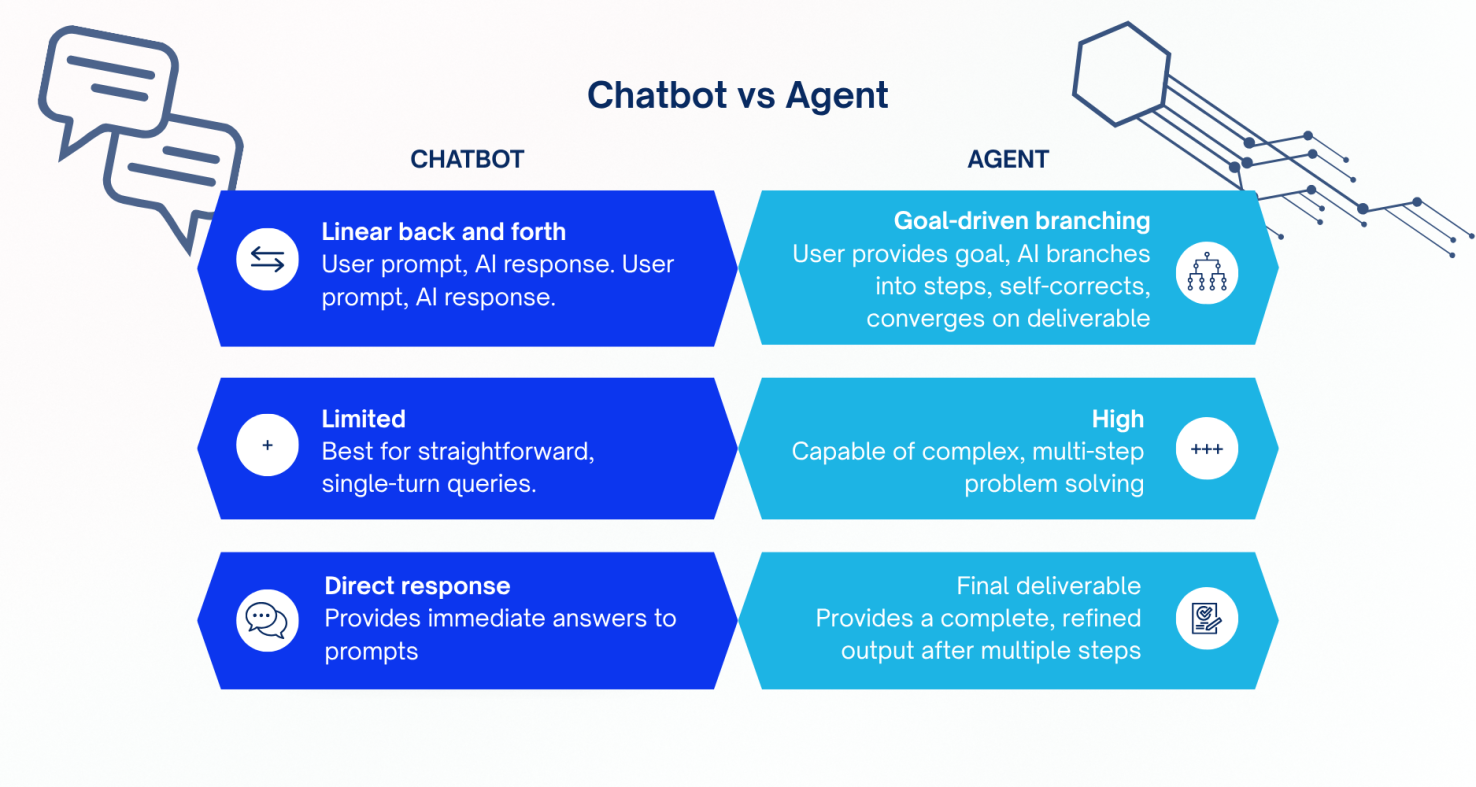
If you’ve been following this column, you already know some of the basics: AI can classify images, forecast demand, summarize documents, and generate text. Those capabilities come from models, the neural networks and large language models (LLMs) discussed in previous installments. A model on its own responds to a single prompt and stops. It can handle a complex, multi-part prompt and produce a long, detailed answer, but each exchange is one-and-done: the model waits for the next prompt before doing anything else. An agent, by contrast, can take an initial goal and keep working, breaking it into steps, deciding what to do next, and continuing until the task is complete.
What if, instead, you could give AI a goal and let it figure out how to get there, deciding what steps to take, what tools to use, and when to ask for help? That is the idea behind AI agents. I think it is a very significant shift in how AI gets used in practice and, in our case, planning.
From chatbot to coworker
Many people who have experimented with AI have used it in what you might call a "call-and-response" pattern. You type a prompt, the model generates output, and then you decide what to do next. Even though today's chatbots can search the web, reference earlier conversations, and use other built-in tools, the basic rhythm is still the same: you ask, it answers, and it waits for your next move. The model does not independently go off to conduct research, open a spreadsheet, or send an email on its own initiative. It might be very capable within that exchange, but the forward motion depends on you.
An AI agent is different. Instead of responding to a single prompt, an agent is given an objective, and then it can execute a series of steps to accomplish it. It can break a complex task into subtasks, determine which tools or data sources to use, evaluate its own progress, and adjust course if something doesn't work. Think of the difference between a GPS app and a self-driving car. The GPS gives you a route when you ask for one, but you still have to steer, brake, merge, and react to whatever comes up along the way. A self-driving car takes the destination as the instruction and handles the rest, adjusting to traffic, detours, and road conditions as it goes. A traditional chatbot is like the GPS. An agent is like a self-driving car.
What makes an agent an agent?
As far as I can tell, there is no single standard definition yet, but most AI agents share a few key features that set them apart from regular chatbots or models. First, they have a reasoning loop. Rather than generating a response all at once, the agent thinks through what it needs to do, takes an action, observes the result, and then decides what to do next. This loop can repeat many times before the agent delivers a final output.
Second, agents can use both tools and skills. Tools are the capabilities an agent can call on, like searching the web, reading a PDF, querying a database, designing a spreadsheet, writing and running code, or interacting with other software — chatbots and models can do this too. Skills, however, are the know-how that tells an agent when and how to use those tools, what sequence of steps to follow for a particular kind of task, and what a good result looks like. A tool without a skill is like handing someone a GIS package without any training in spatial analysis. They will have the software, but not the judgment to use it well. Together, tools and skills mean the agent is not limited to what it already knows. It can find information, run calculations, and work with the data being generated, and it has guidance on how to do the work competently.
Third, agents have some degree of autonomy. You give them a goal, and they determine how to achieve it without you directing every step. That autonomy can range from modest (the agent asks for your approval along the way) to substantial (the agent completes the entire task and presents a finished product).

To make this more concrete, imagine you are a planner preparing a staff report on housing permit trends for a planning commission or city council meeting. Usually, that might involve pulling data from your permit database, accessing census data, building a few tables and charts, writing a narrative summary, and formatting it all into a memo. Each of those steps requires you to move between different software tools and make judgment calls along the way.
Now imagine giving that task to an AI agent. You could say: 'Analyze housing permit activity for the last five years, compare it to population and household growth from ACS data, identify the top three trends, and draft a two-page staff memo with charts.' The agent would then plan its approach, pull the permit data, retrieve and process the census tables, generate charts, write the narrative, and assemble the memo. At each step, it evaluates whether the result looks right before moving to the next one. You review the final product and make edits using your professional judgment, but the agent handled the assembly work.
This is a big advance. Tools that work roughly this way already exist in platforms like ChatGPT, Claude, and Microsoft Copilot, though they are still relatively new and improving.
Where agents could show up in planning
Beyond report preparation, agents could be used in several areas that planners deal with regularly. In development review, an agent could read a submitted site plan, check it against the relevant zoning code sections, flag potential issues, and draft initial review comments. In comprehensive planning, an agent could be assigned to scan public comments from an engagement platform, group them by theme, and produce a summary with representative quotes. For environmental review, an agent might gather data from multiple federal and state databases, cross-reference it with a project site boundary, and draft a constraints memo.
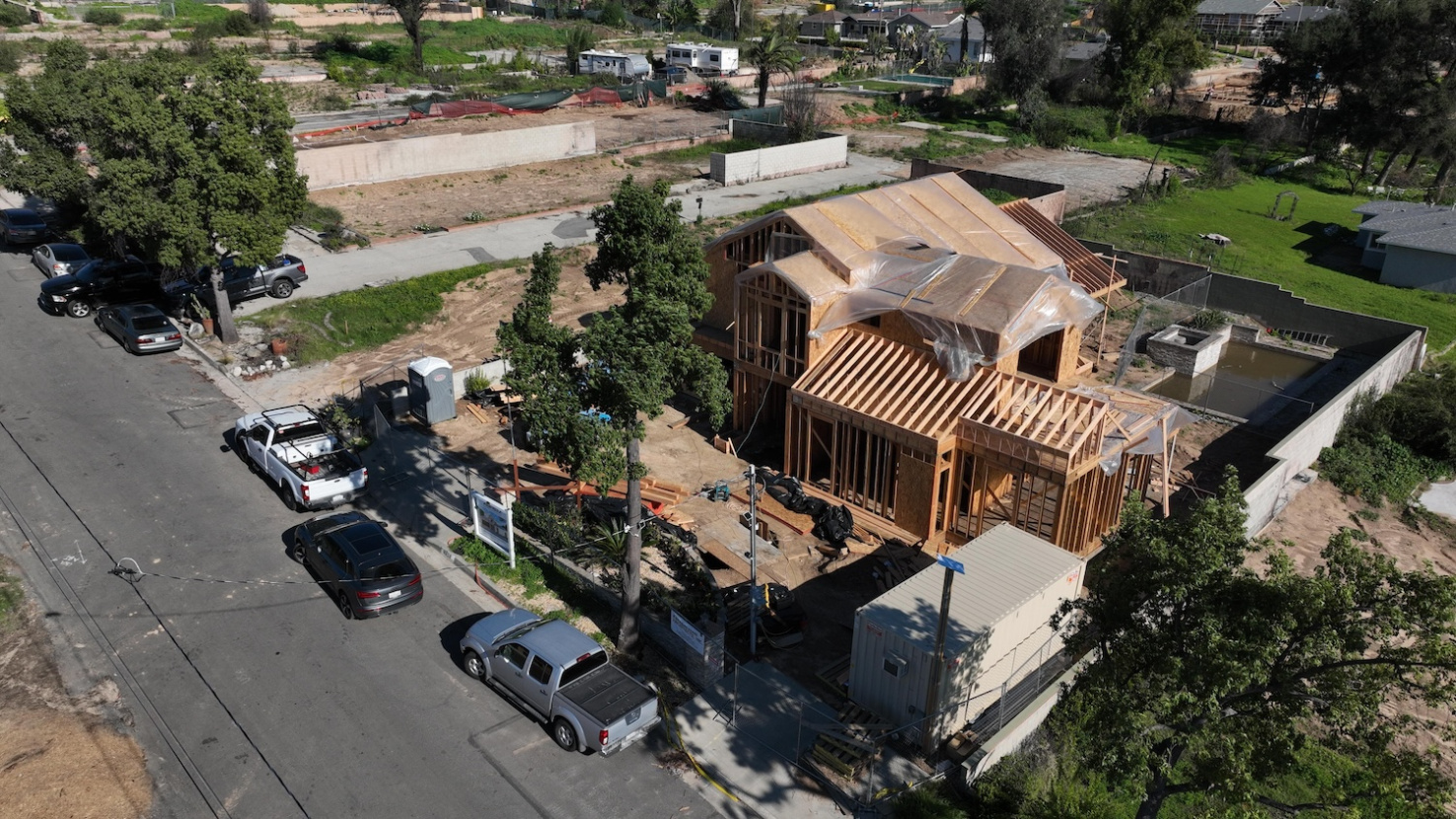
This is already happening. Cities like Austin, Honolulu, and Los Angeles are using AI tools from companies like Archistar that scan building plans against local zoning and building codes and produce compliance reports in hours instead of months. In Los Angeles, the technology was deployed to accelerate rebuilding permits after the wildfires. Just recently, on Ezra Klein's podcast with Jack Clark of Anthropic, Klein mentioned AI being used for municipal development review. This caught me by surprise since planning applications aren’t typically part of the larger AI discussion.
In each case, the value of an agent depends on the decision-making authority we grant it. At one end of the spectrum, an agent handles the time-consuming work of gathering data, cross-referencing sources, and drafting materials. At the same time, the planner retains full responsibility for interpretation and judgment. At the other end, an agent could take on more of the analytical and decision-making work itself, with the planner reviewing outputs rather than shaping them. Where we draw that line is a choice, and it is one of the more important questions the profession will need to work through. At least for now, the most defensible position is probably to let agents handle the groundwork so planners can focus on interpretation, community context, and the judgment calls the public depends on us to make. But this boundary will likely keep shifting as the technology matures, and planners should be part of deciding this rather than having it decided for them.
What planners should be cautious about
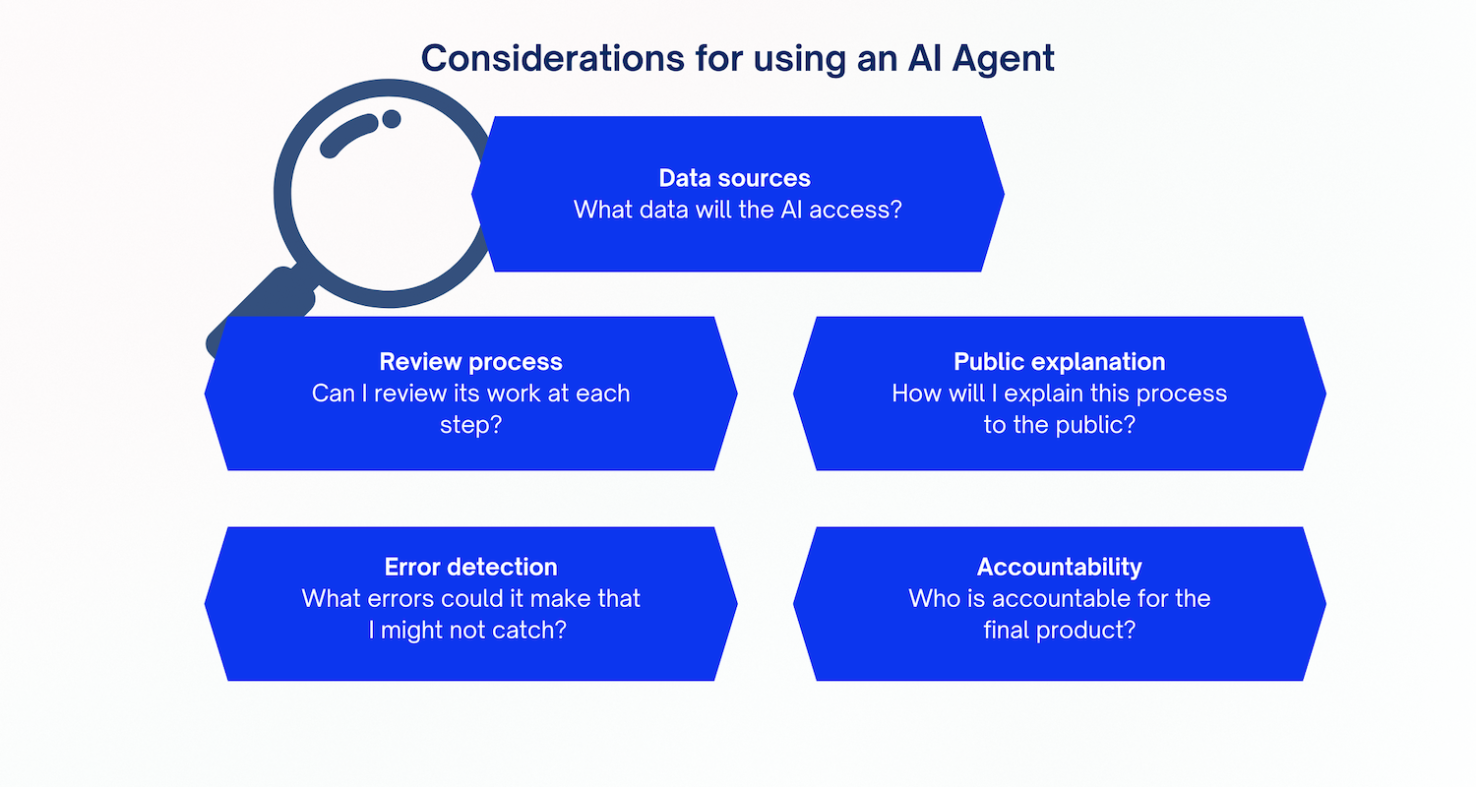
Agents also raise some questions that our profession needs to think through. The first is accountability. If an agent pulls data from the wrong source or makes an error in its analysis, who is responsible? The answer, at least for now, is the planner and the agency. That means we cannot simply hand tasks to an agent and trust the output without review. Human oversight isn’t an option because AI can make mistakes.
The second concern is transparency. Planning decisions need to be explainable to the public. If a staff report or analysis was substantially produced by an AI agent, how do we disclose that? How do we ensure that community members and stakeholders can understand and challenge the process? It is worth noting that agentic systems actually offer an advantage here compared to a single call to an LLM. The underlying model may seem like a black box, but the agent's workflow can be logged step by step, capturing the decisions made, the tools used, the data retrieved, and why the agent moved from one step to the next. That record creates a traceable path that planners and the public can review after the fact. The harder questions are related to governance. What gets logged, who has access to those logs, how long they are retained, and what level of detail is shared in public-facing materials are all choices that planning agencies will need to make. The technical capacity for transparency is there.
Third, there is the question of bias. Like all AI, agents inherit the limitations of the models and data they work with. If an agent is pulling from datasets that undercount certain populations or reflect historical patterns of disinvestment, it will carry those biases forward into its analysis. This is one of the problems that skills are starting to address by giving agents direct planning knowledge about what to watch for, which sources are more reliable for which questions, and how to flag uncertainty in the data. That kind of guidance can substantially address the bias, but it is unlikely to eliminate it. Planners need to be the ones who catch what slips through. We know the history of our datasets, which communities have been systematically underrepresented, and where the official numbers diverge from what people actually experience. That knowledge is part of professional practice, and it is exactly the kind of contextual judgment that an agent, no matter how well designed, will not fully replicate.
The bottom line
AI agents are emerging from the chatbot-style AI that many planners have used so far. Instead of answering one question at a time, agents can work through multistep tasks with real tools and real data. That makes them potentially very useful for the kinds of complex, data-intensive work that planners do. But this also means the stakes are potentially higher. An agent that works unsupervised with bad data or flawed logic can produce polished-looking results that could be quite wrong.
As with every other AI application I have discussed in this column, the technology is only as good as the judgment behind it. Most planners do not need to build agents or understand their code. But we do need to understand what they can and cannot do, and which questions to ask before we rely on them. The agents are here. The question, as always, is whether we will shape how they are used or let someone else make those decisions for us.
—
I want to thank my colleague, Dr. Xinyu Fu, for his terrific comments and suggestions. He is a leading expert on AI for urban planning.
As always, I invite you to share your own experiences, questions, and feedback. Send me a note or leave a comment in the comment section below. I’d like to hear how you got started.
If you have a question that you would like answered, please email [email protected] with "AI question for Tom Sanchez" in the subject line. Let’s learn together how to put AI to work in ways that truly serve our communities.

5 ways to hallucination-proof your AI output
With public trust on the line, the stakes are high for urban planners to ensure accuracy in our AI work. Here’s how to do it.

A planner's guide to AI prompting: Getting from vague to valuable
What you ask AI matters as much as which AI you use. Understanding effective prompt engineering can help you ask better questions.

Getting started with AI, part 2: What some planners are actually saying
Five practicing planners offer their advice for diving — cautiously — into using AI in their day-to-day work.

Desperate measures: Advocates weigh draining Lake Powell to fill Colorado River
Draining the reservoir could reduce evaporation losses by a couple hundred thousand acre-feet.

Eastern Nebraska is running out of electricity
Data centers and electrification are straining eastern Nebraska’s grid, throttling economic development.

Malls are becoming the midtowns of the future
Mall and office park redevelopments are a generational opportunity to create new nodes of urbanity.

NYC breaks ground on anti-flooding infrastructure project
New York City's new system will reduce stormwater flows to local sewers by 90%.

One Kentucky town’s secret to affordable housing
The Smoketown Community Land Trust has already built seven affordable homes for community members.

Houston gains petal-shaped cooling infrastructure to make streets more ‘delightful’
The city has installed the pavilions along 15 blocks in Houston.

FREE Course: Walkable City 1: Why Walkability?
After describing his path towards focusing on walkability as the essence of good planning, Jeff Speck marches through his five principal reasons for making more walkable places.
Reinventing Malls: Planning Alchemy—Turning Gray Fields Into Gold
The course focuses on the opportunities and imperatives that shape reinvention of mall sites.

City of Rosemead
Rutgers University, Edward J. Bloustein School of Planning and Public Policy
One Hundred Miles
University of Michigan School for Environment and Sustainability (SEAS)
Hunter College, City University of New York (CUNY)
The Architects Foundation
City of Cambridge
Montrose County
The Pocatello Development Authority

