U.S. cities struggle to keep streets and sidewalks clean. Some are turning to high-tech trash cans to help.


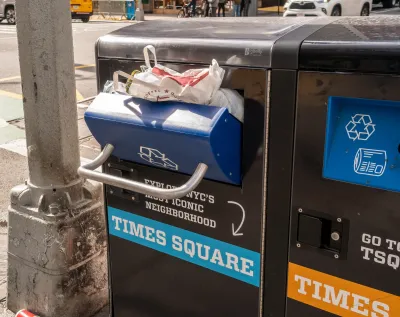
“Why are public trash cans so complicated and expensive?” Mark Dent attempts to answer this question in The Hustle, explaining the different approaches cities in the U.S. and around the world are taking to reduce urban litter.
In some places, like Tokyo and San Francisco during Gavin Newsom’s mayoral administration, cities decided to remove trash cans to discourage illegal dumping. In other places, removing trash cans led to more litter. Washington, D.C. has the most trash cans per resident of any U.S. city and is often considered one of the cleanest.
Dent also notes the high cost of some trash cans, which can cost upwards of $2,000 each and can be designed to be rummage-proof, set off alerts when full, compact trash, and be durable in an urban environment. But while pricier designs can improve function, they sometimes don’t bring the cost savings a city hopes for. Tacoma, Washington ended its experiment with smart trash cans in favor or more affordable non-compacting models. “Ultimately, we moved away from solar compaction because the math simply didn't add up for our specific needs,” said a city spokesperson. In Philadelphia, a former sanitation worker who started his own company used grant funding to install inexpensive trash cans that are emptied twice a week in a North Philadelphia neighborhood lacking enough facilities and hopes to expand the program.
FULL STORY: Why American cities pay over $3,000 for one trash can

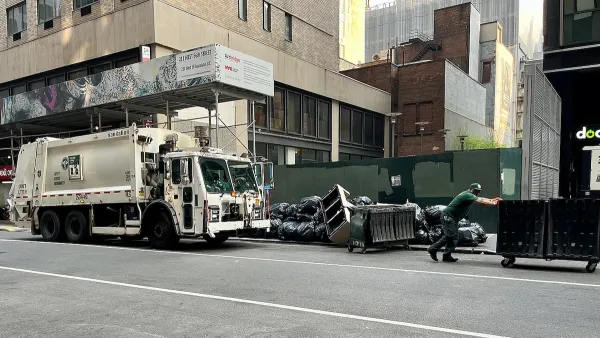
Parked Cars Hamper NYC Trash Containerization Effort
Sanitation workers must manually collect bags from containers blocked by parked cars, slowing a process that is meant to be safer and more efficient.
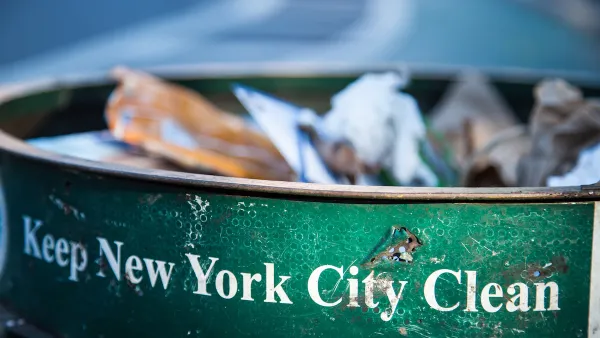
New York to Cut Sidewalk Trash Service by 40 Percent
Budget cuts will force the Department of Sanitation to cut sidewalk trash collection by nearly half.
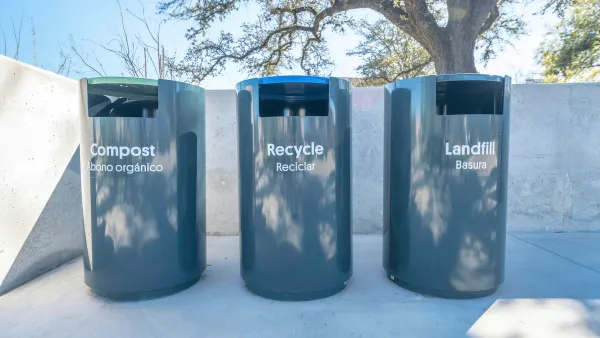
Austin Reveals New Zero Waste Plan
The city aims to eliminate the majority of landfill waste by 2040.

The state-sanctioned urbicide of Austin
People don’t kill cities. Freeways do.

US to reduce Colorado River water deliveries to Mexico
A new Colorado Treaty amendment reduces Mexico’s Colorado River water allocation by 250,000 acre feet.

New Jersey’s second-largest city bans standalone data centers
Jersey City will continue to allow co-location facilities, such as those meant for research institutions that store their own data.

Amtrak not solely to blame for New Jersey commuter rail's unreliability, report finds
A new study from the Garden State Initiative found that NJ Transit’s budget grew 20% across a 4 year period, but reliability declined significantly over the same period.

EPA erases limits on planet-warming pollution from power plants
Under Monday’s plan, power plants would still have some limits on how much mercury, arsenic and other contaminants they can emit.

Phoenix announces new on-demand transit service, more frequent RAPID buses
Both new services will launch in October, and are part of Phoenix's Project Effective Access Solutions for Easing Congestion.

FREE Course: Walkable City 1: Why Walkability?
After describing his path towards focusing on walkability as the essence of good planning, Jeff Speck marches through his five principal reasons for making more walkable places.
Reinventing Malls: Planning Alchemy—Turning Gray Fields Into Gold
The course focuses on the opportunities and imperatives that shape reinvention of mall sites.

Eagle County Government
Harvard University Graduate School of Design
Nashville Planning Department
The Architects Foundation
University of Cincinnati Online
The Pocatello Development Authority
The Urban Renewal Agency of the City of Pocatello
Journal of the American Planning Association