Just 1.4 percent of housing in the affluent enclave of Woodbridge qualifies as affordable.


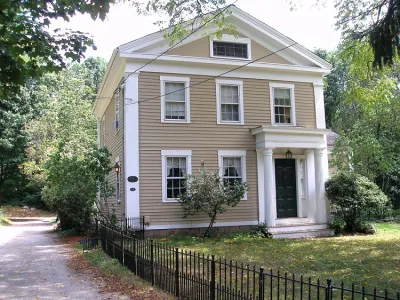
Woodbridge, Connecticut recently approved a 96-unit apartment building, a move challenged by some of the tiny, affluent town’s residents, who say the four-story building would strain local infrastructure, bring too much traffic to the adjacent street, and threaten a local nature preserve.
According to reporting from the Hartford Courant Staff, “Woodbridge, an affluent suburb, was already embroiled in a potentially landmark affordable housing lawsuit when it made the decision on the 804 Fountain St. site. Twelve of the units will be for lower-than-average-income tenants.” The lawsuit in question alleges that the city has repeatedly blocked efforts to build affordable housing.
State law gives significant leeway to housing proposals in areas where less than 10 percent of housing is deemed affordable. In Woodbridge, just 1.4 percent of housing qualifies as such. The Democratic Town Committee said the town’s restrictive zoning policies brought on the flurry of proposals filed under the 8-30g state law, noting in a statement, “When towns don’t increase affordable housing, the state steps in. That’s exactly what 8-30g was designed to do, override local zoning and force towns to act. Responsible planning is how we protect Woodbridge.”
Read the full story: https://www.courant.com/2026/01/02/tiny-affluent-ct-town-approves-controversial-large-apartment-building-some-dubbed-affordable/


California Gives 15 Cities ‘Final Warning’ to Submit Mandatory Housing Plans
Communities are required to produce housing elements that accommodate sufficient housing for all income levels.
‘Montana Miracle:’ The State Actually Succeeding at Housing Reform
A series of ambitious zoning reforms is having a significant impact on the state’s housing supply.

Controversial Texas housing law has 'directly facilitated' over 1,250 new homes
SB 840 allows developers to build multifamily housing by-right on lots zoned for commercial use without applying to a zoning change.

Planetizen Federal Action Tracker
A weekly monitor of how Trump’s orders and actions are impacting planners and planning in America.

California plans to bury El Niño’s downpour
If the state plays its cards right, it may be able to store a billion acre-feet of El Niño’s water in aquifers.

Chicago breaks ground on $3 billion megadevelopment
The new neighborhood, titled Foundry Park, will one day host 3,700 residences.

California High-Speed Rail Authority CEO resigns after $600,000 scandal
Under Ian Choudri, the authority used taxpayer dollars to fund first class flights and trips to nightclubs.

Want to study the Missouri River? Soon, you may need unanimous approval from 10 states
Legislation would require 10 governors’ permission to study or build projects moving water outside the basin.

Desperate measures: Advocates weigh draining Lake Powell to fill Colorado River
Draining the reservoir could reduce evaporation losses by a couple hundred thousand acre-feet.

FREE Course: Walkable City 1: Why Walkability?
After describing his path towards focusing on walkability as the essence of good planning, Jeff Speck marches through his five principal reasons for making more walkable places.
Reinventing Malls: Planning Alchemy—Turning Gray Fields Into Gold
The course focuses on the opportunities and imperatives that shape reinvention of mall sites.


City of Rosemead
Rutgers University, Edward J. Bloustein School of Planning and Public Policy
One Hundred Miles
Hunter College, City University of New York (CUNY)
The Architects Foundation
University of Cincinnati Online
City of Cambridge
Montrose County
The Pocatello Development Authority