After a slow start, permitting is starting to pick up.


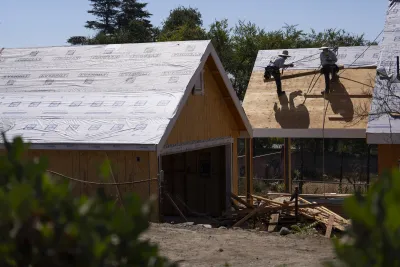
The rebuilding of homed destroyed in the January LA wildfires has had a slow start, but permitting rates picked up in December, according to reporting by Doug Smith, Jack Flemming and Colleen Shalby in the Los Angeles Times.
Around 12 to 13 percent of homes in Altadena and the Pacific Palisades have received rebuild permits, a rate roughly half that of Santa Rosa, another community significantly impacted by fire in recent years.
“Fire victims face significant obstacles: understaffing at city agencies, supply chain delays, insurance gaps, and a strained labor market slowing construction timelines,” the article explains. LA City is processing applications in 79 days on average, while LA County lags behind at 131 days. However, the authors note the county had applications for around 3,000 homes, while the city received applications for just over 1,400. “In total, the county had issued permits for 931 residences by Dec. 14 and the city 604.”
The city issued the first certificate of occupancy for a home in Pacific Palisades in early December, and an Altadena home received the first certificate in that area later that month.
FULL STORY: After a rocky start, rebuilding in the Palisades and Altadena is gaining momentum

What Housing Crisis?
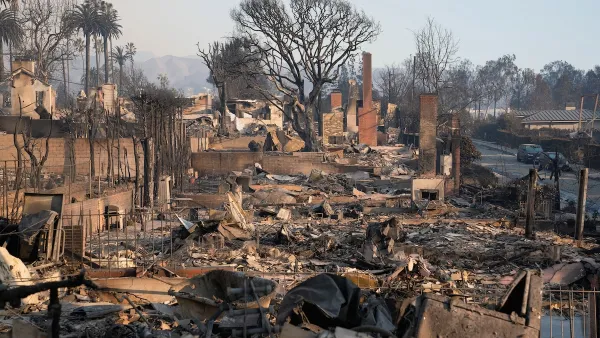
Los Angeles Mayor Karen Bass issued an executive order that prohibits the construction of duplexes, triplexes or fourplexes from replacing single-family-homes destroyed by the recent wildfires in Pacific Palisades, i.e., the suspension of SB 9.

UCLA Experts Offer Critical Support for LA Wildfire Response and Recovery
The UCLA Luskin Center for Innovation offers expert guidance on LA wildfire response and recovery, addressing critical issues like water safety, air quality, equitable rebuilding, and climate adaptation to promote resilience and sustainability.
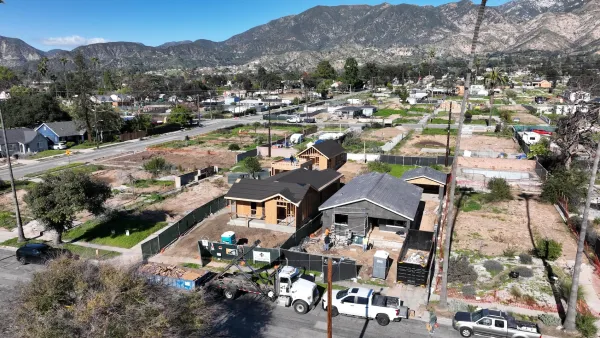
Almost 40% of LA fire survivors face a housing crisis
Many Angelenos who lost their homes in the Altadena and Pacific Palisades fires have already run out of temporary housing funds.

Planetizen Federal Action Tracker
A weekly monitor of how Trump’s orders and actions are impacting planners and planning in America.

The state-sanctioned urbicide of Austin
People don’t kill cities. Freeways do.

US to reduce Colorado River water deliveries to Mexico
A new Colorado Treaty amendment reduces Mexico’s Colorado River water allocation by 250,000 acre feet.

5 New England states march closer to 800 megawatt wind energy project
Securing federal approval for the project may be complicated under the Trump administration, which has historically been hostile towards domestic wind power.

Baltimore to break ground on $50 million Transit Priority Project
The project will bring faster bus trips, safer streets and better bike connections to Baltimore.

Airbnb launches $250 million 'last-dollar financing' housing accelerator, makes first investment in Austin
The company will put $6.4 million towards affordable housing development in Texas’ capital.

FREE Course: Walkable City 1: Why Walkability?
After describing his path towards focusing on walkability as the essence of good planning, Jeff Speck marches through his five principal reasons for making more walkable places.
Reinventing Malls: Planning Alchemy—Turning Gray Fields Into Gold
The course focuses on the opportunities and imperatives that shape reinvention of mall sites.

Eagle County Government
Harvard University Graduate School of Design
Nashville Planning Department
The Architects Foundation
University of Cincinnati Online
The Pocatello Development Authority
The Urban Renewal Agency of the City of Pocatello
Journal of the American Planning Association