An expansion of a federal tax credit is prompting for-profit developers to get into the affordable housing market.


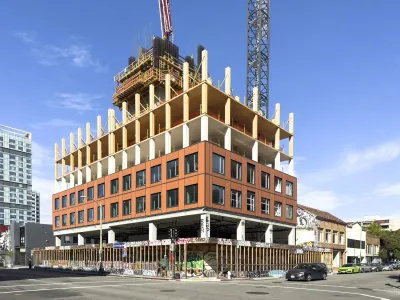
A San Francisco housing developer says his company has found a way to build affordable housing units for around $350,000 each, a fraction of the average cost of $1 million in the city.
As Laura Waxmann and J.K. Dineen explains in the San Francisco Chronicle, Danny Haber, CEO of oWOW, says a combination of efficient building practices and federal tax credits can drastically lower the cost of construction. “Haber’s team is breaking ground early next year on 284 affordable apartments in downtown Oakland, and is part of a growing group of market-rate builders suddenly charging into the affordable housing arena amid the financing crunch that has cooled private housing development.”
Haber is taking advantage of a recent expansion of the federal Low‑Income Housing Tax Credits. “The credit expansion is expected to primarily fuel construction aimed at the upper end of affordable housing often referred to as the “missing middle,” which requires less public funding and serves working-class renters.”
While for-profit developers may be able to build housing without the stack of public financing that often trips up nonprofit builders, there are questions about whether projects like Haber’s will remain affordable after the 10-year tax credit expires or whether they’ll serve the neediest households.
FULL STORY: It costs $1M to build an S.F. affordable housing unit. How developers say they can do it for $350K


As prices skyrocket, San Francisco Mayor declares rent emergency
Landlords in San Francisco have initiated over 2,400 evictions since January, putting the city on track to see more evictions this year than during any year in the past decade.

San Francisco Mayor’s ‘Family Zoning’ Plan Faces Pushback, Displacement Concerns
Newly proposed legislation aims to protect long-term tenants from displacement caused by Mayor Lurie’s proposed zoning reform plan, which would allow for more housing construction in parts of the city.

A San Francisco University Just Built Over 650 Affordable Units. Are Institutions the Answer to the Housing Crisis?
With access to planning resources not always available to private developers, universities are uniquely positioned to build housing quickly and cost-effectively.

Planetizen Federal Action Tracker
A weekly monitor of how Trump’s orders and actions are impacting planners and planning in America.

The state-sanctioned urbicide of Austin
People don’t kill cities. Freeways do.

US to reduce Colorado River water deliveries to Mexico
A new Colorado Treaty amendment reduces Mexico’s Colorado River water allocation by 250,000 acre feet.

Mamdani overhauls NYC's Vision Zero plan with 100 new policy goals
The overhaul aims to reduce traffic deaths and make streets safer for pedestrians, cyclists and drivers through lower speed limits, new safety infrastructure and more.

Amtrak not solely to blame for New Jersey commuter rail's unreliability, report finds
A new study from the Garden State Initiative found that NJ Transit’s budget grew 20% across a 4 year period, but reliability declined significantly over the same period.

EPA erases limits on planet-warming pollution from power plants
Under Monday’s plan, power plants would still have some limits on how much mercury, arsenic and other contaminants they can emit.

FREE Course: Walkable City 1: Why Walkability?
After describing his path towards focusing on walkability as the essence of good planning, Jeff Speck marches through his five principal reasons for making more walkable places.
Reinventing Malls: Planning Alchemy—Turning Gray Fields Into Gold
The course focuses on the opportunities and imperatives that shape reinvention of mall sites.

Eagle County Government
Harvard University Graduate School of Design
Nashville Planning Department
The Architects Foundation
University of Cincinnati Online
The Pocatello Development Authority
The Urban Renewal Agency of the City of Pocatello
Journal of the American Planning Association