With access to planning resources not always available to private developers, universities are uniquely positioned to build housing quickly and cost-effectively.



A project known as Academic Village — a shared campus for multiple universities in the middle of San Francisco — offers “a powerful new approach to the city’s housing crisis,” according to an opinion piece by Rhiannon Ballard and Anders Carpenter in the San Francisco Chronicle.
The Academic Village demonstrates how anchor institutions — including universities, hospitals, major nonprofits and aligned employers — can work together to address housing needs without competing for limited real estate or displacing existing communities.
Institutions including UC College of the Law SF, UCSF, San Francisco State, private not-for-profit institutions and the California Community Colleges have collaborated to build affordable housing for students and staff on the site. One 656-unit building reserved for students and employees has 85 percent occupancy, while an additional 280 beds are scheduled to open by fall 2027.
“These new units are specifically designed to meet the unique needs of community college and undergraduate students, many of whom are already part of San Francisco’s workforce.” This includes dorm-style units to larger two- and three-bedroom units for families.
The authors explain why institutions like universities are uniquely positioned to build housing. For example, they have access to planning tools not available to private developers such as leave-revenue bonds and tax-exempt debt. “By pooling resources and aligning with state funding priorities, higher education institutions can act faster, absorb risk more effectively and deliver affordability at scale.”
The authors note that this model could be expanded beyond academic institutions to hospitals, cultural organizations, and childcare centers. City governments can offer tools to enable co-development and reward cross-sector collaboration with incentives.
FULL STORY: S.F. already has a tangible, replicable model to address its housing crisis

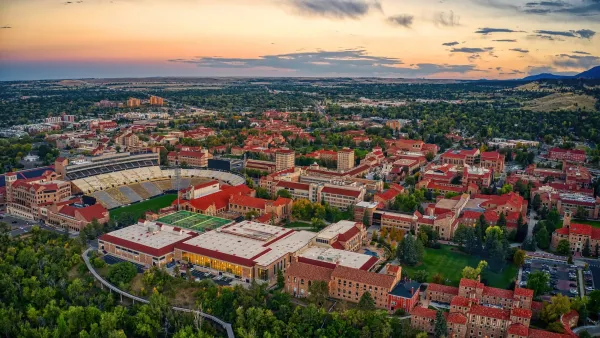
Colorado Law Lets Schools, Other Public Agencies Build Housing Regardless of Local Zoning
The law is modeled on a similar failed measure from last year that included fewer eligible organizations.

San Francisco Mayor’s ‘Family Zoning’ Plan Faces Pushback, Displacement Concerns
Newly proposed legislation aims to protect long-term tenants from displacement caused by Mayor Lurie’s proposed zoning reform plan, which would allow for more housing construction in parts of the city.

20,000 San Francisco Homes Stalled in Construction Pipeline
Despite getting permits as long as a decade ago, thousands of proposed housing units are still waiting to be built.

The state-sanctioned urbicide of Austin
People don’t kill cities. Freeways do.

US to reduce Colorado River water deliveries to Mexico
A new Colorado Treaty amendment reduces Mexico’s Colorado River water allocation by 250,000 acre feet.

New Jersey’s second-largest city bans standalone data centers
Jersey City will continue to allow co-location facilities, such as those meant for research institutions that store their own data.

Amtrak not solely to blame for New Jersey commuter rail's unreliability, report finds
A new study from the Garden State Initiative found that NJ Transit’s budget grew 20% across a 4 year period, but reliability declined significantly over the same period.

EPA erases limits on planet-warming pollution from power plants
Under Monday’s plan, power plants would still have some limits on how much mercury, arsenic and other contaminants they can emit.

Phoenix announces new on-demand transit service, more frequent RAPID buses
Both new services will launch in October, and are part of Phoenix's Project Effective Access Solutions for Easing Congestion.

FREE Course: Walkable City 1: Why Walkability?
After describing his path towards focusing on walkability as the essence of good planning, Jeff Speck marches through his five principal reasons for making more walkable places.
Reinventing Malls: Planning Alchemy—Turning Gray Fields Into Gold
The course focuses on the opportunities and imperatives that shape reinvention of mall sites.

Eagle County Government
Harvard University Graduate School of Design
Nashville Planning Department
The Architects Foundation
University of Cincinnati Online
The Pocatello Development Authority
The Urban Renewal Agency of the City of Pocatello
Journal of the American Planning Association