The housing crisis is hitting education workers particularly hard, making it difficult to find housing near their workplaces.


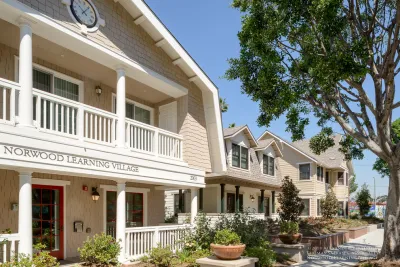
School districts across the nation are looking for ways to build workforce housing on their properties as part of an effort to attract and retain teachers, whose income often makes it difficult to find affordable housing near their workplaces.
According to a piece by Jeff Kruth and Tammy Schwartz in The Conversation, “California has been at the forefront of these efforts. The state’s school districts own more than 75,000 acres of potentially developable land. Meanwhile, more than one-third of the state’s public school employees are rent-burdened, meaning they spend more than 30% of their income on housing costs.” A 2016 state law creates a framework for developing housing on district-owned land and has been used to build educational housing complexes across the state.
Educational housing projects vary in financing and scope. Some offer reduced rent while others give school district employees the opportunity to buy homes. Some build new homes, while others have converted former motels and other buildings to workforce housing. “In Baltimore, more than 775 teachers have recently been housed thanks to initiatives such as the Union Mill project, an 86,000-square-foot historic building converted into teacher apartments that range in price from $700 to $1200 per month.”
Educational workforce housing has multiple benefits, putting teachers and staff closer to work and the community they serve. “Ultimately, teachers grounded in the life of the community can build relationships outside of the walls of school that contribute to more trust in the classroom.”

A South Dakota hospital is funding a new subdivision for its employees
Some employees see investing in housing as the only way to stem the loss of workers moving away due to high housing costs.
California 'strongly encourages' coastal city to fast-track farmworker housing
The state wants Half Moon Bay to approve a farmworker housing project initially proposed in 2022.
Charleston Creates ‘Workforce Housing District’ With Permanent Affordability
The city has a goal of adding 3,500 new housing units by 2032.

Planetizen Federal Action Tracker
A weekly monitor of how Trump’s orders and actions are impacting planners and planning in America.

The state-sanctioned urbicide of Austin
People don’t kill cities. Freeways do.

US to reduce Colorado River water deliveries to Mexico
A new Colorado Treaty amendment reduces Mexico’s Colorado River water allocation by 250,000 acre feet.

Mamdani overhauls NYC's Vision Zero plan with 100 new policy goals
The overhaul aims to reduce traffic deaths and make streets safer for pedestrians, cyclists and drivers through lower speed limits, new safety infrastructure and more.

Amtrak not solely to blame for New Jersey commuter rail's unreliability, report finds
A new study from the Garden State Initiative found that NJ Transit’s budget grew 20% across a 4 year period, but reliability declined significantly over the same period.

EPA erases limits on planet-warming pollution from power plants
Under Monday’s plan, power plants would still have some limits on how much mercury, arsenic and other contaminants they can emit.

FREE Course: Walkable City 1: Why Walkability?
After describing his path towards focusing on walkability as the essence of good planning, Jeff Speck marches through his five principal reasons for making more walkable places.
Reinventing Malls: Planning Alchemy—Turning Gray Fields Into Gold
The course focuses on the opportunities and imperatives that shape reinvention of mall sites.

Eagle County Government
Harvard University Graduate School of Design
Nashville Planning Department
The Architects Foundation
University of Cincinnati Online
The Pocatello Development Authority
The Urban Renewal Agency of the City of Pocatello
Journal of the American Planning Association