Political pushback against DEI is igniting right at the moment that AI is rising in urban planning. If we don’t fight it, the results could be catastrophic.




This article is part of an ongoing column on AI and planning by urban planner and AI expert, Tom Sanchez. Learn more about Tom and read more installments of his column. 
ALSO: Tom’s new book Artificial Intelligence for Urban Planning was recently published by Routledge. The book discusses how planners can effectively use AI in their daily practices, engage constructively with technical specialists, and critically assess the appropriateness of these technologies in different planning contexts. Check it out.
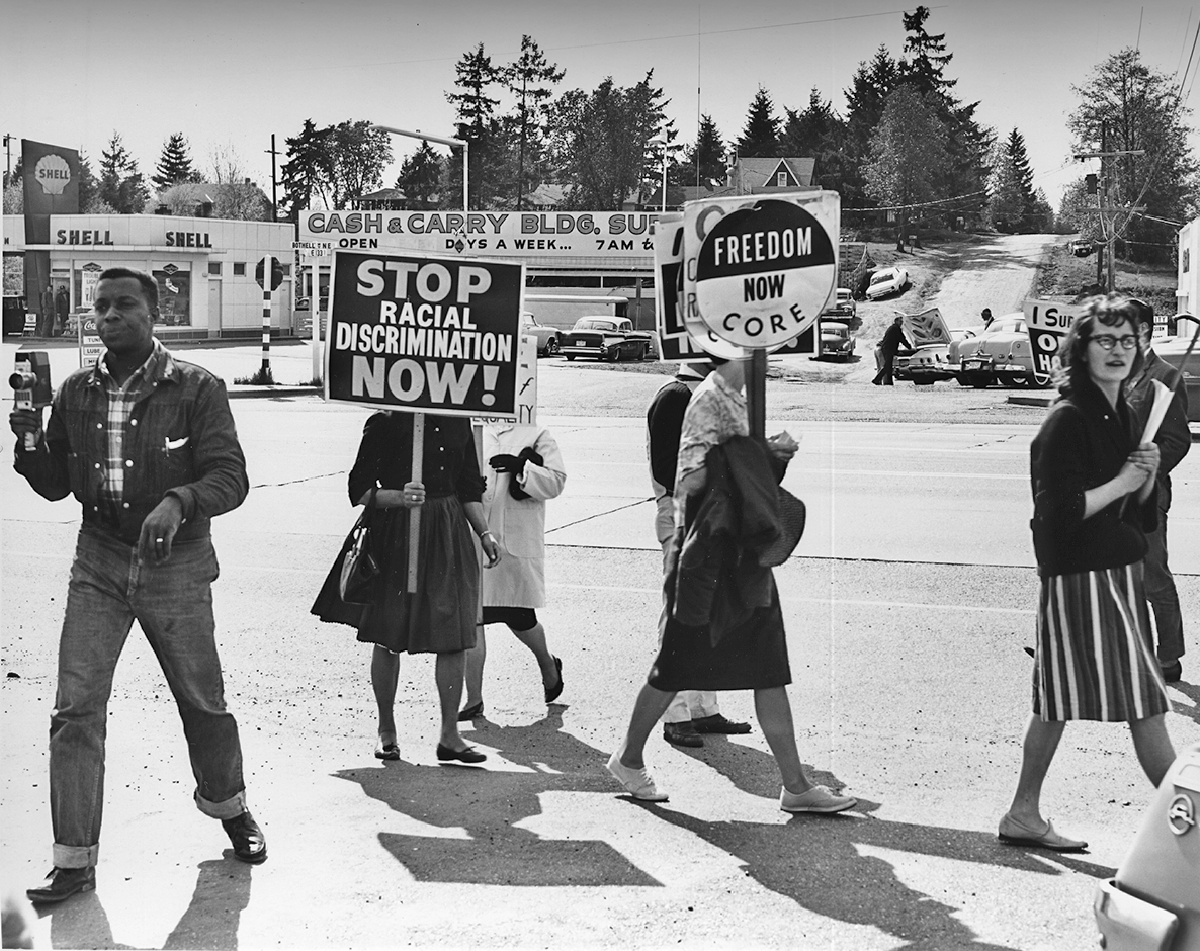
In the U.S., political winds are turning against diversity, equity, and inclusion (DEI) initiatives. Laws and policies now limit how race, gender, and class can be considered in universities, agencies, and even planning practice. Advocates say these measures protect “equal treatment.” The deeper danger is that they strip away the very tools planners need to see inequities and work to fix them.
This is particularly true when it comes to the use of AI. Without demographic data, planning powered by AI (as well as by humans) becomes less fair, less accurate, and more likely to harm vulnerable people rather than help them. This is not just an academic concern. Urban planning has always been tied to fairness and representation, and AI is now amplifying those stakes. Algorithms cannot see what they are not given. If demographic data is off the table, our supposedly “neutral” systems will churn out biased outputs cloaked in objectivity, and the consequences will be real.
Why demographic data matters for AI and planning
Planning depends on knowing who lives where, who needs what, and who is being left out. AI raises the stakes, since its outputs are only as good as the input data. Without detail on race, income, or gender, inequities vanish from view. Environmental racism is one of the clearest examples. Communities of color and low-income neighborhoods face disproportionate exposure to pollution, but without disaggregated data, those disparities disappear from maps and models. That erasure does not mean the harm goes away; it only makes it harder to address. The same applies to transit, housing, or flood protection. Vulnerability is not spread evenly. It falls hardest on women, low-income households, and marginalized groups. If demographic data is missing, so is the ability to prioritize solutions and act on those inequities.
Data is also what lets us track progress. Without a baseline, equity plans risk becoming photo-ops — policies that look good on paper but mostly reinforce advantages for groups already doing fine. Removing demographic variables does not remove bias either. Algorithms latch onto proxies, such as ZIP codes or property values, encoding inequities under a different guise. Accountability also depends on data. Civil rights protections, such as Title VI and the Fair Housing Act, assume that the government will measure the demographic impacts of its actions. Without demographic detail, agencies risk falling out of compliance with the very laws designed to ensure fairness.
The risks of missing data are especially acute when AI is involved. Models trained without sensitive attributes develop blind spots, unable to measure fairness or detect disparate impacts. That blindness can make inequities worse by creating the illusion of neutrality. Research shows that many fairness techniques actually require access to protected categories to compare outcomes. Without them, inequities may remain hidden beneath the surface, while outputs appear objective. The result can be misallocation of resources, with infrastructure funding flowing to neighborhoods that “look” needy by visible metrics like density or property value. At the same time, low-income or majority-minority communities remain underinvested.
And when communities see themselves erased from the data, trust erodes. A plan that looks efficient and rational to professionals can look exclusionary to residents who know their needs are not being counted. That perception gap undermines legitimacy, leaving planners less able to build the coalitions needed to implement solutions. Ignoring race, class, or gender also risks reinforcing historic harms. Planning has long been entangled with redlining, exclusionary zoning, and infrastructure projects that destroyed or divided marginalized neighborhoods. Portland, Oregon, still grapples with the legacy of restrictive covenants and exclusionary zoning that limited access to housing and services. If today’s planning models omit demographic context, they risk baking those inequities into the future rather than correcting them.
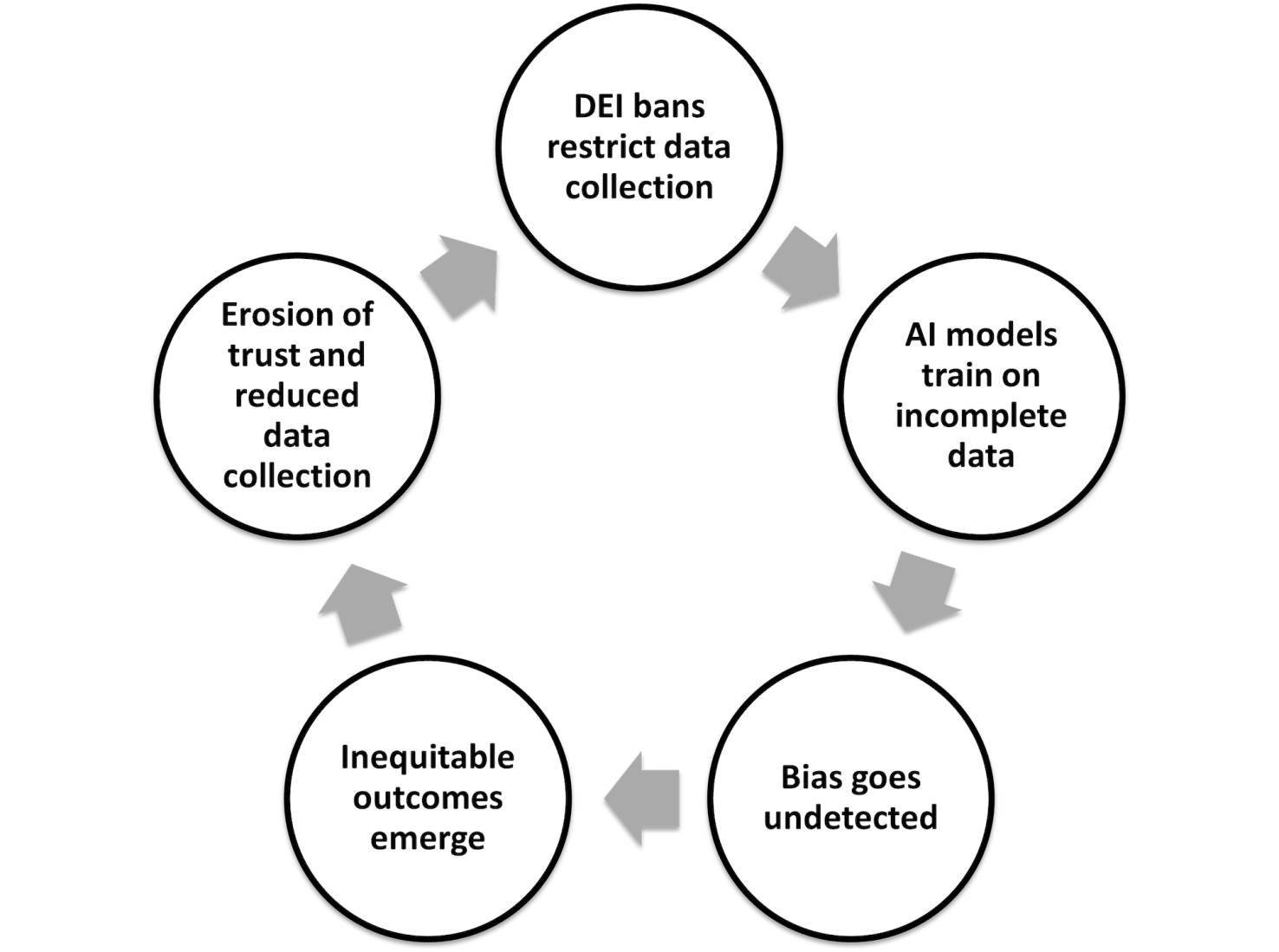
Bans on DEI programs make these risks worse. When universities or agencies lose DEI offices, as happened under Texas’s Senate Bill 17 (2023), they also lose the capacity to collect, analyze, and act on equity data. Staff expertise and training that once flagged inequities disappear, and a chilling effect spreads to research and teaching. Faculty and students steer away from work on race, gender, or class for fear of political or legal backlash, shrinking the knowledge base planners rely on. Agencies feel similar pressure. Even when it is legal to use demographic data, worries about lawsuits, funding, or scrutiny prompt self-censorship. With DEI programs gone, policymaking loses diverse voices, and decisions become narrower, less representative, and less legitimate.

These bans also distort how AI gets built and deployed. Agencies drift toward “colorblind” data practices that train models on incomplete or proxy-heavy datasets. When protected-class attributes and community context are excluded, it becomes far harder to run disparate impact tests, conduct algorithmic audits, or apply fairness constraints. Vendors face fewer expectations to disclose training data or evaluation results, and procurement teams lose the in-house expertise to ask the right questions. The result is predictable: systems that seem neutral while quietly reinforcing historical bias in routing, permitting, code enforcement, benefit eligibility, and disaster response. By undercutting the capacity to measure inequity, DEI bans make biased AI more likely and harder to detect or correct.
These issues are not abstract. They play out in daily urban life. A city using AI to design bus routes without demographic data may favor wealthy, dense areas that look profitable, while bypassing low-income riders who rely most on transit. Disaster planning shows similar blind spots. During the recent Altadena fires, patterns of evacuation and return underscored how income, housing stability, and access to vehicles shape who can leave quickly and who faces a longer path back. Without demographic detail, disaster models underestimate risk, and the communities least able to prepare or recover suffer the most. Environmental and health disparities follow the same pattern. Lead poisoning, failing water systems, and industrial pollution continue to fall disproportionately on communities of color, yet without demographic overlays, monitoring systems may miss them entirely. Housing and displacement pressures also intensify when data is missing. Inclusionary zoning and anti-displacement protections depend on knowing who is being pushed out, and without that knowledge, protections lose their precision. Gender differences are erased even more easily. Women, transgender, and nonbinary people face distinct challenges around safety, mobility, and access, such as reliable lighting or services during nonstandard hours. If gender data is absent, those needs vanish from the planning agenda.
Censoring demographic data not only weakens planning; it also collides with laws, privacy, and ethics. Civil rights protections all assume governments will track demographic impacts. Remove the data, and policy risks drift out of alignment with the law. Privacy concerns are legitimate, but they are often exaggerated or weaponized to justify blanket bans. Tools already exist to use sensitive data responsibly. Anonymization, differential privacy, secure data-sharing, and community oversight can reduce risks while allowing for meaningful analysis. The real question is not whether we can protect individuals but whether we choose to. Restrictions also chill speech and inquiry. When the use of demographic data is framed as politically suspect, academic research, professional practice, and civic dialogue all contract. Communities lose the chance to question, debate, and co-create. Ethics offers the clearest bottom line: fairness requires visibility. Harms that are not measured do not disappear; they simply go unaddressed. Choosing not to collect demographic data is not neutral — it is a decision to look the other way.
Using sensitive data responsibly and legally
Avoiding these harms requires strong safeguards. First, we need strong data governance frameworks that emphasize transparency, privacy, consent, and oversight. Techniques such as anonymization and aggregation can protect individuals while enabling equity analysis. Second, laws should explicitly permit the collection of demographic data for planning, monitoring, and evaluation. DEI programs that rely on this data must be protected from political and legal threats.
Third, communities should help shape what data is collected, how it is used, and how outcomes are interpreted. Categories like race, class, and gender have different meanings in different contexts, and communities should help define them. Fourth, DEI programs must be clear and accountable. They do not have to mean quotas. They can mean inclusive engagement, equity impact assessments, diverse staffing, and measurable benchmarks. Finally, institutions need resilience. Agencies and universities should maintain their capacity for equity, even in hostile political climates, and transparency about how AI models and demographic data are used is crucial for building trust.
The backlash against DEI and demographic data is not just another culture-war skirmish. It strikes at the foundation of urban planning itself. Planning has always been about seeing communities as they are and imagining how they could be better. Take away the ability to see race, class, or gender, and planning does not become “color-blind.” It becomes blind, and that blindness falls hardest on those who can least afford it. If we are serious about building just and equitable cities, demographic data and DEI are not optional. They are essential. The future of AI in planning depends on whether we allow our tools to see the full picture or force them to look away.


5 ways to hallucination-proof your AI output
With public trust on the line, the stakes are high for urban planners to ensure accuracy in our AI work. Here’s how to do it.

AI agents: What urban planners should know
The self-driving cars of the AI world open a trove of opportunities for planners — and a whole new set of challenges to overcome.

Getting Started with AI: A Practical Guide for Urban Planners
Planetizen’s resident AI and planning expert answers the number one question he gets asked: where do I begin?

Planetizen Federal Action Tracker
A weekly monitor of how Trump’s orders and actions are impacting planners and planning in America.

The state-sanctioned urbicide of Austin
People don’t kill cities. Freeways do.

US to reduce Colorado River water deliveries to Mexico
A new Colorado Treaty amendment reduces Mexico’s Colorado River water allocation by 250,000 acre feet.

5 New England states march closer to 800 megawatt wind energy project
Securing federal approval for the project may be complicated under the Trump administration, which has historically been hostile towards domestic wind power.

Baltimore to break ground on $50 million Transit Priority Project
The project will bring faster bus trips, safer streets and better bike connections to Baltimore.

Airbnb launches $250 million 'last-dollar financing' housing accelerator, makes first investment in Austin
The company will put $6.4 million towards affordable housing development in Texas’ capital.

FREE Course: Walkable City 1: Why Walkability?
After describing his path towards focusing on walkability as the essence of good planning, Jeff Speck marches through his five principal reasons for making more walkable places.
Reinventing Malls: Planning Alchemy—Turning Gray Fields Into Gold
The course focuses on the opportunities and imperatives that shape reinvention of mall sites.

Eagle County Government
Harvard University Graduate School of Design
Nashville Planning Department
The Architects Foundation
University of Cincinnati Online
The Pocatello Development Authority
The Urban Renewal Agency of the City of Pocatello
Journal of the American Planning Association


.gif)