Freight operator Norfolk Southern has agreed to prioritize Amtrak trains and work with the agency to identify the cause of delays on the Crescent line.


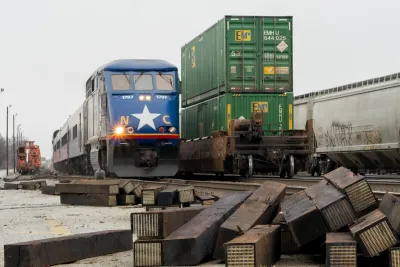
The Justice Department reached a settlement with freight railroad company Norfolk Southern, which controls 1,140 of the Amtrak Crescent line’s 1,377 route-miles, in a lawsuit centered on Amtrak’s right of preference on shared tracks.
As Bill Stephens reports for TrainsPro, the Justice Department alleged that Norfolk Southern violated the 1973 right of preference statute by unlawfully giving its trains priority over passenger trains on the Crescent line. “The resulting delays, the Justice Department said in July 2024, harmed and inconvenienced passengers, impeded passenger rail transportation, and negatively affected Amtrak’s financial performance.”
As part of the settlement, Norfolk Southern agreed to provide Amtrak trains the highest priority, train its dispatchers to prioritize Amtrak trains, require supervisor approval for any dispatching decisions that do not prioritize Amtrak, and provide records about delays on the Crescent line to help identify their causes. “In 2023, according to Amtrak data, 57% of Crescent passengers arrived on time, which was well below the 80% threshold required under federal customer on-time performance standards that went into effect in 2020.” In 2023, none of Amtrak’s 15 long-distance lines met the federal standard.
According to Amtrak, performance on the Crescent line has markedly improved since the case was filed, with 34 percent fewer delays caused by Norfolk Southern compared to last year. “Across all NS-hosted routes, delays decreased 26% and FTI dropped 42% year-over-year. Ridership on these routes also rose by 2%, reflecting growing customer confidence in service reliability.”
FULL STORY: Justice Department, Norfolk Southern settle lawsuit over Amtrak’s Crescent

Who owns US railroad tracks?
Nearly three-quarters of Amtrak's trains operate on tracks owned by private companies. What does this mean for U.S. passenger rail?
Opinion: Prioritize Amtrak, but Don’t Demonize Freight
A proposed bill would tighten enforcement of a 1973 law that gives passenger trains priority over freight shipments.
Amtrak unveils proposal to restructure, split into 3 divisions
Agency officials say the new structure would offer more transparency and accountability.

Planetizen Federal Action Tracker
A weekly monitor of how Trump’s orders and actions are impacting planners and planning in America.

The state-sanctioned urbicide of Austin
People don’t kill cities. Freeways do.

US to reduce Colorado River water deliveries to Mexico
A new Colorado Treaty amendment reduces Mexico’s Colorado River water allocation by 250,000 acre feet.

5 New England states march closer to 800 megawatt wind energy project
Securing federal approval for the project may be complicated under the Trump administration, which has historically been hostile towards domestic wind power.

Baltimore to break ground on $50 million Transit Priority Project
The project will bring faster bus trips, safer streets and better bike connections to Baltimore.

Airbnb launches $250 million 'last-dollar financing' housing accelerator, makes first investment in Austin
The company will put $6.4 million towards affordable housing development in Texas’ capital.

FREE Course: Walkable City 1: Why Walkability?
After describing his path towards focusing on walkability as the essence of good planning, Jeff Speck marches through his five principal reasons for making more walkable places.
Reinventing Malls: Planning Alchemy—Turning Gray Fields Into Gold
The course focuses on the opportunities and imperatives that shape reinvention of mall sites.

Eagle County Government
Harvard University Graduate School of Design
Nashville Planning Department
The Architects Foundation
University of Cincinnati Online
The Pocatello Development Authority
The Urban Renewal Agency of the City of Pocatello
Journal of the American Planning Association