The order seeks to remove legal precedents and consent decrees that prevent cities from moving unhoused people from the street to treatment centers.


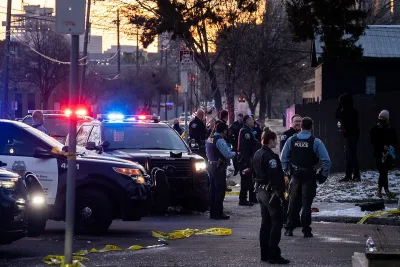
President Trump signed an executive order that makes it easier for cities to remove unhoused people from the street and potentially institutionalize them, reports Joey Garrison for USA Today.
“The move, first reported by USA TODAY, also redirects federal funds to ensure the homeless people impacted are transferred to rehabilitation, treatment and other facilities, though it was not clear how much money would be allocated,” Garrison adds.
The order, titled “Ending Crime and Disorder on America's Streets,” directs the Attorney General to seek to reverse judicial precedents and end consent degrees that “limit local and state governments' ability to move homeless people from streets and encampments into treatment centers.”
The National Homelessness Law Center called the action “misguided at best, and counterproductive and dangerous at worst,” noting that forced treatment is “unethical, ineffective, and illegal.”
Coupled with the Supreme Court’s decision in Grants Pass v. Johnson, the order further encourages punitive measures against homeless people that advocates say don’t address the root causes of the crisis.
FULL STORY: Trump to sign order pushing cities and states to remove homeless people from streets

Connecticut Governor Rejects Trump Homelessness Order
Gov. Lamont — who vetoed a highly anticipated pro-housing bill in June — says his state will not criminalize homelessness or force the institutionalization of unhoused people.
Local Governments Sue HUD Over Funding Cuts
A new lawsuit alleges that the Trump administration’s revised guidelines for housing and homelessness assistance funds will decimate key programs.
Indiana bans public homelessness
A new law prohibits sleeping or camping on public property.

Planetizen Federal Action Tracker
A weekly monitor of how Trump’s orders and actions are impacting planners and planning in America.

The state-sanctioned urbicide of Austin
People don’t kill cities. Freeways do.

US to reduce Colorado River water deliveries to Mexico
A new Colorado Treaty amendment reduces Mexico’s Colorado River water allocation by 250,000 acre feet.

5 New England states march closer to 800 megawatt wind energy project
Securing federal approval for the project may be complicated under the Trump administration, which has historically been hostile towards domestic wind power.

Baltimore to break ground on $50 million Transit Priority Project
The project will bring faster bus trips, safer streets and better bike connections to Baltimore.

Airbnb launches $250 million 'last-dollar financing' housing accelerator, makes first investment in Austin
The company will put $6.4 million towards affordable housing development in Texas’ capital.

FREE Course: Walkable City 1: Why Walkability?
After describing his path towards focusing on walkability as the essence of good planning, Jeff Speck marches through his five principal reasons for making more walkable places.
Reinventing Malls: Planning Alchemy—Turning Gray Fields Into Gold
The course focuses on the opportunities and imperatives that shape reinvention of mall sites.


Eagle County Government
Harvard University Graduate School of Design
Nashville Planning Department
The Architects Foundation
University of Cincinnati Online
The Pocatello Development Authority
The Urban Renewal Agency of the City of Pocatello
Journal of the American Planning Association