Utilities are calling on states to hold data center operators responsible for new energy demands to prevent leaving consumers on the hook for their bills.



Ohio energy regulators ruled that data centers will be subject to a new, special rate class and that they will face penalties if they fail to fulfill their commitments. According to an article by Dan Gearino in Inside Climate News, the action is a result of a proposal by American Electric Power (AEP), a Columbus-based utility.
As Gearino explains, “The ruling recognizes that data centers ‘pose a different type of risk, as well as an increased amount of risk,’ said the Public Utilities Commission of Ohio in its 5-0 decision.” The ruling seeks to prevent “highly speculative” projects that make agreements about power use, then never come to fruition. Now, data centers need to pay for at least 85 percent of the energy they sign up to use, regardless of their actual usage. “This provision helps to cover the costs of building infrastructure to serve the new development.”
Experts say rules like these are necessary because data centers require grid updates that all customers end up paying for, whether or not the data center is actually built. “Ideally, the regulations will mean that some of the most speculative data center plans will never reach the stage of making a power agreement with the utility, which makes it easier for AEP to plan for its future needs.”
Read the full story: Consumers (and a Utility) Get a Win in Ohio, While Data Centers Take the Loss

California Bills Would Rein in Data Centers’ Energy Use
A series of proposed bills seeks to limit ratepayer increases and ensure data centers report their energy usage and electricity sources.

AI’s Thirst for Energy Threatens Electric Grids
The rapidly growing demand for electricity could lead to shortages and is already impacting where data centers are built.
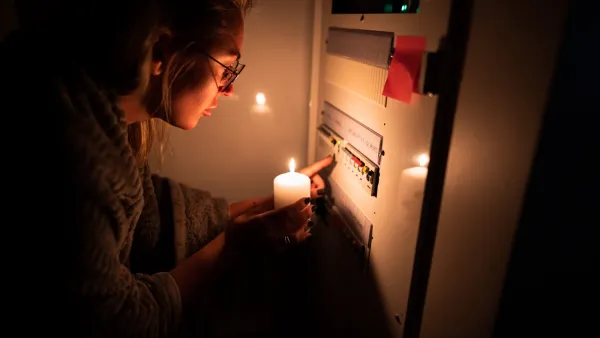
US May Have 100 Times More Blackouts by 2030
Rising demand driven by AI data centers and uncertain energy sources could lead to a surge in power outages by the end of the decade.

Planetizen Federal Action Tracker
A weekly monitor of how Trump’s orders and actions are impacting planners and planning in America.

California plans to bury El Niño’s downpour
If the state plays its cards right, it may be able to store a billion acre-feet of El Niño’s water in aquifers.

Desperate measures: Advocates weigh draining Lake Powell to fill Colorado River
Draining the reservoir could reduce evaporation losses by a couple hundred thousand acre-feet.

Mamdani’s pied-à-terre tax survives legal challenge
A panel of judges found that the plaintiffs failed to demonstrate injury as a result of New York City's implementation of the tax.

Eastern Nebraska is running out of electricity
Data centers and electrification are straining eastern Nebraska’s grid, throttling economic development.

Seattle passes record-breaking transit services expansion
Proposition 1 will double the city’s transit tax to add 95,000 more bus trips and preserve 180,000 bus trips annually.

FREE Course: Walkable City 1: Why Walkability?
After describing his path towards focusing on walkability as the essence of good planning, Jeff Speck marches through his five principal reasons for making more walkable places.
Reinventing Malls: Planning Alchemy—Turning Gray Fields Into Gold
The course focuses on the opportunities and imperatives that shape reinvention of mall sites.

City of Rosemead
Rutgers University, Edward J. Bloustein School of Planning and Public Policy
One Hundred Miles
University of Michigan School for Environment and Sustainability (SEAS)
Hunter College, City University of New York (CUNY)
The Architects Foundation
City of Cambridge
Montrose County
The Pocatello Development Authority