Pittsburgh’s office buildings, many of which date back to the early 20th century, are prime candidates for conversion to housing.


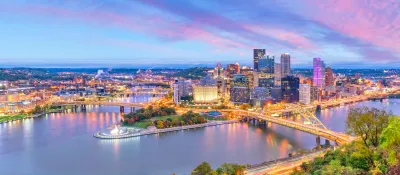
Several downtown Pittsburgh office buildings are being converted to housing, reports Ryan Deto in Axios, which will result in roughly 1,300 new housing units. About one fourth of the units will be subsidized for low-income families.
“Six other office-to-housing conversions are in the pipeline for Downtown — including the iconic 582-foot Gulf Tower and the 18-story former FHL Bank Building — said Kyle Chintalapalli, chief economic development officer for Pittsburgh Mayor Ed Gainey.”
Because many of Pittsburgh’s office buildings were built in the early 20th century before the rise of the open-plan office, they are more appropriate for conversion to housing than newer buildings. According to Chintalapalli, there are two dozen additional downtown buildings that could be converted but do not have funding committed. Downtown Pittsburgh has 91 percent office buildings and 9 percent apartment towers, a lower rate of residential buildings than most downtowns.
Read the full story: These offices are being converted to housing

Office Conversion Sees No Sign of Slowing
The adaptive reuse of office buildings for residential and other uses will grow by as much as 63 percent in 2024 over last year.
Office conversion is picking up steam in San Francisco
The city spent five years streamlining approval processes and reducing fees to encourage more adaptive reuse of vacant office buildings.

With Zero Office Conversions in Four Years, San Francisco Pins Hopes on New Special Financing District
City leaders hope the new incentive will spur the redevelopment of some of the city’s 30,000 square feet of vacant office space into housing.

Planetizen Federal Action Tracker
A weekly monitor of how Trump’s orders and actions are impacting planners and planning in America.

California plans to bury El Niño’s downpour
If the state plays its cards right, it may be able to store a billion acre-feet of El Niño’s water in aquifers.

Chicago breaks ground on $3 billion megadevelopment
The new neighborhood, titled Foundry Park, will one day host 3,700 residences.

Satanic Place Names
From streams and lakes to valleys and canyons, I mapped more than 1,000 places named after the Devil.

California High-Speed Rail Authority CEO resigns after $600,000 scandal
Under Ian Choudri, the authority used taxpayer dollars to fund first class flights and trips to nightclubs.

Want to study the Missouri River? Soon, you may need unanimous approval from 10 states
Legislation would require 10 governors’ permission to study or build projects moving water outside the basin.

FREE Course: Walkable City 1: Why Walkability?
After describing his path towards focusing on walkability as the essence of good planning, Jeff Speck marches through his five principal reasons for making more walkable places.
Reinventing Malls: Planning Alchemy—Turning Gray Fields Into Gold
The course focuses on the opportunities and imperatives that shape reinvention of mall sites.

City of Rosemead
Rutgers University, Edward J. Bloustein School of Planning and Public Policy
One Hundred Miles
Hunter College, City University of New York (CUNY)
The Architects Foundation
University of Cincinnati Online
City of Cambridge
Montrose County
The Pocatello Development Authority