After tracing U.S. health problems to Ssrawl, researchers look to planning for health solutions.


As national and North Carolina overweight and obesity rates climbed to 59 percent in 2002, and runaway health-care costs hit the economy, writes University of North Carolina-Chapel Hill Endeavors magazine writer Neil Caudle, many researchers looked beyond the usual suspects of ''fast food and too much television'' and began to implicate ''the 'built environment,' much of which was built around cars'' and gradually morphed into the ever-farther suburbs. ''We grow up with the understanding that the only way to travel is by car, and the only way for communities to develop is with a separation of uses,'' but the time has come for governments and businesses to grasp the value of mixed uses and ''the economic advantage of having people out and about without cars,'' stresses UNC School of Public Health's Department of Health Behavior and Health Education Associate Professor Rich Killingsworth.
Thanks to Smart Growth News
Read the full story: Made For Action


Planetizen Federal Action Tracker
A weekly monitor of how Trump’s orders and actions are impacting planners and planning in America.

‘Going backwards:’ Baltimore mayor, students rally against state's transit funding plan
Maryland's proposed six-year plan provides no funding for Baltimore’s BMORE bus program and reduces its road maintenance funding.
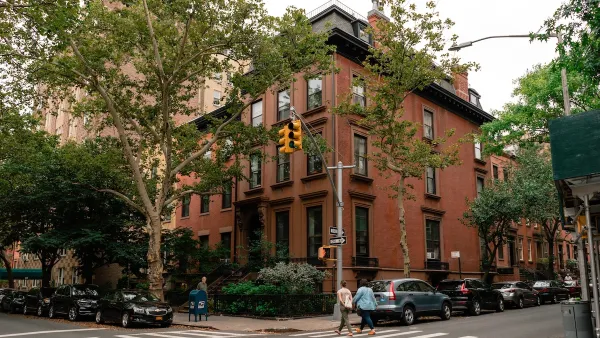
Mamdani sent nearly 6,000 pied-à-terre tax warnings to homes that didn’t qualify
A judge has ordered the administration to cancel thousands of pied-à-terre tax notices after it sent 35% of them erroneously.

A Colorado neighborhood is the testing ground for the future of home energy
A start up may have found a way to quickly bring geothermal energy to new communities.

Mamdani sent nearly 6,000 pied-à-terre tax warnings to homes that didn’t qualify
A judge has ordered the administration to cancel thousands of pied-à-terre tax notices after it sent 35% of them erroneously.

Detroit to transform waterfront with $2.2 billion investment
Developers will convert about 18 acres of unused parking lot space into civic spaces.

FREE Course: Walkable City 1: Why Walkability?
After describing his path towards focusing on walkability as the essence of good planning, Jeff Speck marches through his five principal reasons for making more walkable places.
Reinventing Malls: Planning Alchemy—Turning Gray Fields Into Gold
The course focuses on the opportunities and imperatives that shape reinvention of mall sites.

City of Thousand Oaks
City of Wisconsin Rapids
Harvard University Graduate School of Design
The Architects Foundation
University of Cincinnati Online
Northern Illinois Transit Authority (NITA)
The Pocatello Development Authority
The Urban Renewal Agency of the City of Pocatello