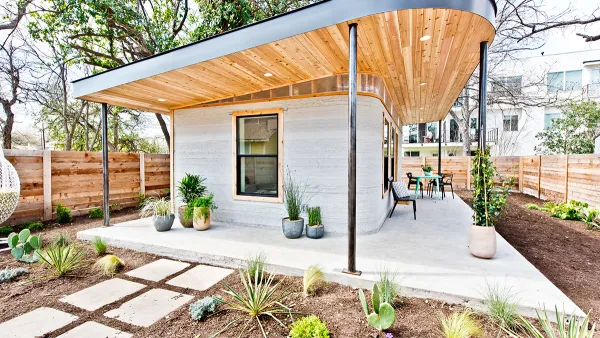
Upon completion, the 100-home Wolf Ranch Community north of Austin will be the largest 3D printed neighborhood in the world.


In 2021, sustainable building start-up ICON, homebuilding company Lennar, and designer BIG announced plans to 3D print a 100-home community in the Georgetown neighborhood of Austin — the largest of its kind in the world. The Wolf Ranch Community project broke ground in November 2022 and is now in its final stages, according to an article from Parametric Architecture. “Some residents have already started moving into their new homes, and more than a quarter of the homes have been sold,” reports PA managing editor Serra Utkum Ikiz.
The single-story, three- to -four bedroom homes are printed on a 4.75 ton Vulcan 3D printer using a mixture of concrete powder, water, sand, and other materials. Each house takes about three weeks to complete and are priced between $450,000 and $600,000. ICON has also built a community of 600-800 square foot homes for impoverished families in Latin America; each of those smaller units could be printed in as little as a day.
While entire neighborhoods of 3D printed homes are still a novel concept, a growing number of developers have turned to 3D printing in recent years as a way to build homes faster and more affordably, including Habitat for Humanity; 3D-printing homes with concrete can save up to 15 percent on construction costs and cut months off traditional construction timelines by requiring smaller construction teams.
FULL STORY: The world’s largest 3D printed neighborhood nears completion


World's Largest 3D-Printed Community Planned In Austin
The process aims to reduce labor hours and material waste, dramatically cutting construction costs for new housing.
Coming Soon: A 3D-Printed Neighborhood
The march of progress continues.
3D Printing Affordable Housing at Scale
A new 3D printer, coming soon to the market, promises serious construction cost savings in an era of seriously expensive construction costs.

Planetizen Federal Action Tracker
A weekly monitor of how Trump’s orders and actions are impacting planners and planning in America.

The state-sanctioned urbicide of Austin
People don’t kill cities. Freeways do.

US to reduce Colorado River water deliveries to Mexico
A new Colorado Treaty amendment reduces Mexico’s Colorado River water allocation by 250,000 acre feet.

Mamdani overhauls NYC's Vision Zero plan with 100 new policy goals
The overhaul aims to reduce traffic deaths and make streets safer for pedestrians, cyclists and drivers through lower speed limits, new safety infrastructure and more.

Amtrak not solely to blame for New Jersey commuter rail's unreliability, report finds
A new study from the Garden State Initiative found that NJ Transit’s budget grew 20% across a 4 year period, but reliability declined significantly over the same period.

EPA erases limits on planet-warming pollution from power plants
Under Monday’s plan, power plants would still have some limits on how much mercury, arsenic and other contaminants they can emit.

FREE Course: Walkable City 1: Why Walkability?
After describing his path towards focusing on walkability as the essence of good planning, Jeff Speck marches through his five principal reasons for making more walkable places.
Reinventing Malls: Planning Alchemy—Turning Gray Fields Into Gold
The course focuses on the opportunities and imperatives that shape reinvention of mall sites.


Eagle County Government
Harvard University Graduate School of Design
Nashville Planning Department
The Architects Foundation
University of Cincinnati Online
The Pocatello Development Authority
The Urban Renewal Agency of the City of Pocatello
Journal of the American Planning Association