Deploying transit police is a short-term fix. How can transit agencies build sustainable safety efforts?


A recent episode of Streetsblog’s The Brake podcast discusses security on public transit, questioning whether an increased police presence addresses violence effectively.
According to Urban Institute Senior Research Associate Lindiwe Rennert, “Criminologists, as well as folks who just study transit and behavior in public space, have identified that bringing in law enforcement may decrease instances of violence in the short run, and [the effect is] highly concentrated to the spots in which they are located. And that what you would expect is very soon after the presence is removed, or relocated, violence and crime in that space surges right back up.” Rennert also points out that extra law enforcement is usually funded from a transit agency’s operational budget.
One actionable solution is improving transit service overall. “There is something to be said for transit agencies actually focusing on improving their service as much as possible and offering the best and most service they can as a means of decreasing assaults. It cuts down on the opportunity for violence, as well as frustrations in the systems when your service is of a high quality.”
Read the full story: Why We Can’t End Violence on Transit With More Police
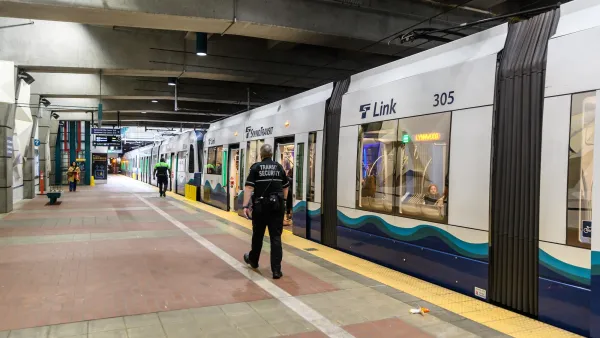
Perception vs. reality: NYC transit crime declined by 14% since 2019
In spite of popular perceptions, crime on many US transit systems is steadily dropping.
MBTA threatens to use eminent domain to pedestrianize Boston streets during World Cup
Boston city hall has been unusually reluctant to align with MassDOT and MBTA's proposed crowd management plans.
Chicago Transit Authority to Boost Policing Hours by 75%
In December, federal officials tasked the CTA to develop an enhanced security plan or risk losing federal funding.

Planetizen Federal Action Tracker
A weekly monitor of how Trump’s orders and actions are impacting planners and planning in America.

California plans to bury El Niño’s downpour
If the state plays its cards right, it may be able to store a billion acre-feet of El Niño’s water in aquifers.

Desperate measures: Advocates weigh draining Lake Powell to fill Colorado River
Draining the reservoir could reduce evaporation losses by a couple hundred thousand acre-feet.

US buildings threatened, destroyed by fires set to triple by 2060
Researchers found a high fire risk for socioeconomically vulnerable neighborhoods in the American West.

LA residents may be allowed to paint their own crosswalks
Councilwoman Katy Yaroslavsky put out a motion instructing the Los Angeles Department of Public Transportation to study the feasibility of allowing volunteers to paint crosswalks.

Dallas moves to overhaul its zoning code
The city's zoning reform will allow more multi-family and mixed-use developments.

FREE Course: Walkable City 1: Why Walkability?
After describing his path towards focusing on walkability as the essence of good planning, Jeff Speck marches through his five principal reasons for making more walkable places.
Reinventing Malls: Planning Alchemy—Turning Gray Fields Into Gold
The course focuses on the opportunities and imperatives that shape reinvention of mall sites.

City of Rosemead
Rutgers University, Edward J. Bloustein School of Planning and Public Policy
One Hundred Miles
Hunter College, City University of New York (CUNY)
The Architects Foundation
University of Cincinnati Online
City of Cambridge
Montrose County
The Pocatello Development Authority