Disability advocate Anna Zivarts' new book, “When Driving Isn't An Option: Steering Away from Car Dependency,” explores why and how transportation planning can better serve nondrivers to create a better quality of life for everyone.


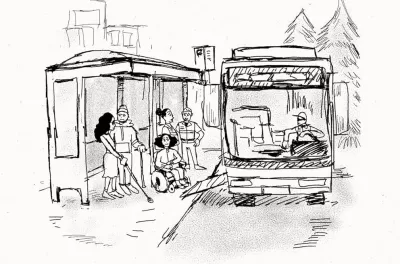
One-third of people living in the United States do not have a driver's license. Because the majority of involuntary nondrivers are disabled, lower income, unhoused, formerly incarcerated, undocumented immigrants, kids, young people, and the elderly, they are largely invisible. The consequence of this invisibility is a mobility system designed almost exclusively for drivers. This system has human health, environmental, and quality-of-life costs for everyone, not just for those excluded from it. If we’re serious about addressing climate change and inequality, we must address our transportation system.
In her new book, When Driving Isn't An Option: Steering Away from Car Dependency, disability advocate Anna Letitia Zivarts shines a light on the number of people in the US who cannot drive and explains how improving our transportation system with nondrivers in mind will create a better quality of life for everyone.
Drawing from interviews with involuntary nondrivers from around the US and from her own experience, Zivarts explains how nondrivers get around and the changes necessary to make our communities more accessible. These changes include improving sidewalk connectivity; providing reliable and affordable transit and paratransit; creating more options for biking, scooting, and wheeling; building more affordable and accessible housing; and understanding the unrecognized burden of asking and paying for rides.
Zivarts shows that it is critical to include people who can’t drive in transportation planning decisions. She outlines steps that organizations can take to include and promote leadership of those who are most impacted—and too often excluded—by transportation systems designed by and run by people who can drive. The book ends with a checklist of actions that you, as an individual living in a car-dependent society, can take in your own life to help all of us move beyond automobility.
FULL STORY: When Driving Is Not an Option: Steering Away from Car Dependency


Planetizen Federal Action Tracker
A weekly monitor of how Trump’s orders and actions are impacting planners and planning in America.

The state-sanctioned urbicide of Austin
People don’t kill cities. Freeways do.

US to reduce Colorado River water deliveries to Mexico
A new Colorado Treaty amendment reduces Mexico’s Colorado River water allocation by 250,000 acre feet.

Mamdani overhauls NYC's Vision Zero plan with 100 new policy goals
The overhaul aims to reduce traffic deaths and make streets safer for pedestrians, cyclists and drivers through lower speed limits, new safety infrastructure and more.

Amtrak not solely to blame for New Jersey commuter rail's unreliability, report finds
A new study from the Garden State Initiative found that NJ Transit’s budget grew 20% across a 4 year period, but reliability declined significantly over the same period.

EPA erases limits on planet-warming pollution from power plants
Under Monday’s plan, power plants would still have some limits on how much mercury, arsenic and other contaminants they can emit.

FREE Course: Walkable City 1: Why Walkability?
After describing his path towards focusing on walkability as the essence of good planning, Jeff Speck marches through his five principal reasons for making more walkable places.
Reinventing Malls: Planning Alchemy—Turning Gray Fields Into Gold
The course focuses on the opportunities and imperatives that shape reinvention of mall sites.

Eagle County Government
Harvard University Graduate School of Design
Nashville Planning Department
The Architects Foundation
University of Cincinnati Online
The Pocatello Development Authority
The Urban Renewal Agency of the City of Pocatello
Journal of the American Planning Association