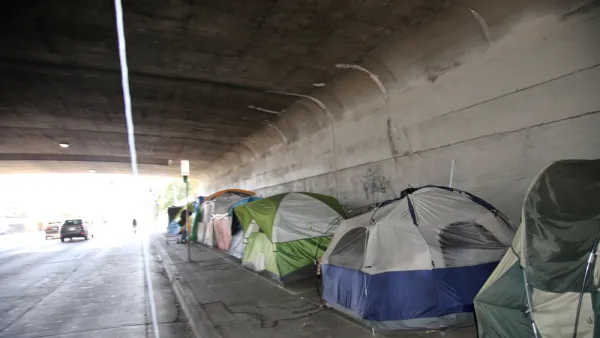
While homelessness rose in most U.S. regions, Hennepin County invested heavily in programs to end chronic homelessness and get people into temporary and supportive housing faster.



Writing in Bloomberg CityLab, Sarah Holder explains how Hennepin County, Minnesota, home to Minneapolis, reduced its unhoused population by 80 percent between 2017 and 2022. The county is “something of a national outlier:” in 2023, homelessness nationwide grew by 12 percent.
As Holder explains, the county’s success came “via a combination of funding, deep community engagement and a housing-first approach that’s matched with real housing resources, local officials say.” The county used the Built for Zero framework created by the nonprofit Community Solutions to develop its policy strategy, which includes starting with a focus on the most vulnerable, chronically homeless residents. “For Hennepin County, the hope is that this single-minded focus on housing the 12% of the total homeless population who have been homeless for the longest will ultimately translate into broader progress on a problem confounding so many US cities.”
The article details Hennepin County’s approach, which includes a ‘Rapid Re-Housing’ model, zoning reform, and significant investment in affordable housing and rental assistance programs, as well as building out its temporary shelter system to protect unhoused people during Minnesota’s harsh winters.
FULL STORY: Beating the Odds on Chronic Homelessness in Minneapolis

Federal Funding To Boost Supportive Housing Efforts
The Department of Housing and Urban Development announced a $365 million package aimed at efforts to reduce homelessness and provide outreach and care for people lacking adequate housing.

King County Supportive Housing Program Offers Hope for Unhoused Residents
The county is taking a ‘Housing First’ approach that prioritizes getting people into housing, then offering wraparound supportive services.

A Decade of Progress on Homelessness in Milwaukee County
Unlike most U.S. communities, Milwaukee County has managed to make significant progress toward assisting unhoused residents through a Housing First approach.

The state-sanctioned urbicide of Austin
People don’t kill cities. Freeways do.

US to reduce Colorado River water deliveries to Mexico
A new Colorado Treaty amendment reduces Mexico’s Colorado River water allocation by 250,000 acre feet.

New Jersey’s second-largest city bans standalone data centers
Jersey City will continue to allow co-location facilities, such as those meant for research institutions that store their own data.

Amtrak not solely to blame for New Jersey commuter rail's unreliability, report finds
A new study from the Garden State Initiative found that NJ Transit’s budget grew 20% across a 4 year period, but reliability declined significantly over the same period.

EPA erases limits on planet-warming pollution from power plants
Under Monday’s plan, power plants would still have some limits on how much mercury, arsenic and other contaminants they can emit.

Phoenix announces new on-demand transit service, more frequent RAPID buses
Both new services will launch in October, and are part of Phoenix's Project Effective Access Solutions for Easing Congestion.

FREE Course: Walkable City 1: Why Walkability?
After describing his path towards focusing on walkability as the essence of good planning, Jeff Speck marches through his five principal reasons for making more walkable places.
Reinventing Malls: Planning Alchemy—Turning Gray Fields Into Gold
The course focuses on the opportunities and imperatives that shape reinvention of mall sites.

Eagle County Government
Harvard University Graduate School of Design
Nashville Planning Department
The Architects Foundation
University of Cincinnati Online
The Pocatello Development Authority
The Urban Renewal Agency of the City of Pocatello
Journal of the American Planning Association