The future of downtown retail is uncertain. In the meantime, pop-ups fill the gaps and provide small businesses with unique opportunities to showcase their wares.



As the combination of e-commerce, pandemic disruptions, and rising real estate costs lead to higher vacancy rates for retail spaces, cities and landlords are looking to pop-up shops as one way to activate downtown commercial spaces and bring in some much-needed revenue.
According to an article by Molly Bolan in Route Fifty, “Under the pop-up model, small businesses work with property owners to temporarily open a brick-and-mortar location, often for a few days or weeks, and rarely more than a few months. Pop-up shops can provide benefits to both small businesses that lack storefronts and permits and commercial districts that want to bring visitors back.
In San Francisco, SF New Deal, a business development nonprofit, is partnering with the city’s Office of Workforce and Economic Development to help small businesses, artists and community organizations set up shop in empty retail spaces downtown.” Program recipients so far include “several artists, a few bakeries, clothing stores, an art nonprofit, a radio station and a plant store that doubles as a performance venue.” In Pittsburgh, the Pittsburgh Downtown Partnership’s Project Pop-Up is funding six businesses for six to 12 months.
FULL STORY: A solution for dying downtowns is popping up in major cities

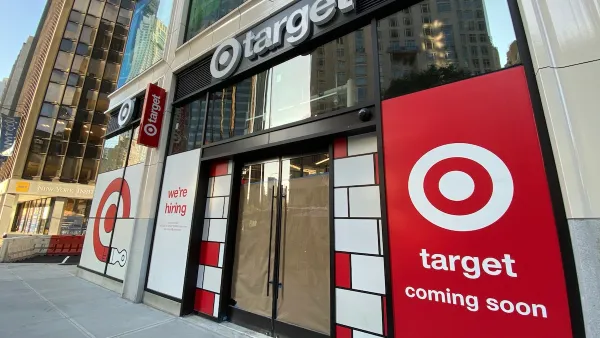
Why Big Box Stores Are Abandoning Their Urban Experiment
And why that may not be such a bad thing.
Pittsburgh downtown tax diversion plan draws criticism for lack of transparency
A proposed new development tax faces opposition from transit advocates.
Downtown Los Angeles Gears Up for Growth
A new report highlights Downtown L.A.’s ongoing revival through major housing projects, adaptive reuse, hospitality growth, and preparations for global events in the years ahead.

Planetizen Federal Action Tracker
A weekly monitor of how Trump’s orders and actions are impacting planners and planning in America.

The state-sanctioned urbicide of Austin
People don’t kill cities. Freeways do.

US to reduce Colorado River water deliveries to Mexico
A new Colorado Treaty amendment reduces Mexico’s Colorado River water allocation by 250,000 acre feet.

5 New England states march closer to 800 megawatt wind energy project
Securing federal approval for the project may be complicated under the Trump administration, which has historically been hostile towards domestic wind power.

Baltimore to break ground on $50 million Transit Priority Project
The project will bring faster bus trips, safer streets and better bike connections to Baltimore.

Airbnb launches $250 million 'last-dollar financing' housing accelerator, makes first investment in Austin
The company will put $6.4 million towards affordable housing development in Texas’ capital.

FREE Course: Walkable City 1: Why Walkability?
After describing his path towards focusing on walkability as the essence of good planning, Jeff Speck marches through his five principal reasons for making more walkable places.
Reinventing Malls: Planning Alchemy—Turning Gray Fields Into Gold
The course focuses on the opportunities and imperatives that shape reinvention of mall sites.

Eagle County Government
Harvard University Graduate School of Design
Nashville Planning Department
The Architects Foundation
University of Cincinnati Online
The Pocatello Development Authority
The Urban Renewal Agency of the City of Pocatello
Journal of the American Planning Association