Building more high-speed passenger rail in the United States could have significant economic and environmental impacts, creating jobs and reducing carbon emissions.


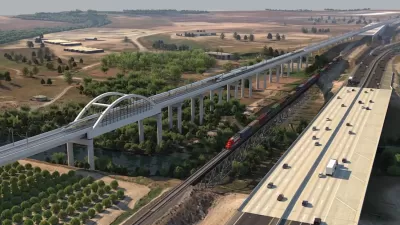
A new report from the Mineta Transportation Institute (MTI) calculates the potential economic and environmental benefits of expanding high-speed rail (HSR) in the United States.
According to an article in Mass Transit, these benefits include “job growth and increased economic activity, creation of an entirely new domestic manufacturing base, station area development and improved regional connectivity and reduced greenhouse gas (GHG) emissions and better land use.”
For example, “The California High-Speed Rail Authority (CHSRA) estimates high-speed rail has generated an estimated 74,000 to 80,000 jobs per year, $5.6 billion to $6 billion in labor income and $15 billion to $16 billion in economic output between 2006 and 2022.” The rail manufacturing industry also supports roughly 90,000 U.S. jobs as of 2015.
Expanding HSR could also connect megaregions, create more opportunities for housing and employment, and reduce vehicle miles driven and greenhouse gas emissions. “One study found it would cost an estimated $122-199 billion to provide the equivalent highway and airport capacity that the San Francisco to Los Angeles high-speed rail network would provide.”
FULL STORY: MTI report outlines economic and environmental benefits of high-speed rail in U.S.

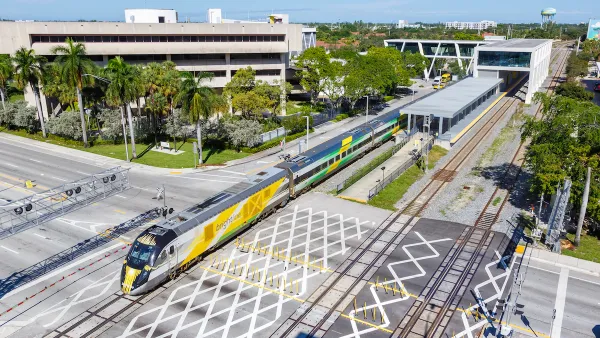
Brightline Founder Predicts a Passenger Rail Resurgence
The HSR operator wants to expand to more US regions.
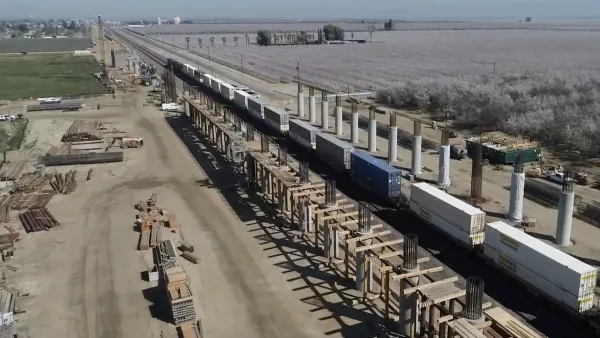
California HSR Could Be Up and Running by 2033
A newly restructured leadership promises to speed up the arduous construction process and start running trains in five to eight years.
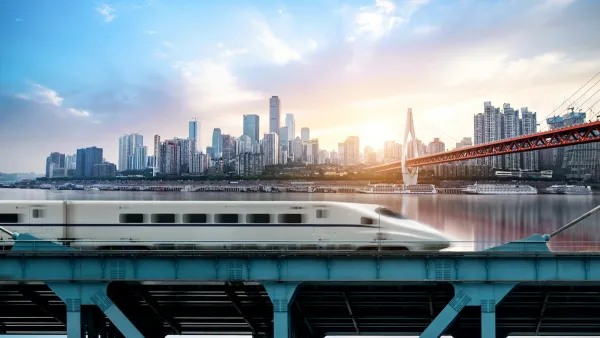
Is China’s High-Speed Rail Boom Unsustainable?
The country is building tens of thousands of miles of rail service that is expensive to maintain and, in some cases, redundant.

The state-sanctioned urbicide of Austin
People don’t kill cities. Freeways do.

US to reduce Colorado River water deliveries to Mexico
A new Colorado Treaty amendment reduces Mexico’s Colorado River water allocation by 250,000 acre feet.

New Jersey’s second-largest city bans standalone data centers
Jersey City will continue to allow co-location facilities, such as those meant for research institutions that store their own data.

Amtrak not solely to blame for New Jersey commuter rail's unreliability, report finds
A new study from the Garden State Initiative found that NJ Transit’s budget grew 20% across a 4 year period, but reliability declined significantly over the same period.

EPA erases limits on planet-warming pollution from power plants
Under Monday’s plan, power plants would still have some limits on how much mercury, arsenic and other contaminants they can emit.

Phoenix announces new on-demand transit service, more frequent RAPID buses
Both new services will launch in October, and are part of Phoenix's Project Effective Access Solutions for Easing Congestion.

FREE Course: Walkable City 1: Why Walkability?
After describing his path towards focusing on walkability as the essence of good planning, Jeff Speck marches through his five principal reasons for making more walkable places.
Reinventing Malls: Planning Alchemy—Turning Gray Fields Into Gold
The course focuses on the opportunities and imperatives that shape reinvention of mall sites.

Eagle County Government
Harvard University Graduate School of Design
Nashville Planning Department
The Architects Foundation
University of Cincinnati Online
The Pocatello Development Authority
The Urban Renewal Agency of the City of Pocatello
Journal of the American Planning Association