Israel's planned 452-mile fence is certainly controversial -- but it will likely be an interesting experiment in how cities evolve.


At an estimated cost of $3 million per mile, the expected barrier's planned 452 miles is likely to be Israel's most expensive public works project. The wall/fence is daunting to examine: "[M]iles of electronically monitored fencing punctuated by a maze of watchtowers, entrenchments and rolls of razor wire, with patrol roads whose surfaces will be kept carefully swept so the footprints of intruders can be spotted... In Israeli towns and cities near the Green Line, the barrier's steady advance has been accompanied by a palpable sense of relief. Kfar Saba, a Tel Aviv bedroom community, was hit by repeated suicide bombings before the barrier was built but has had none since the neighboring West Bank city of Kalkilya was sealed off from it last year by a seemingly impenetrable concrete wall."
Thanks to Laura Kranz
Read the full story: Israeli View: Fence Leads to Heart of a Great Divide


Planetizen Federal Action Tracker
A weekly monitor of how Trump’s orders and actions are impacting planners and planning in America.

The state-sanctioned urbicide of Austin
People don’t kill cities. Freeways do.
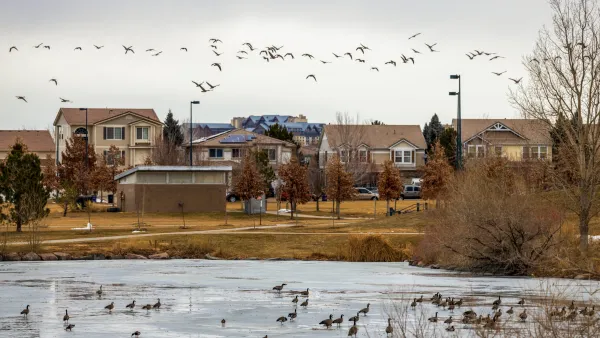
Colorado’s Largest Data Center Could Rise Next to Homes — Without a Public Hearing
The proposed campus would consume 11 times the power of Denver International Airport; as it has across the country, opposition mounts.

Nation's most wind-powered state turns to coal as data centers increase energy demand
For the first time in decades, Iowa has increased its generation of coal power.

NYC cools commuters with city's first rain garden above a bus stop
New York City officials say the plants in the rain garden can absorb 16 gallons of rainwater during heavy storms.

Brightline West’s future may rely on $6 billion federal loan
The company has until Nov. 2 to make a $400 million equity investment into its proposed high-speed rail line.

FREE Course: Walkable City 1: Why Walkability?
After describing his path towards focusing on walkability as the essence of good planning, Jeff Speck marches through his five principal reasons for making more walkable places.
Reinventing Malls: Planning Alchemy—Turning Gray Fields Into Gold
The course focuses on the opportunities and imperatives that shape reinvention of mall sites.

Greater Baltimore Committee
Eagle County Government
Harvard University Graduate School of Design
The Architects Foundation
University of Cincinnati Online
The Pocatello Development Authority
The Urban Renewal Agency of the City of Pocatello
Journal of the American Planning Association