Cities like Seattle and Bellingham are working to increase housing density while also preserving urban trees and green spaces.


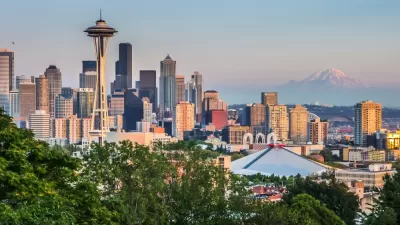
After Washington state passed sweeping zoning reforms to encourage more ‘missing middle’ and multifamily housing production, prompting new questions about sustainability and the conservation of the urban tree canopy, “Cities in Washington are working to give those trees more importance in their planning considerations, centering urban forestry in their community strategies,” writes Clifford Heberden in The Urbanist.
According to Brennon Staley, Strategic Advisor for the Seattle’s Office and Planning and Community Development, “development in dense places like Seattle prevents further sprawl on the fringes, preserving more land and natural resources from development.” Seattle also signed on to the Tree Equity Collaborative, “a statewide partnership to achieve tree equity across the Evergreen State by expanding and fortifying neighborhood tree canopy cover.” If passed by the city council, the updated Urban Forest Protection Ordinance would require street trees with new residential developments and create new protections for existing trees.
In Bellingham, the city is working to balance the need for new housing with conservation with a new Urban Forestry Management Plan, slated for completion this summer. “Bellingham touts 40% tree cover within city limits, representing 7,252 acres of the diverse canopy. The goal is to maintain that percentage across the city.” Bellingham touts the benefits of its ‘urban villages,’ areas that encourage compact development and help preserve outlying green spaces. “Permit data as of March 2022 indicates a total of 2,800 housing units were added in Urban Villages, representing 40% of all new housing in Bellingham since 2006.”
Read the full story: Bellingham and Seattle Balance Urban Forestry with Housing Needs

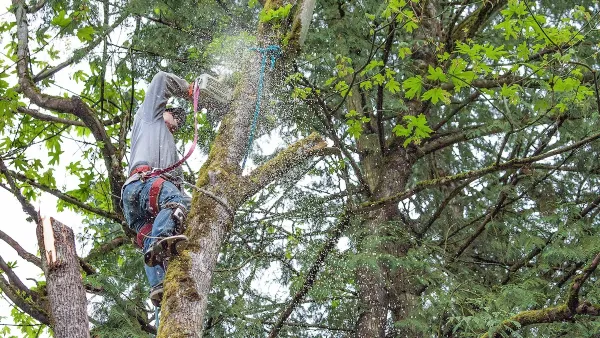
Seattle Conflict Between Trees and Housing Heats up
A 2023 update to Seattle’s tree ordinance has led to sharp increase in the number of trees being cut down for redevelopment, prompting advocates to call for better protection of the city’s tree canopy.
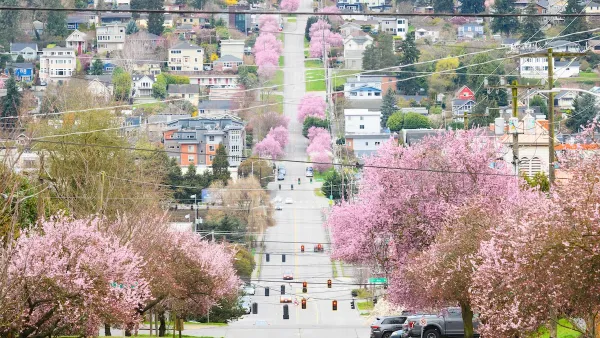
Opinion: Housing Versus Trees Is a False Choice; Swap Pavement for Trees Instead
Seattle’s goal to cover 30 percent of the city with tree canopy by 2037 doesn’t need to be sacrificed in favor of density. There’s a better way.
Washington Urban Forestry Program Faces 'Existential' Budget Cut
A proposed budget eliminates funding for a key urban forestry program that funds greening efforts across the state.

Planetizen Federal Action Tracker
A weekly monitor of how Trump’s orders and actions are impacting planners and planning in America.

California plans to bury El Niño’s downpour
If the state plays its cards right, it may be able to store a billion acre-feet of El Niño’s water in aquifers.

Chicago breaks ground on $3 billion megadevelopment
The new neighborhood, titled Foundry Park, will one day host 3,700 residences.

City officials are dumping billions of gallons of sewage into the Chicago River
This year, the Racine Avenue sewage pumping station has poured over 10 billion gallons of sewage into the Chicago River.

Move over, LA: St. Louis gears up for Olympics, invests millions in downtown redevelopment
The Missouri city will host the 2028 Olympic soccer group stage and knockout matches.

Satanic place names
From streams and lakes to valleys and canyons, I mapped more than 1,000 places named after the Devil.

FREE Course: Walkable City 1: Why Walkability?
After describing his path towards focusing on walkability as the essence of good planning, Jeff Speck marches through his five principal reasons for making more walkable places.
Reinventing Malls: Planning Alchemy—Turning Gray Fields Into Gold
The course focuses on the opportunities and imperatives that shape reinvention of mall sites.

City of Rosemead
Rutgers University, Edward J. Bloustein School of Planning and Public Policy
One Hundred Miles
Hunter College, City University of New York (CUNY)
The Architects Foundation
University of Cincinnati Online
City of Cambridge
Montrose County
The Pocatello Development Authority