A 2023 update to Seattle’s tree ordinance has led to sharp increase in the number of trees being cut down for redevelopment, prompting advocates to call for better protection of the city’s tree canopy.


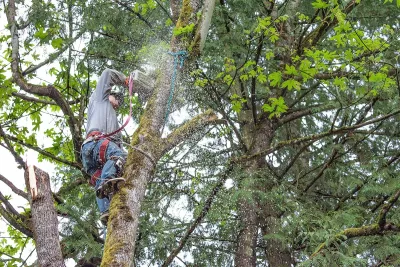
Seattle’s efforts to increase its urban tree canopy to improve air quality, provide shade, filter stormwater, and reduce the heat island effect are coming up against the need for more housing, pitting tree conservationists against developers.
As Robert McClure reports for the Associated Press, the city updated its tree ordinance in 2023 in ways that tree advocates say privileges developers. According to an analysis, the city used to lose about six trees per week to development. Since the updated ordinance was passed, that number was about 58 trees per week.
Seattle Construction and Inspections Department spokesperson Bryan Stevens said over 90 percent of the removed trees were less than two feet in diameter, and that close to double the number of new trees were planted. However, new trees will take years to bring the same benefits as mature trees.
The 2023 ordinance makes it easier for developers to cut down trees on private land. Meanwhile, the city is not on track to meet its goal of covering 30 percent of the city with tree canopy by 2037, with a study finding it is “slowly losing ground.”
Although the Department of Transportation is tasked with planting new trees on public property to make up for trees lost to development, an SDOT report found that even if trees were planted on all available public properties, it would still fall short of the city’s goal. A large portion of public property is unsuitable for new trees, or would require expensive removal of concrete and utilities.
While housing advocates say the trees are an excuse to block development, tree advocates say smarter design, particularly if incentivized by the city, could prevent the loss of as many trees.
FULL STORY: Seattle’s housing crisis leads to conflict between living spaces and mature trees

Washington Urban Forestry Program Faces 'Existential' Budget Cut
A proposed budget eliminates funding for a key urban forestry program that funds greening efforts across the state.

Updating LA’s Tree Rules Could Bring More Shade to Underserved Neighborhoods
A new USC study finds that relaxing Los Angeles’ outdated tree planting guidelines could significantly expand urban tree canopy and reduce shade disparities in lower-income neighborhoods, though infrastructure investments are also needed.
Opinion: Housing Versus Trees Is a False Choice; Swap Pavement for Trees Instead
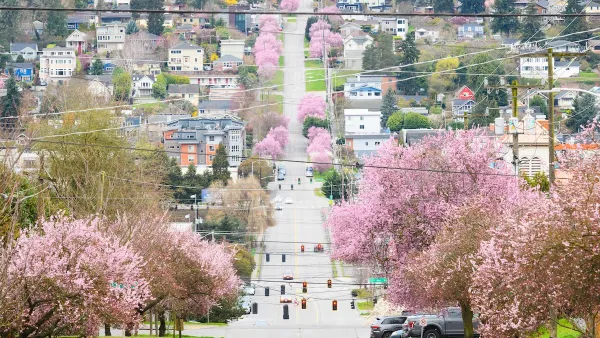
Seattle’s goal to cover 30 percent of the city with tree canopy by 2037 doesn’t need to be sacrificed in favor of density. There’s a better way.

The state-sanctioned urbicide of Austin
People don’t kill cities. Freeways do.

US to reduce Colorado River water deliveries to Mexico
A new Colorado Treaty amendment reduces Mexico’s Colorado River water allocation by 250,000 acre feet.

New Jersey’s second-largest city bans standalone data centers
Jersey City will continue to allow co-location facilities, such as those meant for research institutions that store their own data.

Amtrak not solely to blame for New Jersey commuter rail's unreliability, report finds
A new study from the Garden State Initiative found that NJ Transit’s budget grew 20% across a 4 year period, but reliability declined significantly over the same period.

EPA erases limits on planet-warming pollution from power plants
Under Monday’s plan, power plants would still have some limits on how much mercury, arsenic and other contaminants they can emit.

Phoenix announces new on-demand transit service, more frequent RAPID buses
Both new services will launch in October, and are part of Phoenix's Project Effective Access Solutions for Easing Congestion.

FREE Course: Walkable City 1: Why Walkability?
After describing his path towards focusing on walkability as the essence of good planning, Jeff Speck marches through his five principal reasons for making more walkable places.
Reinventing Malls: Planning Alchemy—Turning Gray Fields Into Gold
The course focuses on the opportunities and imperatives that shape reinvention of mall sites.

Eagle County Government
Harvard University Graduate School of Design
Nashville Planning Department
The Architects Foundation
University of Cincinnati Online
The Pocatello Development Authority
The Urban Renewal Agency of the City of Pocatello
Journal of the American Planning Association