USA Today debunks the false claim that the United Nations’ call for enabling 15-minute cities is a coded plan to institute ‘climate change lockdowns.’


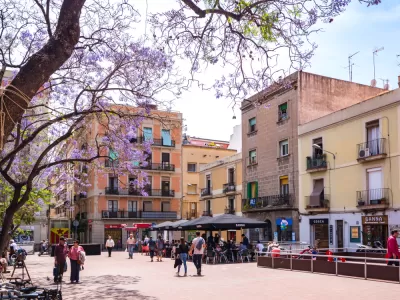
Writing in USA Today, Isabella Fertel fact-checks the conspiracy-minded claim that the concept of the 15-minute city is a global plot to create “climate change lockdowns.”
To be clear, the United Nations 2030 Agenda for Sustainable Development makes zero mentions of lockdowns or keeping people in their own neighborhoods. Rather, the 15-minute city is shorthand for the goal of making transit, jobs, healthcare, parks, and all the other amenities we come to expect from city life accessible to all residents within a 15-minute walk or bike ride.
Carlos Moreno, who coined the concept, says “The core of the ‘15-minute city’ is an open city, a human city, an interconnected city.” Moreno adds, “Of course, all citizens are free to go where they want. There are no constraints.” Dan Luscher, founder of the 15-Minute City Project, says the concept is about promoting, not limiting, mobility.
Read the full story: Fact check: False claim ‘15-minute cities’ are actually ‘climate lockdowns’


Planetizen’s Top Urban Planning Books of 2024
Top of mind in 2024 were the far-reaching impacts of climate displacement, zoning as a solution to the housing crisis, and the potential for safer roads and better public transit in American cities.
When Planning Issues Become ‘Culture Wars’
‘Commonsense’ urbanism projects are being painted by opponents as sinister plots to limit movement and erode property rights.
Ten Urban Success Stories From 2021
Still battling a global pandemic and its widespread economic and social effects, cities nevertheless made progress in some unexpected ways.

Planetizen Federal Action Tracker
A weekly monitor of how Trump’s orders and actions are impacting planners and planning in America.

California plans to bury El Niño’s downpour
If the state plays its cards right, it may be able to store a billion acre-feet of El Niño’s water in aquifers.

Chicago breaks ground on $3 billion megadevelopment
The new neighborhood, titled Foundry Park, will one day host 3,700 residences.

Satanic Place Names
From streams and lakes to valleys and canyons, I mapped more than 1,000 places named after the Devil.

California High-Speed Rail Authority CEO resigns after $600,000 scandal
Under Ian Choudri, the authority used taxpayer dollars to fund first class flights and trips to nightclubs.

Want to study the Missouri River? Soon, you may need unanimous approval from 10 states
Legislation would require 10 governors’ permission to study or build projects moving water outside the basin.

FREE Course: Walkable City 1: Why Walkability?
After describing his path towards focusing on walkability as the essence of good planning, Jeff Speck marches through his five principal reasons for making more walkable places.
Reinventing Malls: Planning Alchemy—Turning Gray Fields Into Gold
The course focuses on the opportunities and imperatives that shape reinvention of mall sites.

City of Rosemead
Rutgers University, Edward J. Bloustein School of Planning and Public Policy
One Hundred Miles
Hunter College, City University of New York (CUNY)
The Architects Foundation
University of Cincinnati Online
City of Cambridge
Montrose County
The Pocatello Development Authority