Amazon has been tending to buy when previously it would have leased, and the trend has massive implications for the industrial real estate market.


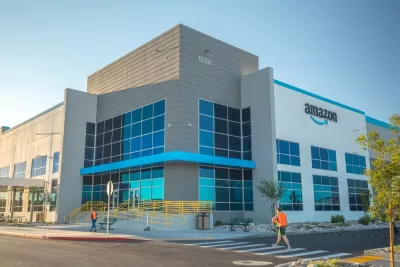
According to an article by Jon Banister and Jarred Schenke that is free to access with a long-in, Amazon is shifting its approach to its industrial spaces, with consequences for the broader real estate investment industry.
"Over the course of the last year, Amazon has gone from being indifferent on whether it leases or owns the millions of square feet that make up its industrial empire to preferring to buy and develop its own facilities," according to the article.
Where the massive online shopping and delivery company would previously lease industrial real estate from developers, the company si showing up to bid on sales. In addition to reports from experts inside the industry, the article also calls on the company's own financial reports to reach its conclusions.
The e-commerce giant has spent at least $450M over the past year to acquire industrial properties and development sites, Bisnow has found. Sources expect Amazon will continue to ramp up this buying activity, as the investments allow it to capture the value premium that it creates for an industrial property and for years has passed along to its landlords.
According to the article, Amazon's evolving industrial portfolio could have massive implications for an asset class that is already seeing huge price increases—16.9% year-over-year and 41% over the past three years.
"Amazon has contributed more than any other company to the growth in prominence and value of distribution facilities, leasing them up in huge numbers across the country to build out its supply chain for delivering goods to customers," writes Banister and Schenke.
As recently as last fall, Amazon Vice President of Real Estate and Global Facilities John Schoettler told The Wall Street Journal the company was "really agnostic" about whether it owned or leased real estate.
FULL STORY: Amazon Ramping Up Industrial Acquisitions In Pivot Away From Leasing, Sources Say

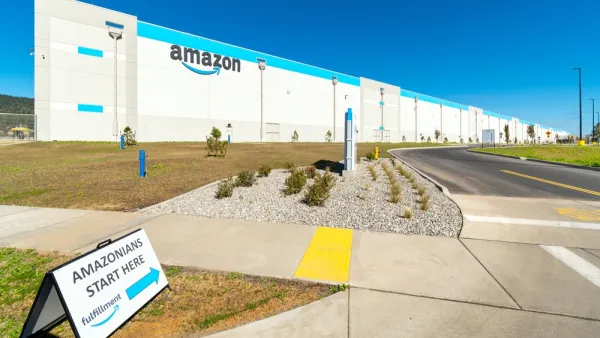
Amazon Plans for More Massive Warehouses
The company is building its biggest-ever distribution centers in New York, Colorado, and California.
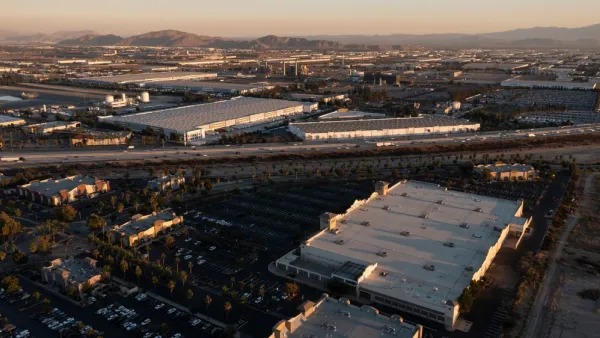
Communities Near Warehouses Unprotected by Outdated Zoning Codes
Today’s massive modern distribution centers have outsized impacts on adjacent neighborhoods. But outdated zoning codes often let them slip through the cracks with no environmental review.
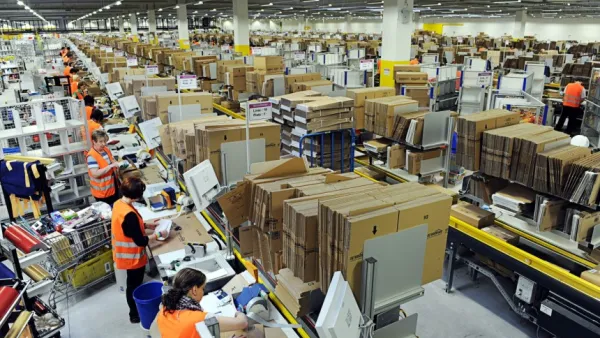
The Impact of Amazon Warehouses on Communities
Often located in low-income communities of color, Amazon's warehouses contribute to public health impacts like poor air quality, noise pollution, and traffic congestion.

Planetizen Federal Action Tracker
A weekly monitor of how Trump’s orders and actions are impacting planners and planning in America.

The state-sanctioned urbicide of Austin
People don’t kill cities. Freeways do.

US to reduce Colorado River water deliveries to Mexico
A new Colorado Treaty amendment reduces Mexico’s Colorado River water allocation by 250,000 acre feet.

Mamdani overhauls NYC's Vision Zero plan with 100 new policy goals
The overhaul aims to reduce traffic deaths and make streets safer for pedestrians, cyclists and drivers through lower speed limits, new safety infrastructure and more.

Amtrak not solely to blame for New Jersey commuter rail's unreliability, report finds
A new study from the Garden State Initiative found that NJ Transit’s budget grew 20% across a 4 year period, but reliability declined significantly over the same period.

EPA erases limits on planet-warming pollution from power plants
Under Monday’s plan, power plants would still have some limits on how much mercury, arsenic and other contaminants they can emit.

FREE Course: Walkable City 1: Why Walkability?
After describing his path towards focusing on walkability as the essence of good planning, Jeff Speck marches through his five principal reasons for making more walkable places.
Reinventing Malls: Planning Alchemy—Turning Gray Fields Into Gold
The course focuses on the opportunities and imperatives that shape reinvention of mall sites.

Eagle County Government
Harvard University Graduate School of Design
Nashville Planning Department
The Architects Foundation
University of Cincinnati Online
The Pocatello Development Authority
The Urban Renewal Agency of the City of Pocatello
Journal of the American Planning Association