The Shanghai Statement creating the Global Planning Education Association Network (GPEAN) was signed by ten planning school associations at the closing ceremony of the 1st World Planning Schools Congress at Tongji University, 20 years ago this week.



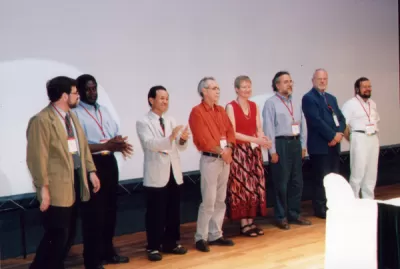
In July 2001, four planning school associations representing urban and regional planning schools on four continents convened the first World Planning Schools Congress in Shanghai. In all, 650 scholars from over 250 schools in more than 60 countries met for five days to exchange research results, teaching experiences, and ideas about the future of the urban planning profession. Leaders of the four associations, Asian Planning Schools Association (APSA), Association of Collegiate Schools of Planning (ACSP), Association of European Schools of Planning (AESOP), and Australia and New Zealand Association of Planning Schools (ANZAPS), took the opportunity to convene a meeting of leaders of all the world’s planning school associations. They were joined by six other associations representing schools in Africa, Brazil, Canada, Indonesia, Latin America, and the francophone world, in two days of meetings discussing the potential for future cooperation.
Although the ten associations reflected wide differences in organization, activities and politico-economic contexts, they shared belief in the substantial potential for cooperation to advance planning education and scholarship. At the conclusion of the meetings, they agreed to cooperate on an ongoing basis with what became known as the Shanghai Statement:
Representatives of national and international planning education associations gathered at Tongji University in Shanghai and agreed on the goal of increasing mutual communication in order to improve the quality and visibility of planning and planning education. To achieve this, it was agreed to establish a global planning education association network and committees to plan holding the second World Planning Schools Congress and to develop an inclusive communications network. [1]
The Shanghai Statement was signed in English and Mandarin by the association delegates at the closing ceremony of the WPSC at Tongji University on 14 July 2001. A year later, nine of the associations sent representatives to an organizational meeting of the network in Volos, Greece, held in conjunction with the annual congress of AESOP. A proposed charter prepared in Volos was ratified and signed by the associations on 31 December 2002, establishing the Global Planning Education Association Network (GPEAN), today a network of 11 associations, those already named, plus the Association of African Planning Schools (AAPS), Association of Canadian University Planning Programmes (ACUPP), Latin-American Association of Schools of Urbanism and Planning (ALEUP), National Association of Urban and Regional Post-graduate and Research Programs (ANPUR, Brazil), Association for the Development of Planning Education and Research (APERAU, francophone), Association of Schools of Planning of Indonesia (ASPI), and Turkish Association of Planning Schools (TUPOB). [2]
Currently, GPEAN has an active role in discussions on teaching, research and practice of urban and regional planning on a global scale as a result of that initiative. The network's activities have included four world planning schools congresses, six edited issues of its book series, "Dialogues in Urban and Regional Planning," published with Routledge [3], joint work with UN-Habitat , the International Society of City and Regional Planners, and the Global Planners Network, and in the various academic and professional activities in which its associations’ members participate. With its 11 associations, GPEAN brings together urban and regional planning schools from more than 80 countries, as can be seen in the map below. This week, GPEAN commemorates the 20th Anniversary of the Shanghai Statement, which was the cornerstone for its creation.
[1] Shanghai Statement, Tongji University, Shanghai, July 14th, 2001. https://www.gpean-planning.org/history/
[2] Bruce Stiftel and Vanessa Watson. Building global integration in planning scholarship. Pp. 1-14 in Dialogues in Urban and Regional Planning, ed. by Bruce Stiftel and Vanessa Watson. Routledge: London and New York, 2004.
[3] Routledge, Taylor and Francis. https://www.routledge.com/Dialogues-in-Urban-and-Regional-Planning/book…

The Top Schools For Urban Planners
The 7th Edition of the Planetizen Guide to Graduate Urban Planning Programs, now available, includes an updated ranking of the Top 25 master’s programs in urban planning, city planning, regional planning, and community planning.

Innovative Planning Curriculum Awarded
Winners of an annual award for innovation in planning curriculum were announced earlier this year, and applications for 2020's award will be open until February.

Which Urban Planning Academics Use Twitter and How
About 1/3 of planning faculty members use Twitter in a professional capacity. Semantic and network analysis of their Twitter use is helpful for reading the pulse of the field.

Planetizen Federal Action Tracker
A weekly monitor of how Trump’s orders and actions are impacting planners and planning in America.

Northwest rail fans eager for Sept. 30 debut of Amtrak’s Airo fleet
Get ready for that new train smell and more seats. But they won’t go faster or run more frequently on the Cascades route in Washington and Oregon.

Trump is considering data centers on 6 states' public land — some state officials say they had no idea
If the administration approves the proposed projects, data center and data center-related developments will cover 17,600 acres of public land.

California high-speed rail accomplishes only one legislative goal in 2026
The majority of the agency's failed pitches were never developed into written proposals.

Sharp cuts to federal passenger rail, public transit funding arrive today
The American Public Transportation Associations estimates the stopgap bill will result in an over 80% cut to federal passenger rail investment and 20% cut to public transit investment.

Chicago to showcase country’s first battery-operated passenger train
Metra estimates the trains will be ready for passenger use around the start of 2028.

FREE Course: Walkable City 1: Why Walkability?
After describing his path towards focusing on walkability as the essence of good planning, Jeff Speck marches through his five principal reasons for making more walkable places.
Reinventing Malls: Planning Alchemy—Turning Gray Fields Into Gold
The course focuses on the opportunities and imperatives that shape reinvention of mall sites.

City of Thousand Oaks
City of Wisconsin Rapids
Harvard University Graduate School of Design
The Architects Foundation
University of Cincinnati Online
Northern Illinois Transit Authority (NITA)
The Pocatello Development Authority
The Urban Renewal Agency of the City of Pocatello

