Although homeowners have so far accessed financial relief from the pandemic much more easily than renters, housing counselors are bracing for a foreclosure crisis as forbearance terms start to end.


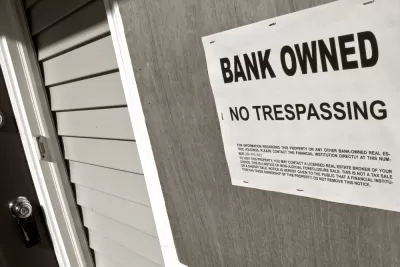
When Nora Hertel’s husband lost his job working at a small, private school for kids with special needs earlier this year due to the pandemic, their two-income household was instantly scaled down to one. Hertel, a marketing communications specialist at NCALL Research Inc., says she and her husband initially paid their mortgage with money from savings. As months passed, however, the couple started to miss their 15-day grace period and receive penalties.
“It was just getting to the point that by the time I paid the mortgage, the next bill would come in,” Hertel recalls. “And then there were times that I would pay the mortgage and then end up late on my credit card and other things. We just didn’t have enough and I had to choose one or the other.”
For homeowners like the Hertels, the CARES Act provided an option for financial relief by stipulating that single-family homes with a government-backed mortgage are automatically eligible for forbearance if they have been affected, directly or indirectly, by COVID-19. Homeowners who meet this criterion and request assistance are entitled to an initial forbearance period of up to 180 days (6 months) and a one-time extension of an additional 180 days, should they choose to take advantage of it.
Though the CARES Act provision has acted as a safeguard to prevent homeowners from suffering complete devastation at the hands of the pandemic, it has not come without challenges. As with the nationwide eviction moratoriums, housing advocates and counselors say that the conditions of the provision are unclear to the average consumer, particularly relating to their rights and how to manage and exit their forbearance term. As a result, housing advocates and counselors are bracing for a foreclosure crisis in early 2021 once the provision expires on Dec. 31. It’s unclear, however, just how severe next year’s pending crisis might be.
A Skewed Picture
While there is no question that there will be a foreclosure crisis, housing experts say ...
Read the full story: The Foreclosure Crisis Waiting for Us in January

Federal Government Developing More Foreclosure Protections
Millions of American property owners are behind on mortgage payments and facing the prospect of foreclosure and eviction later this year.

'Seriously Delinquent' Mortgages Explode, But Don't Expect a Great Recession-Style Meltdown
More and more homeowners are falling behind on mortgage payments as the pandemic lingers, according to recent market data.
CDC's Eviction Moratorium Extended
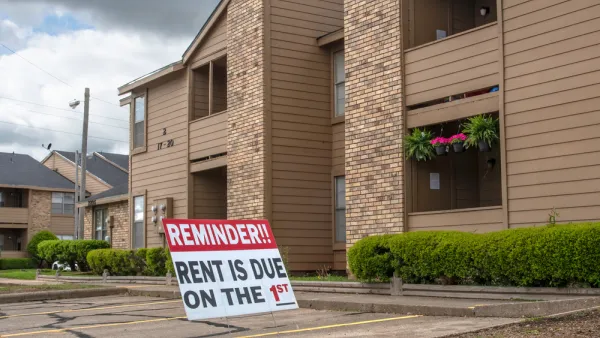
The CDC's eviction moratorium will stay in place until at least June 30, 2021.

Planetizen Federal Action Tracker
A weekly monitor of how Trump’s orders and actions are impacting planners and planning in America.

California plans to bury El Niño’s downpour
If the state plays its cards right, it may be able to store a billion acre-feet of El Niño’s water in aquifers.

Chicago breaks ground on $3 billion megadevelopment
The new neighborhood, titled Foundry Park, will one day host 3,700 residences.

California High-Speed Rail Authority CEO resigns after $600,000 scandal
Under Ian Choudri, the authority used taxpayer dollars to fund first class flights and trips to nightclubs.

Want to study the Missouri River? Soon, you may need unanimous approval from 10 states
Legislation would require 10 governors’ permission to study or build projects moving water outside the basin.

Desperate measures: Advocates weigh draining Lake Powell to fill Colorado River
Draining the reservoir could reduce evaporation losses by a couple hundred thousand acre-feet.

FREE Course: Walkable City 1: Why Walkability?
After describing his path towards focusing on walkability as the essence of good planning, Jeff Speck marches through his five principal reasons for making more walkable places.
Reinventing Malls: Planning Alchemy—Turning Gray Fields Into Gold
The course focuses on the opportunities and imperatives that shape reinvention of mall sites.

City of Rosemead
Rutgers University, Edward J. Bloustein School of Planning and Public Policy
One Hundred Miles
Hunter College, City University of New York (CUNY)
The Architects Foundation
University of Cincinnati Online
City of Cambridge
Montrose County
The Pocatello Development Authority