It will take a combination of local, provincial, and federal funding, but Vancouver, B.C. recently approved the most ambitious vision anywhere in North America to directly address homelessness and housing affordability challenges.


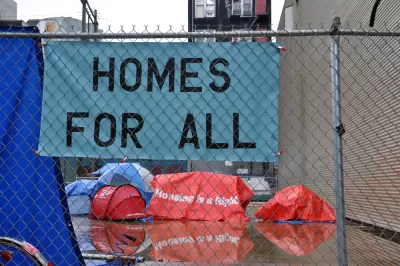
"In an effort to tackle the affordable housing crisis that has become a visible reality in tent cities and on downtown streets, Vancouver city council last week passed a motion to devote $30-million to the problem. It’s just one of the city’s recent moves to deal with the housing crisis," reports Kerry Gold.
"The money will be used to provide temporary housing by either leasing or purchasing units in hotels and vacant buildings or single room occupancy hotels," adds Gold.
In September, the federal government of Canada announced $1 billion new affordable housing funding for the country. Vancouver Mayor Kennedy Stewart is quoted in the article saying that the city is responding to the federal government's willingness to provide funding for housing since the pandemic began. "[Stewart is] hoping the federal government will also invest in co-op housing, a housing choice that helped make False Creek South an affordable neighbourhood," reports Gold.
In a separate article on a related housing program, Jen St. Denis provides detailed coverage of Vancouver's newly approved plans to leverage that potential federal funding to invest in single-room occupancy (SRO) buildings, separate from the $30 million plan highlighted by Gold.
St. Denis explains the SRO program:
Under the plan, the city will pursue $1 billion in funding from the provincial and federal governments to buy up to 105 SRO hotel buildings. Around 2,500 rooms in the buildings would be renovated or redeveloped into self-contained units with their own bathrooms.
St. Denis includes a soundbite from Wendy Pedersen, a housing activist who founded the SRO Collaborative, in the article. Pedersen says, "Not since the early ’70s has the city been so bold in its vision and so responsive to community," according to the article.
The article includes more details on the history of SROs in the city, and the potential of $1 billion to transform Downtown Eastside and the city by providing new housing opportunities for the city's most vulnerable residents.
FULL STORY: Vancouver takes aim at affordable housing shortage

Federal cuts to voucher program put 9,000 New Yorkers at risk of homelessness
The Emergency Housing Voucher program is ending years ahead of schedule, forcing housing agencies to find new ways to support roughly 70,000 households nationwide.
Judge: HUD acted illegally in changing homelessness grant rules
A Rhode Island judge struck down 'partisan' Trump restrictions on Continuum of Care Build grants.

One Federal Low-Income Housing Program is Actually Being Expanded
Recent changes to the Low-Income Housing Tax Credit program could lead to over a million new housing units, but cuts to adjacent and complementary programs could limit its impact.

The state-sanctioned urbicide of Austin
People don’t kill cities. Freeways do.

US to reduce Colorado River water deliveries to Mexico
A new Colorado Treaty amendment reduces Mexico’s Colorado River water allocation by 250,000 acre feet.

New Jersey’s second-largest city bans standalone data centers
Jersey City will continue to allow co-location facilities, such as those meant for research institutions that store their own data.

Amtrak not solely to blame for New Jersey commuter rail's unreliability, report finds
A new study from the Garden State Initiative found that NJ Transit’s budget grew 20% across a 4 year period, but reliability declined significantly over the same period.

EPA erases limits on planet-warming pollution from power plants
Under Monday’s plan, power plants would still have some limits on how much mercury, arsenic and other contaminants they can emit.

Phoenix announces new on-demand transit service, more frequent RAPID buses
Both new services will launch in October, and are part of Phoenix's Project Effective Access Solutions for Easing Congestion.

FREE Course: Walkable City 1: Why Walkability?
After describing his path towards focusing on walkability as the essence of good planning, Jeff Speck marches through his five principal reasons for making more walkable places.
Reinventing Malls: Planning Alchemy—Turning Gray Fields Into Gold
The course focuses on the opportunities and imperatives that shape reinvention of mall sites.

Eagle County Government
Harvard University Graduate School of Design
Nashville Planning Department
The Architects Foundation
University of Cincinnati Online
The Pocatello Development Authority
The Urban Renewal Agency of the City of Pocatello
Journal of the American Planning Association