State and local lawmakers hope that recent reforms to the Washington State Environmental Policy Act are only an initial step toward ending the law's use as a tool for delaying affordable housing plans.


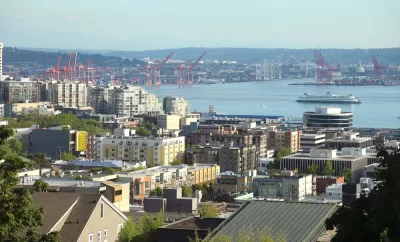
Josh Cohen revisits the year in housing construction in Seattle for lessons on the effects of Washington's State Environmental Policy Act (SEPA). In 2019, according to the article, a number of long-delayed housing plans finally came to fruition:
In March, more than two years after legislation was first introduced, the Seattle City Council unanimously passed the centerpiece of its housing solution: citywide Mandatory Housing Affordability (MHA) upzones that require for-profit developers to build subsidized housing or pay into Seattle’s affordable housing fund. In June, the council voted unanimously to build at least 235 units of low-income housing at the decommissioned Fort Lawton site in Magnolia, 13 years after the process began. In July, after four years of delay, the council again voted unanimously to ease regulations on backyard cottages and basement apartments in an effort to incentivize their construction.
Instead of blaming the delays to those plans on the "Seattle process," Cohen pins responsibility on SEPA, which gives individuals "gives individuals tremendous power to slow down or stop land-use changes," according to Cohen.
Given the growing housing affordability challenges facing Seattle and other cities in the state, lawmakers at both the local and state levels are "working to reform the nearly 40-year-old environmental law and limit its power," reports Cohen. Some reforms have already been approved, as part of a housing density bill approved by the Washington State Legislature in 2019.
"The heart of the new law is a menu of things Washington cities can do to increase density, such as allowing backyard cottages in single family zones; allowing duplexes and triplexes in single family zones; and allowing larger buildings near transit hubs," explains Cohen. "In exchange for doing them, the cities are eligible for a $100,000 grant to help with planning. And, importantly, the law makes all of those actions exempt from SEPA appeal."
The city of Seattle also recently adopted a new law intended to "streamline" the SEPA process, even attaining political support from environmental groups like the Sierra Club’s Seattle Group, 350 Seattle, Futurewise and Climate Solutions on the way to approval.
FULL STORY: State environmental law slowed housing construction in Seattle. Lawmakers want to pick up the pace

State Law Allows for Local Reform of the Washington State Environmental Policy Act
Reform of the Washington State Environmental Policy Act (SEPA) is underway at the local level after a new state bill offered "safe harbor" under the law for a menu of land use and development reforms.

New Washington State Law Lets Cities Give Social Housing Developers City-owned Land
In its current form, HB 1687, which authorizes local governments to assist social housing agencies with land or other resources, only applies to Seattle.

Seattle has Built Over 14,000 Affordable Units Since 2020 — More Than Any Other US Metro
Despite being ahead of other cities, Seattle is still short more than 150,000 affordable units.

Planetizen Federal Action Tracker
A weekly monitor of how Trump’s orders and actions are impacting planners and planning in America.

The state-sanctioned urbicide of Austin
People don’t kill cities. Freeways do.

US to reduce Colorado River water deliveries to Mexico
A new Colorado Treaty amendment reduces Mexico’s Colorado River water allocation by 250,000 acre feet.

Mamdani overhauls NYC's Vision Zero plan with 100 new policy goals
The overhaul aims to reduce traffic deaths and make streets safer for pedestrians, cyclists and drivers through lower speed limits, new safety infrastructure and more.

Amtrak not solely to blame for New Jersey commuter rail's unreliability, report finds
A new study from the Garden State Initiative found that NJ Transit’s budget grew 20% across a 4 year period, but reliability declined significantly over the same period.

EPA erases limits on planet-warming pollution from power plants
Under Monday’s plan, power plants would still have some limits on how much mercury, arsenic and other contaminants they can emit.

FREE Course: Walkable City 1: Why Walkability?
After describing his path towards focusing on walkability as the essence of good planning, Jeff Speck marches through his five principal reasons for making more walkable places.
Reinventing Malls: Planning Alchemy—Turning Gray Fields Into Gold
The course focuses on the opportunities and imperatives that shape reinvention of mall sites.

Eagle County Government
Harvard University Graduate School of Design
Nashville Planning Department
The Architects Foundation
University of Cincinnati Online
The Pocatello Development Authority
The Urban Renewal Agency of the City of Pocatello
Journal of the American Planning Association