Fewer people investing in low-income housing tax credits means fewer affordable housing units being built—at a time when affordable units are in extremely short supply.


When the Republican tax cuts of 2017 lowered the corporate tax rate from 35 to 21 percent, it also lowered the potential benefits of low-income housing tax credits.
According to an article by Kate Irby, those changes had a chilling effect on affordable housing development.
According to "independent data" cited by Irby, data show the GOP tax reform bill has delayed or killed 15,000 affordable housing units in California alone. Irby cites an expert for more detail:
Scott Hoekman, president and CEO of Enterprise Housing Credit Investments, LLC, a company that manages funds for the tax credits nationwide, estimated that meant companies were willing to invest about 10 to 15 percent less than they had before the 2016 election, cutting off a major source of funding and derailing thousands of projects.
Less investment means less construction:
In California, that meant about 10,000 delayed or killed housing units in 2017 and 5,500 in 2018, according to Matt Schwartz, president and CEO of the California Housing Partnership, and a 23 percent decrease in affordable housing production — from about 24,000 units in 2016 to less than 19,000 in 2018.
According to Irby, bipartisan legislation in Congress designed to increase the use of the Low-Income Housing Tax Credit has stalled.
FULL STORY: Corporate tax cuts blocked at least 15,000 affordable homes in California. Here’s how

The Prospect of Lower Corporate Taxes Already Slowing Affordable Housing Investment
Across the country, affordable housing projects depend on tax credits to encourage investment; the possibility of a lower tax rate has already affected their funding.
America's Most Effective Urban Revitalization Incentives Under Threat
The low-income housing and new-markets tax credits are two of the most effective tools for stimulating affordable housing creation and the revitalization of low-income neighborhoods. Don't let them fall victim to tax reform, argues Michael Rubinger.
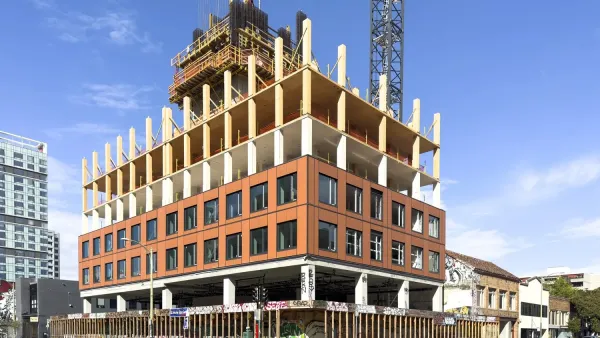
San Francisco Affordable Housing can Cost $1 Milllion per Unit. One Developer Says He can Slash the Cost by 65%
An expansion of a federal tax credit is prompting for-profit developers to get into the affordable housing market.

Planetizen Federal Action Tracker
A weekly monitor of how Trump’s orders and actions are impacting planners and planning in America.

The state-sanctioned urbicide of Austin
People don’t kill cities. Freeways do.

US to reduce Colorado River water deliveries to Mexico
A new Colorado Treaty amendment reduces Mexico’s Colorado River water allocation by 250,000 acre feet.

5 New England states march closer to 800 megawatt wind energy project
Securing federal approval for the project may be complicated under the Trump administration, which has historically been hostile towards domestic wind power.

Baltimore to break ground on $50 million Transit Priority Project
The project will bring faster bus trips, safer streets and better bike connections to Baltimore.

Airbnb launches $250 million 'last-dollar financing' housing accelerator, makes first investment in Austin
The company will put $6.4 million towards affordable housing development in Texas’ capital.

FREE Course: Walkable City 1: Why Walkability?
After describing his path towards focusing on walkability as the essence of good planning, Jeff Speck marches through his five principal reasons for making more walkable places.
Reinventing Malls: Planning Alchemy—Turning Gray Fields Into Gold
The course focuses on the opportunities and imperatives that shape reinvention of mall sites.

Eagle County Government
Harvard University Graduate School of Design
Nashville Planning Department
The Architects Foundation
University of Cincinnati Online
The Pocatello Development Authority
The Urban Renewal Agency of the City of Pocatello
Journal of the American Planning Association