Courtney Knapp of the Pratt Institute writes about a recent article in the Journal of Planning Education and Research




Planning students and practitioners need tools and strategies to build critical self-awareness, foster communication and radical empathy across difference, and facilitate emotionally and politically sensitive and constructive discussions in communities. This need is acute within our profession, considering planners’ historic contributions toward reproducing place-based racial inequalities and exclusions. My study, "Integrating Critical Autobiography to Foster Anti-Racism Learning in the Urban Studies Classroom," recently published in the Journal for Planning Education and Research, examines one potential tool for engaging in this reflexive, sometimes painful work: critical autobiographical writing.
The study uses a longitudinal, mixed method approach to ask and answer the following question: can structured autobiographical writing help individuals (in the case of this study, undergraduate students) cultivate critical awareness in ways that encourage them to locate their own experiences within patterns and structures of inclusion/exclusion, and in ways that inspire longer-term commitments to anti-racism and social justice praxis? To answer this question, I combine a critical interpretation of a sample of students’ essays with the results of a post-course survey and interviews, designed to assess potential longer-term impacts of the assignment.
My analysis revealed a number of trends relevant to planners and planning educators. First, despite students’ highly diverse cultural, socioeconomic, and geographic backgrounds, their stories of personal racial identity formation shared common narrative arcs. Regardless of race, most followed a similar format of naivety—encounter—cognitive dissonance—epiphany. Surveyed several years later, some students reported that sharing their testimonies in class had allowed then to find common ground with their peers and form lasting bonds.
Second, the study revealed that students used thirty distinct identity markers to describe their personal racial identities. Related, students identified more than eighty social, and a dozen geographic, factors influencing their personal identity formation and understandings of race and racism. These perspectives suggest individuals’ identities are more complex and multi-faceted than standard public discourse and demography afford. Supplementing community-level race and ethnicity data with autobiographical testimony can help bring census data to life.
Third, students’ essays and follow-up responses underscored the significance of interpersonal encounters in shaping these understandings. This was especially true for students’ families, close friends, classmates, and teachers. Related, daily environments, especially school settings, where highly influential. The assignment had prompted students to connect to their personal stories with theoretical and discussions of race and place. Students who connected their personal experiences with established conceptual frameworks (for example, Jewish anti-racist scholar George Lipsitz), reported higher levels of sustained engagement with social justice issues following the class. Importantly, many students reported the assignment had helped them build self-confidence to discuss emotionally and politically charged topics, such as local legacies of racism.
So what are the takeaways for planning education and practice? Certainly, planning schools are where professionals-in-training have historically grappled with these sorts of questions, and the academy will no doubt continue to play critical roles convening spaces to discuss race, place, and planning in structured and substantive ways. However, critical autobiography writing is also useful outside the classroom, where it can be incorporated into strategic planning and community engagement processes on the local, neighborhood, or organizational levels.
Autobiography writing allowed participants to go beyond standard identity markers of race and cultural belonging, and explore how personal experiences, environments, and social influences shaped them as unique individuals. During a follow up interview, one student summarized this lesson succinctly, stating that the exercise reminded her that even though she was “training to be a planner, I am a person with a story, and I have an obligation to listen to the stories of the people I work with and serve. Planning is about trying to understand the complexity of identity in place, which goes way deeper than the standard checkbox definitions of race” (quoted in Knapp 2018, p. 10).
In short, behind every checked box on a census or community engagement form is a person, an individual with a complex racial identity and story of be/longing. To the extent planners can tap into these emotional and value-based attachments, and leverage them to strengthen social bonds and foster common ground across diverse populations, the better off our profession, and by association, the communities we serve, will be.
Full Article Open Access Until March 28, 2019
Courtney Knapp Ph.D. AICP., is an Associate Professor of City and Regional Planning at Pratt Institute. She is the author of Constructing the Dynamo of Dixie: Race, Urban Planning, and Cosmopolitanism in Chattanooga, Tennessee(2018, UNC Press).

Making Mobility More Inclusive
A new study highlights the challenges people with disabilities continue to face in navigating urban spaces.

‘Shawshank Redemption’: 5 Adaptive Reuse Strategies for Shuttered Jails
Redeveloping closed correctional facilities in ways that foster just and thriving communities is a growing trend across the United States.
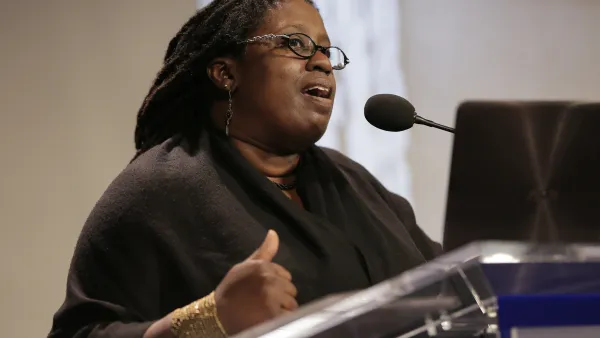
Climate Justice Advocate Named One of TIME's Women of the Year
Jacqueline Patterson has dedicated her career to intersectional approaches to systems change and social and environmental justice.

Planetizen Federal Action Tracker
A weekly monitor of how Trump’s orders and actions are impacting planners and planning in America.

California plans to bury El Niño’s downpour
If the state plays its cards right, it may be able to store a billion acre-feet of El Niño’s water in aquifers.

Desperate measures: Advocates weigh draining Lake Powell to fill Colorado River
Draining the reservoir could reduce evaporation losses by a couple hundred thousand acre-feet.

Los Angeles just elected an urban planner as its mayor
Transportation analysts are optimistic that Raman will be more aggressive in addressing transit issues than Bass.

Mamdani’s pied-à-terre tax survives legal challenge
A panel of judges found that the plaintiffs failed to demonstrate injury as a result of New York City's implementation of the tax.

Eastern Nebraska is running out of electricity
Data centers and electrification are straining eastern Nebraska’s grid, throttling economic development.

FREE Course: Walkable City 1: Why Walkability?
After describing his path towards focusing on walkability as the essence of good planning, Jeff Speck marches through his five principal reasons for making more walkable places.
Reinventing Malls: Planning Alchemy—Turning Gray Fields Into Gold
The course focuses on the opportunities and imperatives that shape reinvention of mall sites.

City of Rosemead
Rutgers University, Edward J. Bloustein School of Planning and Public Policy
One Hundred Miles
University of Michigan School for Environment and Sustainability (SEAS)
Hunter College, City University of New York (CUNY)
The Architects Foundation
City of Cambridge
Montrose County
The Pocatello Development Authority

